What is HAEDAL: A Comprehensive Guide to Korea's Advanced Defense and Autonomous Learning System


Haedal Protocol (HAEDAL) Research Report
Haedal Protocol's Positioning and Significance
Haedal Protocol (HAEDAL) is a prime liquid staking protocol natively built on Sui, designed to address the need for efficient staking infrastructure and liquidity optimization within the Sui ecosystem. As a leading liquid staking solution, Haedal plays a crucial role in the decentralized finance (DeFi) sector by enabling users to stake their assets while maintaining liquidity.
As of December 2025, Haedal has established itself as an emerging protocol within the Sui ecosystem, with a market capitalization of $7.5 million and a circulating supply of 195 million tokens. The protocol operates across 29 exchanges and maintains an active developer community committed to advancing liquid staking infrastructure.
This report provides a comprehensive analysis of Haedal's technical architecture, market performance, and growth potential within the Sui blockchain ecosystem.
Origin and Development Timeline
Background and Purpose
Haedal Protocol was created to solve a fundamental challenge in blockchain ecosystems: enabling users to earn staking rewards while maintaining access to their capital through liquidity. Traditional staking mechanisms lock user assets, preventing participation in DeFi opportunities. Haedal addresses this pain point by providing robust liquid staking infrastructure that allows users to stake SUI and Walrus tokens into validators while receiving liquid staking tokens (LSTs) that can be used across the DeFi ecosystem.
The protocol represents a response to the growing demand for capital efficiency in proof-of-stake networks, enabling users to maximize returns through multiple income streams simultaneously.
Key Development Milestones
- Launch: Haedal established itself as a native protocol on Sui, introducing liquid staking infrastructure to the ecosystem.
- Product Expansion: Development of complementary products including Haedal Market Maker and haeVault to create a systematic product matrix.
- Ecosystem Growth: Integration across 29 exchanges, establishing liquidity and accessibility for HAEDAL token holders.
Haedal continues to optimize its protocol security, user experience, and DeFi integration capabilities with strong community support and ongoing development initiatives.
How Haedal Protocol Works?
Decentralized Infrastructure
Haedal operates on a decentralized network of validators distributed across the Sui blockchain. This distributed architecture eliminates central points of failure and ensures network resilience while maintaining transparency. Users maintain custody and control of their staked assets without relying on a single entity, fostering trust and reducing counterparty risk.
Liquid Staking Mechanism
Haedal's core functionality enables users to stake SUI and Walrus tokens into validators while receiving liquid staking tokens (LSTs) in return. These LSTs represent the user's staked position and accrued rewards, allowing users to:
- Earn continuous consensus rewards from validator participation
- Maintain liquidity through LST tokens that can be traded or used in DeFi protocols
- Maximize capital efficiency by leveraging staked assets across multiple applications
The protocol's architecture ensures that users receive a proportional share of validator rewards while maintaining flexibility in capital deployment.
Reward Distribution
Haedal facilitates fair reward distribution through its integration with Sui's consensus mechanism. Validators operating within the network receive staking rewards, which are proportionally distributed to token stakers based on their contribution. The protocol's design ensures:
- Transparent and algorithmic reward calculations
- Regular distribution of consensus rewards to participants
- Incentive alignment between the protocol and its users
Security and Technical Foundation
Haedal's security model is built on Sui's robust blockchain infrastructure, leveraging the network's Byzantine Fault Tolerant (BFT) consensus mechanism. The protocol implements:
- Cryptographic Protection: Public-private key cryptography secures all transactions and staking operations
- Validator Verification: Stake delegation to multiple validators reduces single-point-of-failure risks
- Smart Contract Audits: Protocol security reinforced through rigorous code verification and testing
- Transparent On-Chain Operations: All staking, reward distribution, and LST minting occur on-chain with full auditability
These security measures ensure that user funds remain protected while maintaining the integrity of the staking and reward mechanisms.
Market Performance and Metrics
Current Market Status (as of December 22, 2025)
| Metric | Value |
|---|---|
| Current Price | $0.03847 |
| 24-Hour Change | +3.47% |
| 7-Day Change | -9.59% |
| 30-Day Change | -34.74% |
| 1-Year Change | -76.97% |
| Market Capitalization | $7.50 million |
| Fully Diluted Valuation | $38.47 million |
| 24-Hour Volume | $303,420.13 |
| Circulating Supply | 195 million HAEDAL |
| Total Supply | 1 billion HAEDAL |
| All-Time High | $0.3059 (July 17, 2025) |
| All-Time Low | $0.03495 (December 18, 2025) |
| Market Rank | #1325 |
Price Performance Analysis
Haedal's price trajectory reflects the broader market conditions within the Sui ecosystem. The token experienced a significant decline from its all-time high of $0.3059, trading near support levels established in December 2025. The 24-hour positive price movement of 3.47% suggests potential stabilization, while longer-term metrics indicate substantial consolidation period for the asset.
The token's 1-hour decline of -0.36% reflects short-term volatility typical of emerging ecosystem tokens, while the significant year-to-date decline reflects the broader cryptocurrency market cycle and ecosystem maturation process.
Ecosystem and Product Suite
Core Infrastructure
Haedal provides foundational liquid staking infrastructure that enables users to:
- Stake SUI and Walrus tokens to earn validator rewards
- Receive LSTs representing their staked positions
- Deploy staked capital across Sui's DeFi ecosystem without unstaking
Complementary Products
Haedal Market Maker: Facilitates liquidity provision and trading pair establishment for LSTs and related assets, enabling efficient price discovery and capital deployment.
haeVault: An additional product component within Haedal's systematic product matrix designed to optimize yield generation and capital efficiency.
Strategic Significance
Haedal's product architecture captures significant value from active on-chain trading flows within the Sui network. This systematic approach enables the protocol to:
- Extract yield from multiple revenue streams
- Provide enhanced liquidity depth to Sui users
- Optimize overall yield performance for stakeholders
Strategic Significance for Sui Ecosystem
Network Security Contribution
Haedal strengthens the Sui blockchain by enabling broader validator participation. Liquid staking protocols facilitate token distribution across more validators, enhancing network decentralization and resilience against potential attacks.
Long-Term Sustainability
By incentivizing participation in network validation through attractive reward structures and capital efficiency, Haedal contributes to:
- Increased validator node participation
- Enhanced network governance participation
- Long-term protocol sustainability through aligned incentives
DeFi Integration
Haedal's LSTs enable deeper integration within the Sui DeFi ecosystem, allowing liquid staked assets to serve as collateral, yield-generating assets, or trading pairs across multiple protocols.
Getting Started with Haedal
Where to Trade
HAEDAL tokens are available for trading on multiple exchanges, including Gate.com and 28 other trading platforms. Users can access real-time pricing, liquidity, and trading opportunities through these venues.
Resources and Information
- Official Website: https://www.haedal.xyz/
- Documentation: https://haedal-protocol.gitbook.io/haedal-protocol-docs
- Blockchain Explorer: https://explorer.sui.io/
- Social Media: https://x.com/HaedalProtocol
Token Specifications
- Network: Sui Blockchain
- Token Contract: 0x3a304c7feba2d819ea57c3542d68439ca2c386ba02159c740f7b406e592c62ea::haedal::HAEDAL
- Symbol: HAEDAL
Conclusion
Haedal Protocol represents a significant infrastructure development within the Sui ecosystem, addressing the critical need for efficient liquid staking solutions. By enabling users to earn rewards while maintaining capital liquidity, Haedal contributes to a more efficient and decentralized DeFi environment on Sui.
The protocol's systematic product matrix and focus on capturing value from active on-chain flows position it as a key participant in Sui's ecosystem development. As the protocol matures and expands its product offerings, Haedal is likely to play an increasingly important role in the Sui blockchain's long-term sustainability, governance participation, and decentralization.
Users interested in Sui ecosystem participation and staking rewards should research Haedal's current offerings and evaluate its role within their broader investment and DeFi strategy.
Haedal Protocol's Market Performance
Circulating Supply Overview
As of December 22, 2025, Haedal Protocol (HAEDAL) has a circulating supply of 195,000,000 tokens, with a total supply of 1,000,000,000 tokens. The token currently has a circulating supply ratio of 19.5%, indicating that the majority of tokens remain to be released into the market over time, following an inflationary model that will gradually increase token availability.
Price Volatility
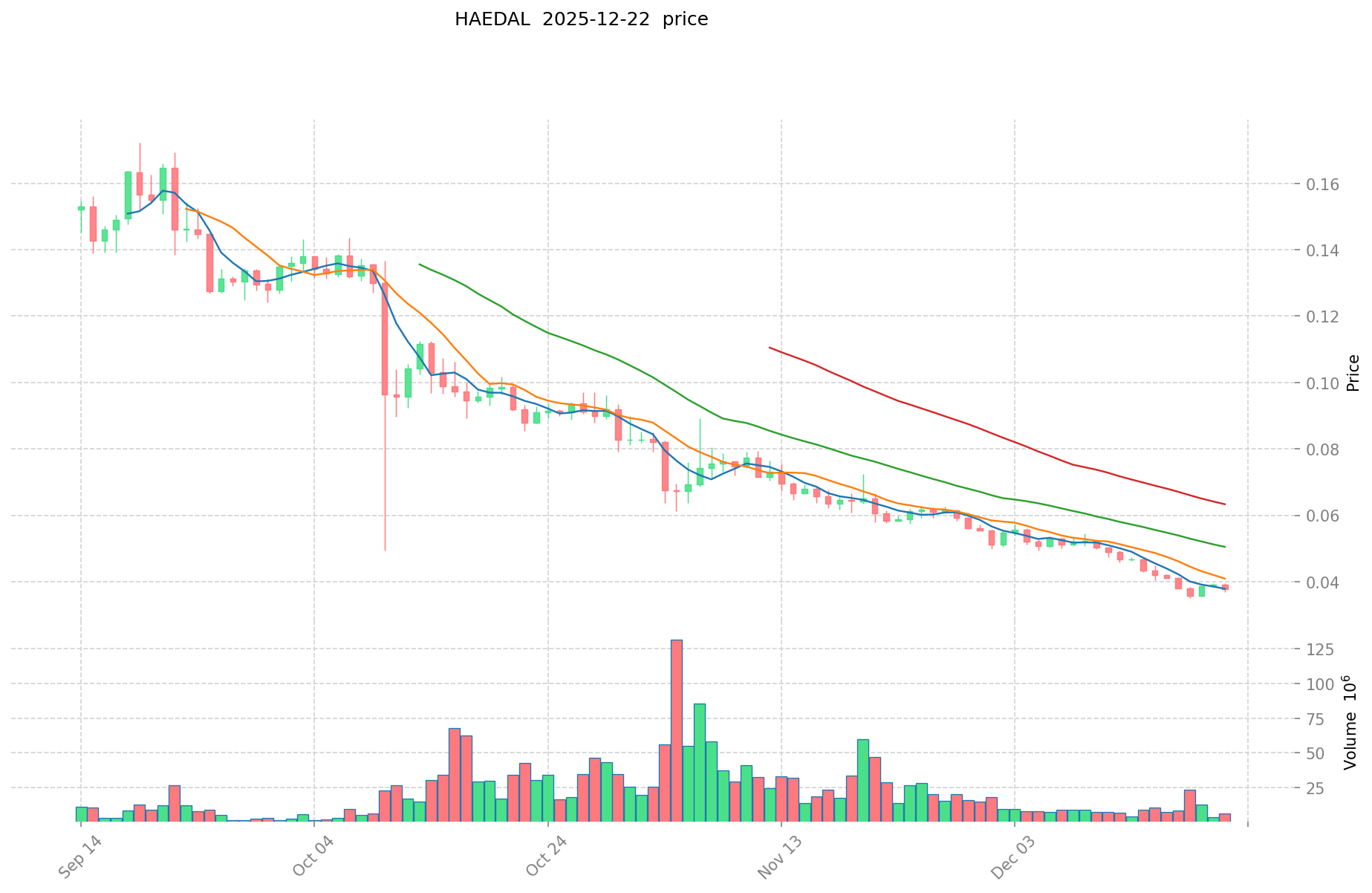
Haedal Protocol reached its all-time high of $0.3059 on July 17, 2025, reflecting strong market sentiment and increased adoption of the liquid staking protocol during the peak of market enthusiasm. Conversely, the token hit its all-time low of $0.03495 on December 18, 2025, marking a significant correction that reflects broader market pressures and consolidation phases. These substantial fluctuations highlight the volatile nature of emerging DeFi protocols and their sensitivity to market conditions.
As of the latest update on December 22, 2025, HAEDAL is trading at $0.03847, representing a 3.47% increase over the past 24 hours, while showing a -9.59% decline over the past 7 days and a -34.74% decline over the past 30 days. The one-year performance indicates a -76.97% decrease from its launch price, reflecting the challenging market environment for newer cryptographic assets.
Click to view current HAEDAL market price
Market Metrics
- Market Capitalization: $7,501,649.99 (based on circulating supply)
- Fully Diluted Valuation: $38,470,000.00 (based on total token supply)
- 24-Hour Trading Volume: $303,420.13 (demonstrating market liquidity and trading activity)
- Market Dominance: 0.0011% of total cryptocurrency market
- Exchange Availability: Listed on 29 cryptocurrency exchanges, including Gate.com, providing users with multiple trading venues
Haedal Protocol (HAEDAL) - Comprehensive Research Report
Overview
Haedal is a prime liquid staking protocol natively built on Sui. It provides users with robust liquid staking infrastructure, allowing people to stake their SUI and Walrus tokens into validators to earn continual consensus rewards while unleashing LST (Liquid Staking Token) liquidity for use in DeFi applications.
Key Metrics (as of December 22, 2025)
| Metric | Value |
|---|---|
| Current Price | $0.03847 |
| Market Cap | $7,501,649.99 |
| 24H Trading Volume | $303,420.13 |
| Circulating Supply | 195,000,000 HAEDAL |
| Total Supply | 1,000,000,000 HAEDAL |
| Market Ranking | #1,325 |
| 24H Price Change | +3.47% |
| All-Time High | $0.3059 (July 17, 2025) |
| All-Time Low | $0.03495 (December 18, 2025) |
Project Mission and Vision
Haedal aims to become the ultimate platform for users to stake and earn on Sui. The protocol contributes to:
- Blockchain Security: Helping secure the Sui blockchain through liquid staking mechanisms
- Long-term Sustainability: Supporting Sui's economic sustainability and decentralization
- Network Governance: Enabling active participation in Sui's governance and decision-making processes
Core Use Cases and Product Ecosystem
Primary Function: Liquid Staking
Haedal's core service allows users to:
- Stake SUI and Walrus tokens to validators
- Earn continuous consensus rewards
- Maintain liquidity through LST tokens
- Participate in DeFi protocols without locking up assets
Product Matrix
Haedal is building a systematic suite of complementary products:
- Haedal Market Maker: Facilitates efficient trading and liquidity provision
- haeVault: Provides advanced yield optimization strategies
This product ecosystem is designed to capture significant value from active on-chain trading flows on Sui, optimizing yield performance and providing deeper liquidity infrastructure for Sui users.
Tokenomics and Distribution
| Parameter | Details |
|---|---|
| Token Name | Haedal Protocol |
| Token Symbol | HAEDAL |
| Blockchain | Sui (SUI) |
| Contract Address | 0x3a304c7feba2d819ea57c3542d68439ca2c386ba02159c740f7b406e592c62ea::haedal::HAEDAL |
| Total Supply | 1,000,000,000 HAEDAL |
| Circulating Supply | 195,000,000 HAEDAL (19.5%) |
| Fully Diluted Valuation | $38,470,000 |
| Exchange Listings | 29 exchanges |
Price Performance Analysis
Recent Price Trends
| Timeframe | Change | Amount |
|---|---|---|
| 1 Hour | -0.36% | -$0.00014 |
| 24 Hours | +3.47% | +$0.00129 |
| 7 Days | -9.59% | -$0.00408 |
| 30 Days | -34.74% | -$0.02048 |
| 1 Year | -76.97% | -$0.12857 |
Price Range (24H)
- High: $0.03896
- Low: $0.03702
Trading and Liquidity
- 24H Volume: $303,420.13
- Market Share: 0.0011%
- Gate.com Availability: HAEDAL is tradable on Gate.com, providing secure access to trading and staking opportunities
Community and Social Presence
Official Channels
- Website: https://www.haedal.xyz/
- X (Twitter): @HaedalProtocol
- Whitepaper & Documentation: Haedal Protocol Docs
- Block Explorer: Sui Explorer
Competitive Advantages
Haedal's value proposition includes:
- Native Sui Integration: Built directly on Sui, optimized for the ecosystem
- Dual Token Support: Enables staking of both SUI and Walrus tokens
- Liquidity Preservation: Users maintain liquidity while earning rewards through LST mechanisms
- Value Capture: Systematic product matrix enables revenue generation from on-chain trading flows
- Enhanced Depth: Provides stronger liquidity infrastructure for Sui ecosystem participants
Market Position and Challenges
Current Challenges
- High Volatility: 76.97% decline over one year reflects market volatility in DeFi staking protocols
- Market Competition: Faces competition from other liquid staking solutions in the broader DeFi ecosystem
- Adoption Dependency: Success relies on continued adoption and growth of the Sui blockchain ecosystem
Risk Factors
- Price has declined significantly from all-time high of $0.3059
- Circulating supply represents only 19.5% of total supply, indicating potential dilution risk
- Market cap concentration among altcoins creates liquidity challenges
How to Participate in Haedal
1. Trading HAEDAL
Purchase HAEDAL tokens on Gate.com, which offers secure trading pairs and competitive liquidity for HAEDAL tokens.
2. Staking
Participate in Haedal's liquid staking protocol by staking SUI or Walrus tokens to earn consensus rewards while holding LST tokens.
3. DeFi Integration
Use your LST tokens in DeFi applications to generate additional yield through lending, providing liquidity, or other strategies.
4. Ecosystem Participation
Engage with Haedal's product ecosystem, including Haedal Market Maker and haeVault, to optimize returns.
Future Outlook
Haedal's continued development roadmap includes:
- Product Expansion: Further development of Haedal Market Maker and haeVault capabilities
- Sui Integration: Deepening integration with emerging Sui ecosystem applications and protocols
- Liquidity Enhancement: Continuous improvement of LST liquidity and market depth
- Ecosystem Growth: Supporting the expansion of Sui's DeFi ecosystem and user base
Conclusion
Haedal Protocol represents a sophisticated approach to liquid staking on the Sui blockchain, addressing the critical need for efficient staking mechanisms while maintaining capital liquidity. As a native Sui protocol, it benefits from deep blockchain integration and ecosystem alignment.
Key Takeaways
- Innovation: Haedal's systematic product matrix captures value from on-chain trading flows while serving user needs
- Sui Ecosystem Role: Critical infrastructure supporting Sui's security, sustainability, and decentralization
- Market Opportunity: Positioned to benefit from Sui's ecosystem growth and DeFi expansion
- Risk Awareness: Current market conditions reflect broader altcoin volatility; investors should conduct thorough due diligence
Whether you are exploring liquid staking opportunities, seeking Sui ecosystem exposure, or evaluating DeFi infrastructure, Haedal merits serious consideration. Access trading and staking opportunities through Gate.com, review the comprehensive documentation, and stay connected via official channels for the latest protocol updates.
Last Updated: December 22, 2025
Data Source: Gate.com Market Data
FAQ
What is Haedal crypto?
Haedal is the native token powering the Haedal DeFi platform on the Sui blockchain. It enables transactions and governance within the ecosystem, driving value through the platform's expanding DeFi infrastructure and user adoption.
What is the purpose and use case of Haedal?
Haedal is a liquid staking protocol for Sui blockchain, enabling users to stake assets while maintaining trading flexibility. It enhances staking efficiency and liquidity for network participants.
How does Haedal work and what technology does it use?
Haedal Protocol operates on the Sui blockchain, utilizing liquid staking technology. It enables users to stake assets while maintaining liquidity and accessibility, combining blockchain innovation with cultural heritage preservation through its decentralized architecture.
What blockchain network is Haedal built on?
Haedal is built on the SUI blockchain. It provides liquid staking services, allowing users to stake SUI tokens and receive haSUI in return.
How can I buy and store Haedal tokens?
Select Haedal tokens and choose your preferred payment method to purchase. Your HAEDAL tokens will be securely delivered to your wallet for safe storage.
Share
Content
Haedal Protocol's Positioning and Significance
Origin and Development Timeline
How Haedal Protocol Works?
Market Performance and Metrics
Ecosystem and Product Suite
Strategic Significance for Sui Ecosystem
Getting Started with Haedal
Conclusion
Haedal Protocol's Market Performance
Overview
Project Mission and Vision
Core Use Cases and Product Ecosystem
Tokenomics and Distribution
Price Performance Analysis
Trading and Liquidity
Community and Social Presence
Competitive Advantages
Market Position and Challenges
How to Participate in Haedal
Future Outlook
Conclusion
FAQ
How to Buy Cryptocurrency


Trending Cryptocurrencies



What is AERO: Understanding the Revolutionary Aerodynamic Technology in Modern Engineering

MILK vs XLM: Comparing Two Powerful Multilingual Language Models for Cross-Lingual Transfer Learning

PSTAKE vs NEAR: Comparative Analysis of Two Leading Blockchain Protocols for Decentralized Applications

Is Persistence (XPRT) a good investment?: Analyzing the potential and risks of this DeFi protocol token
Is Milkyway (MILK) a Good Investment?: Analyzing the Potential Returns and Risks in the Crypto Dairy Space

VNO vs STX: Comparing Investment Performance and Growth Potential in Today's Market
Unlocking the Future of Loyalty: Web3 Rewards and Programs

Unlocking Real Estate Investment: Lower Barriers Through Tokenization Platform Innovation

Is SUPERFORTUNE (GUA) a good investment?: A Comprehensive Analysis of Risk, Potential Returns, and Market Outlook

Is Chrema Coin (CRMC) a good investment?: A Comprehensive Analysis of Risk, Potential Returns, and Market Viability

Is Swell Network (SWELL) a good investment?: A Comprehensive Analysis of Tokenomics, Use Cases, and Market Potential