


What is XLM: A Comprehensive Guide to Stellar Lumens and Its Role in Cross-Border Payments
Stellar's Positioning and Significance
In 2014, Jed McCaleb, one of the former founders of Ripple, launched Stellar (XLM) to address issues such as financial inequality and inefficient cross-border payments.
As a decentralized network for currency transfers, Stellar plays a crucial role in the fields of payments and financial inclusion.
As of 2025, Stellar has become a top 25 cryptocurrency by market capitalization, with over 10 million user accounts and an active developer community. This article will delve into its technical architecture, market performance, and future potential.
Origins and Development History
Background
Stellar was created by Jed McCaleb in 2014 to tackle financial inequality and inefficient cross-border payments. It emerged during the blockchain technology boom, aiming to change the status quo by providing fast, stable, and extremely low-cost transfers of digital assets among banks, payment institutions, and individuals.
The launch of Stellar brought new possibilities for the global financial industry and underserved populations.
Key Milestones
- 2014: Mainnet launch, achieving high network throughput and low-cost transactions.
- 2015: The Stellar Development Foundation was established to support the network's growth and development.
- 2017: IBM partnered with Stellar to develop cross-border payment solutions, driving the price to new highs.
- 2021: Stellar's ecosystem expanded, with numerous projects issuing new assets on the Stellar network.
With the support of the Stellar Development Foundation, Stellar continues to optimize its technology, security, and real-world applications.
How Does Stellar Work?
Decentralized Control
Stellar operates on a decentralized network of computers (nodes) spread across the globe, free from control by banks or governments. These nodes collaborate to validate transactions, ensuring system transparency and attack resistance, granting users greater autonomy and enhancing network resilience.
Blockchain Core
Stellar's blockchain is a public, immutable digital ledger that records every transaction. Transactions are grouped into blocks and linked through cryptographic hashes to form a secure chain. Anyone can view the records, establishing trust without intermediaries.
Stellar's unique Stellar Consensus Protocol (SCP) further enhances performance and efficiency.
Ensuring Fairness
Stellar uses the Stellar Consensus Protocol (SCP) to validate transactions and prevent fraudulent activities such as double-spending. Participants maintain network security by running nodes and reaching consensus, with innovations including energy efficiency and high transactions per second (TPS).
Secure Transactions
Stellar uses public-key cryptography to protect transactions:
- Private keys (like secret passwords) are used to sign transactions
- Public keys (like account numbers) are used to verify ownership
This mechanism ensures fund security, while transactions remain pseudonymous. Stellar also supports additional security features like multi-signature accounts and time-bound transactions.
Stellar (XLM) Market Performance
Circulation Overview
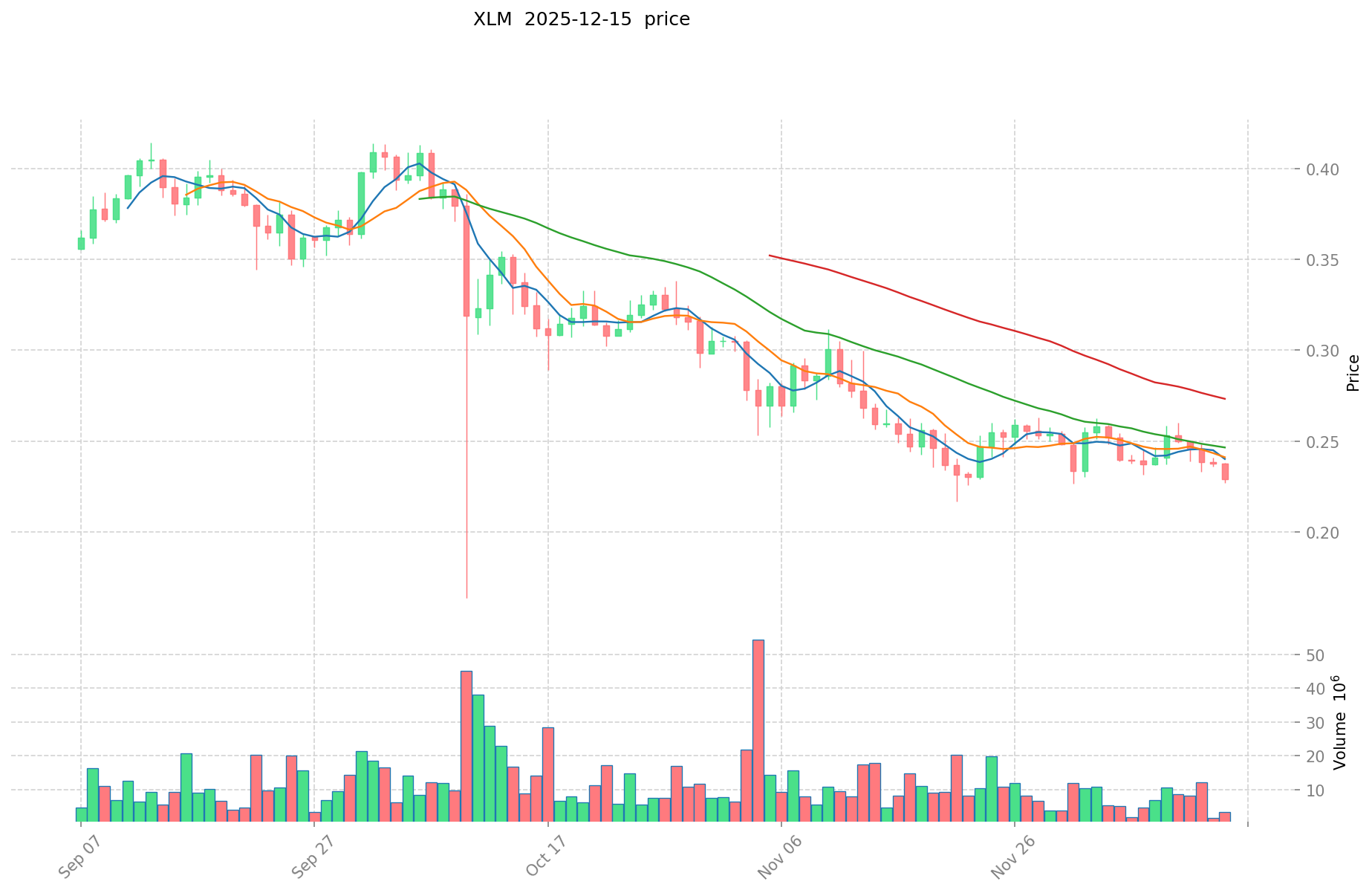
As of December 15, 2025, Stellar's circulating supply is 32,352,838,247.15458 XLM, with a total supply of 50,001,786,892 XLM.
Price Fluctuations
Stellar reached its all-time high of $0.875563 on January 3, 2018, driven by the overall cryptocurrency market bull run.
Its lowest price was $0.00047612, occurring on March 5, 2015, likely due to early market uncertainties and low adoption rates.
These fluctuations reflect market sentiment, adoption trends, and external factors.
Click to view the current XLM market price
On-chain Metrics
- Daily Transaction Volume: 1,327,188.9707272 XLM (indicating network activity)
- Active Addresses: 10,002,927 (reflecting user engagement)
Stellar (XLM) Ecosystem Applications and Partnerships
Core Use Cases
Stellar's ecosystem supports various applications:
- Cross-border Payments: Facilitating fast and low-cost international transactions.
- Asset Tokenization: Enabling the creation of digital representations of real-world assets.
Strategic Collaborations
Stellar has established partnerships with financial institutions and tech companies to enhance its capabilities and market influence. These partnerships provide a solid foundation for Stellar's ecosystem expansion.
Controversies and Challenges
Stellar faces the following challenges:
- Technical Issues: Scalability concerns as the network grows.
- Regulatory Risks: Potential regulatory scrutiny in various jurisdictions.
- Competitive Pressure: The rise of other blockchain platforms with similar offerings.
These issues have sparked discussions within the community and market, driving Stellar's continuous innovation.
Stellar Community and Social Media Atmosphere
Fan Enthusiasm
Stellar's community is vibrant, with significant daily transaction volumes and wallet address growth. On X platform, related posts and hashtags like "#Stellar" and "#XLM" frequently trend. New partnerships and technological advancements often ignite community excitement.
Social Media Sentiment
Sentiment on X shows a mix of opinions:
- Supporters praise Stellar's speed, low fees, and potential for financial inclusion.
- Critics focus on issues such as price volatility and centralization concerns.
Recent trends indicate a generally positive outlook, especially during periods of market growth.
Hot Topics
X users actively discuss Stellar's role in cross-border payments, its potential in the remittance market, and its partnerships with traditional financial institutions.
More Information Sources on Stellar
- Official Website: Visit Stellar's official website for features, use cases, and latest updates.
- Whitepaper: Stellar's whitepaper details its technical architecture, goals, and vision.
- X Updates: On X platform, Stellar uses @StellarOrg, with posts covering technical upgrades, community events, and partnership news.
Stellar's Future Roadmap
- Ecosystem Goals: Support more financial applications and increase global adoption.
- Long-term Vision: Become a global financial infrastructure for seamless cross-border transactions.
How to Participate in Stellar?
- Purchase Channels: Buy XLM on Gate.com
- Storage Solutions: Use secure wallets recommended by the Stellar foundation
- Participate in Governance: Engage in community decisions through the Stellar Community Fund
- Build on Stellar: Visit Stellar's developer documentation to create applications or contribute code
Summary
Stellar redefines digital currency through blockchain technology, offering transparency, security, and efficient payments. Its active community, rich resources, and strong market performance make it stand out in the cryptocurrency space. Despite facing challenges such as regulatory uncertainties and technical bottlenecks, Stellar's innovative spirit and clear roadmap position it as a key player in the future of decentralized technology. Whether you're a newcomer or an experienced player, Stellar is worth watching and participating in.
FAQ
Is XLM a good investment?
Yes, XLM is a promising investment. Its strong foundation, ongoing development, and relevance to current financial trends make it a potentially lucrative long-term asset.
Can XLM reach $100?
While XLM has potential, reaching $100 is highly improbable. It would require unprecedented market growth and adoption, far beyond current projections for the cryptocurrency sector.
What is better, XRP or XLM?
XLM has lower fees and a smaller supply of 50 billion coins, while XRP has 100 billion. Choose based on your preference for supply size and transaction costs.
How much will XLM be in 5 years?
XLM could reach $1.508 by 2030, with potential highs of $1.062 and lows of $0.738. However, these are estimates and actual prices may vary.
Share
Content
Stellar's Positioning and Significance
Origins and Development History
How Does Stellar Work?
Stellar (XLM) Market Performance
Stellar (XLM) Ecosystem Applications and Partnerships
Controversies and Challenges
Stellar Community and Social Media Atmosphere
More Information Sources on Stellar
Stellar's Future Roadmap
How to Participate in Stellar?
Summary
FAQ
How to Buy Cryptocurrency


Trending Cryptocurrencies



XZXX: A Comprehensive Guide to the BRC-20 Meme Token in 2025

Bitcoin Fear and Greed Index: Market Sentiment Analysis for 2025

Top Crypto ETFs to Watch in 2025: Navigating the Digital Asset Boom

5 ways to get Bitcoin for free in 2025: Newbie Guide
Bitcoin Market Cap in 2025: Analysis and Trends for Investors
2025 Bitcoin Price Prediction: Trump's Tariffs' Impact on BTC

Is Ronin Network (RON) a good investment?: A Comprehensive Analysis of Performance, Risks, and Future Potential in the Gaming Blockchain Ecosystem

Is KUB Coin (KUB) a good investment?: A Comprehensive Analysis of Price Performance, Market Potential, and Risk Factors in 2024

Is Akash Network (AKT) a good investment?: A Comprehensive Analysis of the Decentralized Cloud Computing Platform's Potential and Risk Factors
Is MAG7.ssi (MAG7SSI) a good investment?: A Comprehensive Analysis of Performance, Risks, and Future Prospects

Is Ravencoin (RVN) a good investment?: A Comprehensive Analysis of Price Trends, Technology, and Market Potential
