Avec l’essor rapide des blockchains modulaires et du Rollup comme solution de passage à l’échelle, de plus en plus de protocoles adoptent des modèles de sécurité partagée pour réduire les coûts de lancement des réseaux et renforcer la sécurité de la couche 2. Dans ce contexte, EigenLayer et AltLayer se sont imposés comme des piliers incontournables de l’infrastructure modulaire.
EigenLayer se concentre sur la sécurité partagée, avec pour mission centrale de permettre la réutilisation des ETH déjà mis en stake, afin d’offrir une sécurité économique à d’autres protocoles. AltLayer s’appuie sur cette base de sécurité et propose une infrastructure complète pour les Rollups via le Restaked Rollup, l’AVS et le Rollup-as-a-Service. Bien que les deux protocoles fonctionnent en synergie, ils diffèrent considérablement dans leur hiérarchie protocolaire, leur public cible et leurs objectifs techniques.
Qu’est-ce qu’EigenLayer ?
En tant que protocole de restaking basé sur Ethereum, EigenLayer permet aux validateurs de réutiliser les ETH déjà mis en stake ou les jetons de staking liquides (LST) pour sécuriser d’autres protocoles.
Dans les réseaux Proof of Stake (PoS) traditionnels, les actifs stakés ne sécurisent généralement qu’une seule chaîne. Le modèle de restaking d’EigenLayer permet aux mêmes actifs stakés de servir simultanément plusieurs protocoles, ce qui améliore l’efficacité du capital.
La valeur centrale d’EigenLayer réside dans la sécurité partagée. Grâce à son mécanisme de restaking, le protocole fournit une source de sécurité économique pour les Services Activement Validés (AVS).
Qu’est-ce qu’AltLayer ?
AltLayer est un protocole d’infrastructure modulaire pour Rollups qui propose des capacités de Restaked Rollup, d’AVS et de Rollup-as-a-Service (RaaS).
Contrairement à EigenLayer, AltLayer ne se concentre pas sur le protocole de restaking sous-jacent. Il est plutôt orienté vers le passage à l’échelle des Rollups et le déploiement de chaînes d’application. Les développeurs peuvent utiliser AltLayer pour lancer rapidement des réseaux Rollup compatibles avec OP Stack, Arbitrum Orbit ou ZK Stack.
L’objectif principal d’AltLayer est de doter les Rollups d’une sécurité partagée, d’une finalité rapide et d’un séquencement décentralisé.
Quelles sont les différences fondamentales entre AltLayer et EigenLayer ?
La plus grande différence réside dans la couche qu’occupe chaque protocole au sein de l’écosystème modulaire.
EigenLayer agit comme une couche de sécurité partagée de base, fournissant une sécurité économique basée sur le restaking aux protocoles. AltLayer fonctionne comme une couche d’infrastructure pour Rollups, renforçant les capacités des réseaux de couche 2 en exploitant l’AVS et les ressources de sécurité partagée.
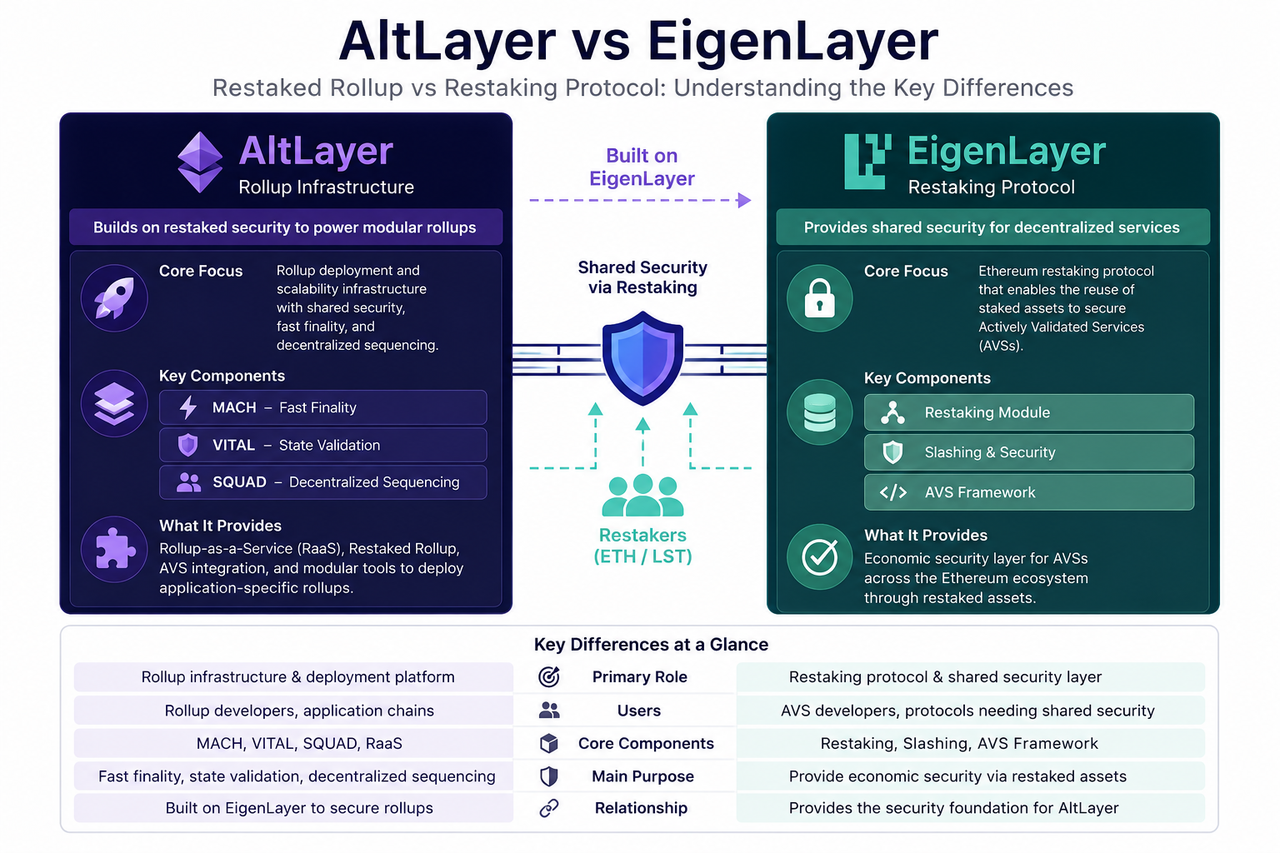
En termes simples :
- EigenLayer fournit la « sécurité partagée »
- AltLayer utilise la « sécurité partagée » pour construire des réseaux Rollup
Cela reflète la relation entre la couche d’infrastructure et la couche de services applicatifs dans le cloud computing.
Quelle est la différence entre le restaking et le Restaked Rollup ?
Le restaking est le mécanisme de sécurité partagée introduit par EigenLayer, tandis que le Restaked Rollup est une architecture de Rollup construite par AltLayer sur la base de ce mécanisme.
Le restaking se concentre sur la réutilisation des ETH pour apporter de la sécurité à plusieurs protocoles. Le Restaked Rollup applique ce modèle de sécurité directement aux réseaux Rollup.
Ainsi, les deux ne sont pas en concurrence : ils forment une collaboration en amont et en aval.
Quel rôle joue l’AVS dans chaque protocole ?
L’AVS est le composant central qui relie AltLayer et EigenLayer.
Dans l’écosystème EigenLayer, l’AVS fait référence aux réseaux de services qui nécessitent une sécurité partagée. Les couches de disponibilité des données, les oracles et les systèmes de vérification peuvent tous fonctionner comme des AVS.
Dans AltLayer, l’AVS est davantage orienté vers les composants de sécurité des Rollups, notamment les services MACH, VITAL et SQUAD.
AltLayer lui-même est une application concrète majeure de l’AVS.
Pourquoi MACH, VITAL et SQUAD dépendent-ils d’EigenLayer ?
MACH, VITAL et SQUAD d’AltLayer sont tous des services AVS qui ont besoin du support de la sécurité partagée.
EigenLayer fournit des actifs restakés et un réseau de validateurs que les AVS d’AltLayer utilisent pour atteindre une finalité rapide, une vérification de l’état et un séquencement décentralisé.
Sans une couche de sécurité partagée de base, AltLayer devrait construire son propre grand réseau de validateurs, ce qui augmenterait les coûts de lancement et la complexité de maintenance.
C’est pourquoi EigenLayer constitue un fondement critique pour le modèle de sécurité d’AltLayer.
En quoi leurs positions diffèrent-elles dans la blockchain modulaire ?
Les blockchains modulaires séparent l’exécution, la disponibilité des données, le consensus et le règlement en couches distinctes.
EigenLayer fonctionne comme une « couche de sécurité partagée », comparable à un intergiciel de sécurité au sein de l’écosystème modulaire.
AltLayer agit comme une « couche d’exécution et de passage à l’échelle des Rollups », principalement chargée du déploiement de chaînes d’application, du séquencement et du renforcement de la sécurité des Rollups.
Comme ils occupent des positions différentes dans la pile modulaire, leurs fonctions ne se chevauchent pas.
AltLayer et EigenLayer sont-ils en concurrence ?
AltLayer et EigenLayer ne sont généralement pas considérés comme des concurrents directs.
EigenLayer vise à fournir une sécurité partagée à un large éventail de protocoles, tandis qu’AltLayer est l’un des protocoles qui consomment ces ressources de sécurité partagée.
D’un point de vue écosystémique, ils forment un partenariat d’infrastructure : EigenLayer fournit la sécurité, et AltLayer l’intègre dans les réseaux Rollup.
En quoi les structures de risque d’AltLayer et d’EigenLayer diffèrent-elles ?
Le risque principal d’EigenLayer se concentre sur la couche de sécurité partagée. Si plusieurs protocoles s’appuient simultanément sur les mêmes actifs restakés, cela pourrait déclencher un risque en cascade dans des scénarios extrêmes.
Les risques d’AltLayer proviennent davantage de l’architecture des Rollups, des séquenceurs, de la coordination inter-chaînes et de la complexité opérationnelle de l’AVS.
Bien que leurs sources de risque diffèrent, la dépendance partielle d’AltLayer envers le modèle de sécurité d’EigenLayer implique une certaine interconnexion.
Quels scénarios utilisent à la fois AltLayer et EigenLayer ?
Les jeux blockchain, les agents IA, la DeFi et les Rollups spécifiques à une application exploitent souvent ensemble AltLayer et EigenLayer.
Par exemple, un Rollup de jeu blockchain peut être déployé rapidement via AltLayer tout en utilisant la sécurité de restaking d’EigenLayer pour renforcer la confiance dans le réseau.
Les réseaux d’agents IA, qui exigent une finalité rapide, une faible latence et une sécurité partagée, sont également bien adaptés à cette architecture combinée.
Résumé
AltLayer et EigenLayer sont tous deux des infrastructures critiques de l’écosystème blockchain modulaire, mais ils remplissent des rôles différents.
EigenLayer est un protocole de sécurité partagée et de restaking qui offre une source de sécurité économique pour les AVS. AltLayer est un protocole d’infrastructure pour Rollups qui apporte une finalité rapide, une vérification de l’état et un séquencement décentralisé aux réseaux de couche 2 via le Restaked Rollup, l’AVS et le RaaS.
Les deux ne sont pas concurrents. Ils forment plutôt un partenariat amont-aval : EigenLayer fournit la couche de sécurité partagée de base, et AltLayer utilise ces capacités de sécurité pour construire les réseaux Rollup modulaires de nouvelle génération.
FAQ
Quelle est la différence entre AltLayer et EigenLayer ?
EigenLayer est un protocole de sécurité partagée et de restaking ; AltLayer est un protocole d’infrastructure modulaire pour Rollups. Ils opèrent à différentes couches de l’écosystème.
Le restaking et le Restaked Rollup sont-ils le même concept ?
Le restaking est un mécanisme de restaking, tandis que le Restaked Rollup est une architecture de Rollup construite par AltLayer sur la base de la sécurité du restaking.
AltLayer dépend-il d’EigenLayer ?
L’AVS et les capacités de sécurité partagée d’AltLayer sont construites sur le modèle de restaking d’EigenLayer, créant ainsi une relation de collaboration.
EigenLayer peut-il être utilisé indépendamment d’AltLayer ?
EigenLayer est un protocole de sécurité partagée indépendant qui peut prendre en charge une grande variété d’AVS et de protocoles modulaires au-delà d’AltLayer.
MACH et VITAL appartiennent-ils à EigenLayer ?
MACH et VITAL sont des services AVS d’AltLayer, mais ils utilisent les ressources de sécurité de restaking fournies par EigenLayer.