A medida que Web3 evoluciona de ecosistemas de una sola cadena a ecosistemas multicadena, diferentes blockchains (como Ethereum, Solana, Layer2, Cosmos y Avalanche) han creado redes independientes de aplicaciones y liquidez, pero la comunicación cross-chain nativa sigue siendo difícil de lograr.
Los primeros puentes cross-chain resolvían principalmente la migración de activos, como mover tokens de Ethereum a otras cadenas. Pero con el auge de las DeFi cross-chain, las billeteras de abstracción de cadena, los juegos Omnichain y la gobernanza multicadena, el mercado ahora exige capacidades cross-chain mucho más complejas.
Los desarrolladores ya no solo necesitan «transferencias cross-chain»; quieren que las blockchains intercambien datos, invoquen contratos inteligentes y sincronicen estados de forma directa. Por ello, los protocolos de mensajería cross-chain se han convertido en una infraestructura esencial de Web3.
¿Qué es Axelar?
Axelar es una red descentralizada de interoperabilidad cross-chain que utiliza una red independiente de validadores PoS para transmitir mensajes y activos entre diferentes blockchains.
Su característica principal es General Message Passing (GMP), que permite a los desarrolladores invocar contratos inteligentes entre cadenas de forma directa. A diferencia de los puentes tradicionales, Axelar se centra en ejecutar la lógica de las aplicaciones cross-chain.
La red consta de la red Axelar, Gateways y los validadores, ofreciendo una API unificada para infraestructura cross-chain.
Arquitectónicamente, Axelar funciona más como una «capa cross-chain».
¿Qué es Wormhole?
Wormhole es un protocolo de mensajería y puente cross-chain, diseñado originalmente para transferencias de activos entre Ethereum y Solana.
Desde entonces se ha expandido a un protocolo de mensajería multicadena. Su núcleo es la Red de Guardianes, donde los nodos Guardianes verifican conjuntamente los mensajes cross-chain.
Cuando ocurre un evento cross-chain en la cadena de origen, los Guardianes generan una prueba firmada que la cadena de destino verifica y ejecuta.
Wormhole ahora admite muchas blockchains importantes y se usa ampliamente para puentes, migración de NFT y aplicaciones Omnichain.
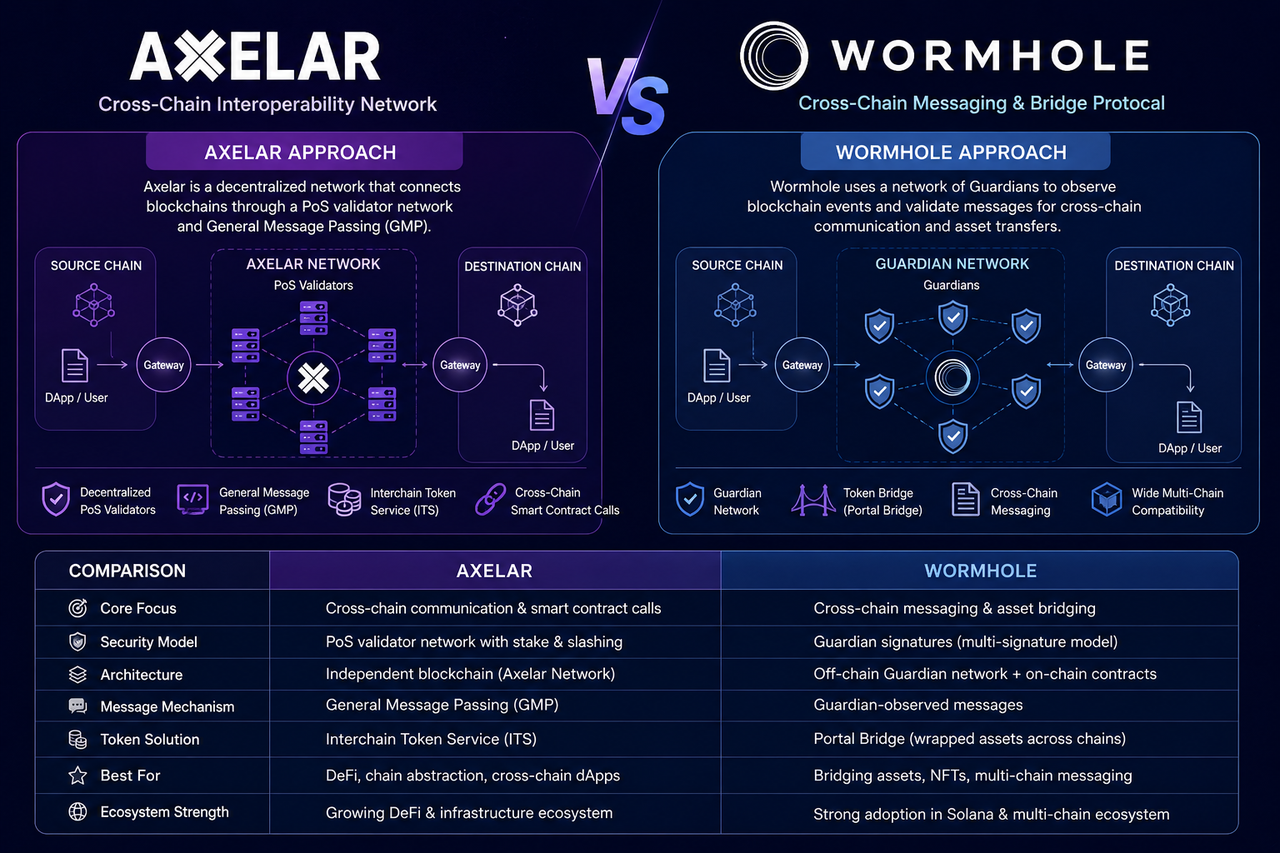
Diferencias principales entre Axelar y Wormhole
| Dimensión |
Axelar |
Wormhole |
| Posicionamiento principal |
Red descentralizada de comunicación cross-chain |
Red de puentes y mensajería cross-chain |
| Mecanismo central |
General Message Passing (GMP) |
Verificación de mensajes por Guardianes |
| Método de verificación |
Red de validadores PoS |
Red de Guardianes |
| Modelo de seguridad |
Staking y mecanismo de consenso |
Verificación de firma multinodo |
| ¿Blockchain propia? |
Sí (red Axelar) |
No |
| Ventaja principal |
Llamadas a contratos inteligentes cross-chain |
Compatibilidad de puentes y mensajes multicadena |
| Dirección principal |
Abstracción de cadena y comunicación cross-chain |
Puentes y mensajería Omnichain |
| Solución de tokens cross-chain |
ITS |
Portal Bridge |
| Mejores casos de uso |
DeFi cross-chain, abstracción de cadena |
NFT, GameFi, puentes de activos |
| Arquitectura |
Más cercana a una capa cross-chain |
Más cercana a una capa de retransmisión de mensajes |
¿En qué se diferencian sus mecanismos de verificación?
El mecanismo de verificación es una de las mayores diferencias entre ambos protocolos.
Axelar emplea una red independiente de validadores PoS para garantizar la seguridad cross-chain. Los validadores ponen en staking tokens AXL y confirman mensajes cross-chain mediante consenso.
Esto hace que Axelar sea similar a una blockchain, con un modelo de seguridad parecido al de las cadenas públicas PoS.
Wormhole utiliza la Red de Guardianes. Los Guardianes monitorean eventos cross-chain en varias blockchains y producen colectivamente firmas de verificación. Una vez que se recogen suficientes firmas, la cadena de destino ejecuta el mensaje.
En resumen, Axelar se basa más en la «verificación de consenso a nivel de cadena», mientras que Wormhole se basa en la «verificación de firma multinodo».
¿En qué se diferencian sus arquitecturas de mensajes cross-chain?
La comunicación cross-chain de Axelar gira en torno a GMP, enfatizando las llamadas a contratos inteligentes cross-chain y la ejecución de lógica de aplicaciones.
Los desarrolladores pueden enviar mensajes complejos entre cadenas a través de GMP y desencadenar la ejecución de funciones en contratos inteligentes de la cadena de destino. Por lo tanto, Axelar es más adecuado para DeFi cross-chain, abstracción de cadena y coordinación multicadena.
Wormhole se centra más en la transmisión de mensajes y la compatibilidad de puentes. Su estructura de mensajes es más genérica, compatible con tokens, NFT y datos arbitrarios.
Arquitectónicamente, Axelar es una «red de comunicación cross-chain», mientras que Wormhole es una «capa de retransmisión de mensajes cross-chain».
¿En qué se diferencian sus modelos de seguridad?
La seguridad es un factor diferenciador clave para los protocolos cross-chain.
La seguridad de Axelar proviene de su red PoS. Los validadores ponen en staking AXL y se enfrentan a riesgos de slashing, vinculando estrechamente la seguridad a los incentivos económicos.
La seguridad de Wormhole depende del conjunto de Guardianes. Si la mayoría de los nodos Guardianes se ven comprometidos o coluden, la seguridad de la verificación cross-chain podría verse afectada en teoría.
Dadas las grandes cantidades de activos on-chain involucrados, la seguridad siempre es una de las principales preocupaciones de la industria.
¿En qué se diferencian sus direcciones de ecosistema?
Axelar se orienta hacia la infraestructura cross-chain y la abstracción de cadena.
Su ecosistema se centra en GMP, ITS (Interchain Token Service), abstracción de gas cross-chain y comunicación DeFi multicadena. Squid y otros protocolos de liquidez multicadena forman parte de su ecosistema.
Wormhole tiene una presencia más fuerte en puentes cross-chain, NFT y el ecosistema Solana. Muchos proyectos Omnichain de NFT, GameFi y puentes de activos utilizan Wormhole.
Aunque ambos son redes de interoperabilidad cross-chain, sus prioridades de ecosistema son claramente diferentes.
¿Cuál es mejor para la abstracción de cadena?
La abstracción de cadena tiene como objetivo permitir que los usuarios interactúen sin notar la blockchain subyacente.
Axelar ha hecho una mayor inversión en este ámbito. Sus servicios GMP y de gas cross-chain ayudan a los desarrolladores a ocultar la complejidad, por lo que los usuarios no necesitan cambiar de red con frecuencia.
Wormhole también admite aplicaciones Omnichain, pero su enfoque está más en la compatibilidad de mensajes y la escalabilidad de puentes.
Hasta ahora, Axelar tiene una posición más clara en infraestructura de abstracción de cadena.
¿Para qué escenarios es más adecuado cada uno?
Axelar destaca en escenarios que necesitan lógica cross-chain compleja y una capa de comunicación unificada: DeFi cross-chain, billeteras de abstracción de cadena, gobernanza entre cadenas y coordinación multicadena.
Wormhole es mejor para puentes, migración de NFT, juegos Omnichain y sincronización de mensajes multicadena.
A medida que crece el ecosistema Web3 multicadena, estos dos protocolos pueden volverse complementarios en diferentes capas de aplicación.
Resumen
Axelar y Wormhole son ambos protocolos cross-chain clave en el mundo multicadena de Web3, pero utilizan diferentes enfoques técnicos y modelos de seguridad.
Axelar construye una capa de comunicación cross-chain unificada sobre una red PoS y GMP, centrándose en llamadas a contratos inteligentes entre cadenas y abstracción de cadena. Wormhole proporciona puentes y mensajería a través de la Red de Guardianes, con fuerte influencia en puentes multicadena y aplicaciones Omnichain.
Preguntas frecuentes
¿Cuál es la mayor diferencia entre Axelar y Wormhole?
Axelar utiliza una red de verificación PoS; Wormhole utiliza la Red de Guardianes para la verificación de mensajes cross-chain.
¿Cuál es la diferencia entre GMP y la mensajería de Wormhole?
GMP se centra en llamadas a contratos inteligentes cross-chain; Wormhole se centra en mensajería general y compatibilidad de puentes.
¿Es Wormhole un puente cross-chain?
Sí. Comenzó como un puente y luego evolucionó hasta convertirse en un protocolo de mensajería.
¿Es Axelar mejor para la abstracción de cadena?
Actualmente, sí. Axelar tiene más enfoque en abstracción de cadena y comunicación cross-chain unificada.
¿Admite Wormhole NFT cross-chain?
Sí. Se usa ampliamente para NFT cross-chain y juegos Omnichain.
¿Admiten Axelar y Wormhole llamadas a contratos inteligentes cross-chain?
Sí. Ambos ofrecen diversos grados de mensajería cross-chain e interacción con contratos inteligentes.