Babylon vs EigenLayer: Bitcoin Staking and ETH Restaking Compared

Last Updated 2026-06-09 09:06:13
Reading Time: 7m
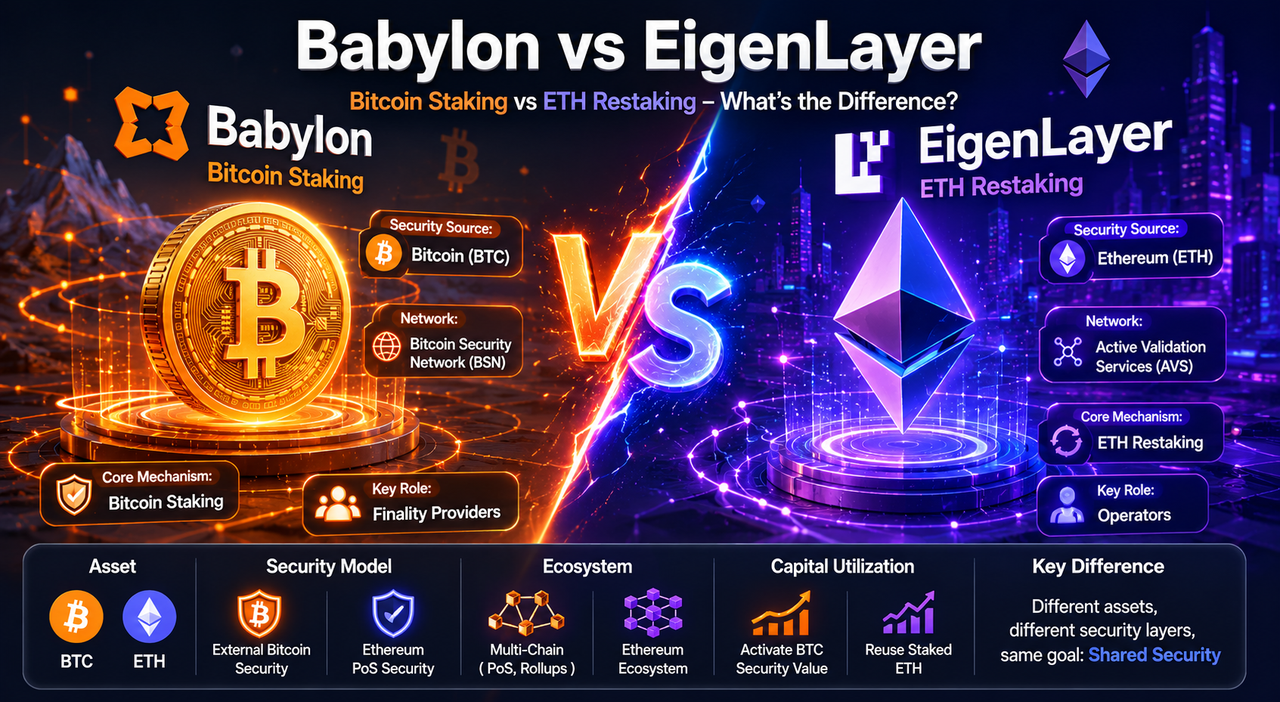
The core difference between Babylon and EigenLayer lies in their security sources: Babylon uses Bitcoin Staking to extend the security of Bitcoin to the multichain ecosystem, while EigenLayer uses ETH Restaking to reuse the security of staked Ethereum assets. Both are shared security infrastructure projects, but they differ significantly in their target users, economic models, validation mechanisms, and ecosystem positioning.

From an industry development perspective, shared security is becoming an important infrastructure layer in the modular blockchain era. As the number of Rollups, appchains, and decentralized service networks continues to grow, more protocols are looking to mature blockchain security resources to reduce bootstrapping costs.

Against this backdrop, Babylon and EigenLayer represent two different development paths: Bitcoin Security and Ethereum Restaking.

Babylon vs EigenLayer

What Is Babylon

Babylon is a shared security protocol based on Bitcoin Staking. Its goal is to use Bitcoin’s security to provide economic security protection for multiple blockchain networks.

In Babylon’s architecture, BTC holders can lock assets through Bitcoin Staking and participate in building the Bitcoin Security Network (BSN). Babylon uses a timestamping protocol, Finality Providers, and a shared security model to expand Bitcoin from a store of value into a cross network security resource.

Babylon’s core value lies in unlocking the economic security scale that Bitcoin has accumulated over time and applying that security to PoS networks, appchains, and the modular blockchain ecosystem.

What Is EigenLayer

EigenLayer is a Restaking protocol in the Ethereum ecosystem. Its core goal is to allow ETH that has already participated in Ethereum staking to be used again for other protocols and services.

In EigenLayer’s model, users can reauthorize staked ETH or liquid staking tokens (LSTs) to additional networks, providing security support for Active Validation Services (AVS).

This design allows the same ETH to support both Ethereum mainnet security and external protocol security at the same time, which is why it is known as Restaking.

The Core Difference Between Bitcoin Staking and ETH Restaking

The most fundamental difference between Babylon and EigenLayer comes from the source of their security assets.

Babylon uses BTC to build a shared security system. Bitcoin Staking does not participate in Bitcoin consensus. Instead, it uses the economic value of BTC to provide backing for other networks.

EigenLayer, by contrast, uses ETH that has already participated in Ethereum consensus. The essence of Restaking is to reuse existing staked assets so they can serve multiple protocols at once.

As a result, Bitcoin Staking places greater emphasis on introducing a new source of security, while ETH Restaking focuses more on reusing existing security resources.

How Do Their Security Models Differ

The security model is one of the clearest points of difference between the two.

Babylon’s Security Source

Babylon’s security mainly comes from Bitcoin’s long established economic scale and degree of decentralization.

BTC itself does not participate in Babylon network consensus. Instead, it exists as an external economic security resource.

This model allows Babylon to inherit Bitcoin’s security advantages while avoiding direct changes to the Bitcoin protocol.

EigenLayer’s Security Source

EigenLayer’s security comes from Ethereum’s established PoS system.

ETH participating in Restaking already carries Ethereum mainnet validation responsibilities, so EigenLayer is effectively building a second layer security market on top of the existing security layer.

This model improves capital efficiency, but it also increases the complexity of staking responsibilities.

How Are Their Network Architectures Different

Babylon and EigenLayer also differ clearly in their overall architectural design.

Babylon’s Network Structure

Babylon is mainly composed of the following parts:

  • Bitcoin Staking Layer

  • Bitcoin Timestamping Layer

  • Babylon Genesis

  • Finality Provider

  • Bitcoin Security Network (BSN)

The entire system revolves around BTC security resources.

EigenLayer’s Network Structure

The EigenLayer ecosystem mainly includes:

  • Ethereum Validator

  • Restaker

  • Operator

  • Active Validation Service (AVS)

The entire system is built around the Ethereum validator network.

Therefore, Babylon is more like a Bitcoin security extension layer, while EigenLayer is more like an Ethereum security marketplace platform.

How Do Their Target Users Differ

Although both belong to the shared security sector, they serve different ecosystems.

Babylon mainly targets:

  • Cosmos appchains

  • Modular blockchains

  • Rollup networks

  • Bitcoin Layer 2

  • PoS public chains

EigenLayer mainly serves:

  • Ethereum AVS

  • Data availability networks

  • Oracle networks

  • Decentralized sequencers

  • Ethereum infrastructure protocols

This difference means their ecosystem expansion paths do not fully overlap.

How Do Their Validation Mechanisms Work

The validation mechanisms reflect the different approaches behind these two shared security models.

Babylon introduces Finality Providers to provide finality services and uses the timestamping protocol to strengthen security.

EigenLayer uses Operators to carry out the validation tasks required by AVS.

In Babylon, the focus is on bringing BTC into external networks as a security resource. In EigenLayer, the focus is on giving ETH validators more responsibilities.

Core Differences Between Babylon and EigenLayer

Comparison Dimension Babylon EigenLayer
Core asset BTC ETH
Security model Bitcoin Staking ETH Restaking
Ecosystem Bitcoin ecosystem Ethereum ecosystem
Security source Bitcoin economic security Ethereum validator security
Main participants BTC holders ETH stakers
Core role Finality Provider Operator
Target networks PoS chains, appchains, Rollups AVS and infrastructure protocols
Form of shared security Bitcoin Security Network Restaking Security Market
Capital utilization model Activates BTC security value Reuses ETH security value
Core concept Bitcoin Security Ethereum Restaking

Which Model Is More Suitable for the Development of Shared Security

Babylon and EigenLayer are not direct substitutes. Instead, they represent two different approaches to shared security.

Babylon emphasizes bringing Bitcoin’s security into the multichain world, making BTC a reusable security resource.

EigenLayer emphasizes improving the utilization of Ethereum staked assets and providing security services for various infrastructure protocols.

From an industry perspective, both models are pushing shared security forward and may continue to coexist across different ecosystems over the long term.

Conclusion

Babylon and EigenLayer are both working to build shared security infrastructure, but their core logic is fundamentally different. Babylon is based on Bitcoin Staking, extending BTC security to the multichain ecosystem and building the Bitcoin Security Network. EigenLayer uses ETH Restaking to reuse Ethereum validator security and provide protection for Active Validation Services.

From asset sources and validation models to ecosystem structures and target users, the two represent distinct shared security paths for the Bitcoin ecosystem and the Ethereum ecosystem.

FAQs

What Is the Biggest Difference Between Babylon and EigenLayer?

The biggest difference between Babylon and EigenLayer lies in their security sources. Babylon uses BTC to build a shared security system, while EigenLayer uses already staked ETH to reuse security.

Are Bitcoin Staking and Restaking the Same Concept?

Bitcoin Staking and Restaking both belong to shared security mechanisms, but they work differently. Bitcoin Staking uses BTC to provide security resources, while Restaking uses already staked ETH to provide security services again.

Can EigenLayer Only Serve the Ethereum Network?

EigenLayer is built within the Ethereum ecosystem, but its service targets include not only Ethereum itself, but also various Active Validation Services (AVS), decentralized infrastructure, and scaling protocols.

What Is the Difference Between Bitcoin Security Network (BSN) and AVS?

BSN is the shared security network built by Babylon, focusing on using BTC to provide security protection. AVS refers to the collection of external services in EigenLayer that need security support. They are concepts at different levels.

Are Babylon and EigenLayer Competitors?

Babylon and EigenLayer both belong to the shared security sector, so they do compete at the conceptual level. However, because they rely on different base assets and ecosystems, they are better understood as two different technical paths being developed and explored.

Author: Jayne
Translator: Jared
Disclaimer
* The information is not intended to be and does not constitute financial advice or any other recommendation of any sort offered or endorsed by Gate.
* This article may not be reproduced, transmitted or copied without referencing Gate. Contravention is an infringement of Copyright Act and may be subject to legal action.

Related Articles

In-depth Explanation of Yala: Building a Modular DeFi Yield Aggregator with $YU Stablecoin as a Medium
Beginner

In-depth Explanation of Yala: Building a Modular DeFi Yield Aggregator with $YU Stablecoin as a Medium

Yala inherits the security and decentralization of Bitcoin while using a modular protocol framework with the $YU stablecoin as a medium of exchange and store of value. It seamlessly connects Bitcoin with major ecosystems, allowing Bitcoin holders to earn yield from various DeFi protocols.
2026-03-24 11:55:44
Sui: How are users leveraging its speed, security, & scalability?
Intermediate

Sui: How are users leveraging its speed, security, & scalability?

Sui is a PoS L1 blockchain with a novel architecture whose object-centric model enables parallelization of transactions through verifier level scaling. In this research paper the unique features of the Sui blockchain will be introduced, the economic prospects of SUI tokens will be presented, and it will be explained how investors can learn about which dApps are driving the use of the chain through the Sui application campaign.
2026-04-07 01:11:45
BTC and Projects in The BRC-20 Ecosystem
Beginner

BTC and Projects in The BRC-20 Ecosystem

This article introduces BTC ecological related projects in detail.
2026-04-08 08:16:27
What Is Ethereum 2.0? Understanding The Merge
Intermediate

What Is Ethereum 2.0? Understanding The Merge

A change in one of the top cryptocurrencies that might impact the whole ecosystem
2026-04-09 09:17:06
What Is a Yield Aggregator?
Beginner

What Is a Yield Aggregator?

Yield Aggregators are protocols that automate the process of yield farming which allows crypto investors to earn passive income via smart contracts.
2026-04-09 06:13:50
Dive into Hyperliquid
Intermediate

Dive into Hyperliquid

Hyperliquid's vision is to develop an on-chain open financial system. At the core of this ecosystem is Hyperliquid L1, where every interaction, whether an order, cancellation, or settlement, is executed on-chain. Hyperliquid excels in product and marketing and has no external investors. With the launch of its second season points program, more and more people are becoming enthusiastic about on-chain trading. Hyperliquid has expanded from a trading product to building its own ecosystem.
2026-04-07 00:06:09