Beginner’s Guide to Bitcoin Profit Estimation and Calculation

Beginner
Quick Reads
Last Updated 2026-03-28 07:27:54
Reading Time: 1m
Beginner’s Guide: How to Estimate BTC Investment Profits Get started fast with the Bitcoin profit calculator—follow straightforward steps and use practical tools to project your returns.


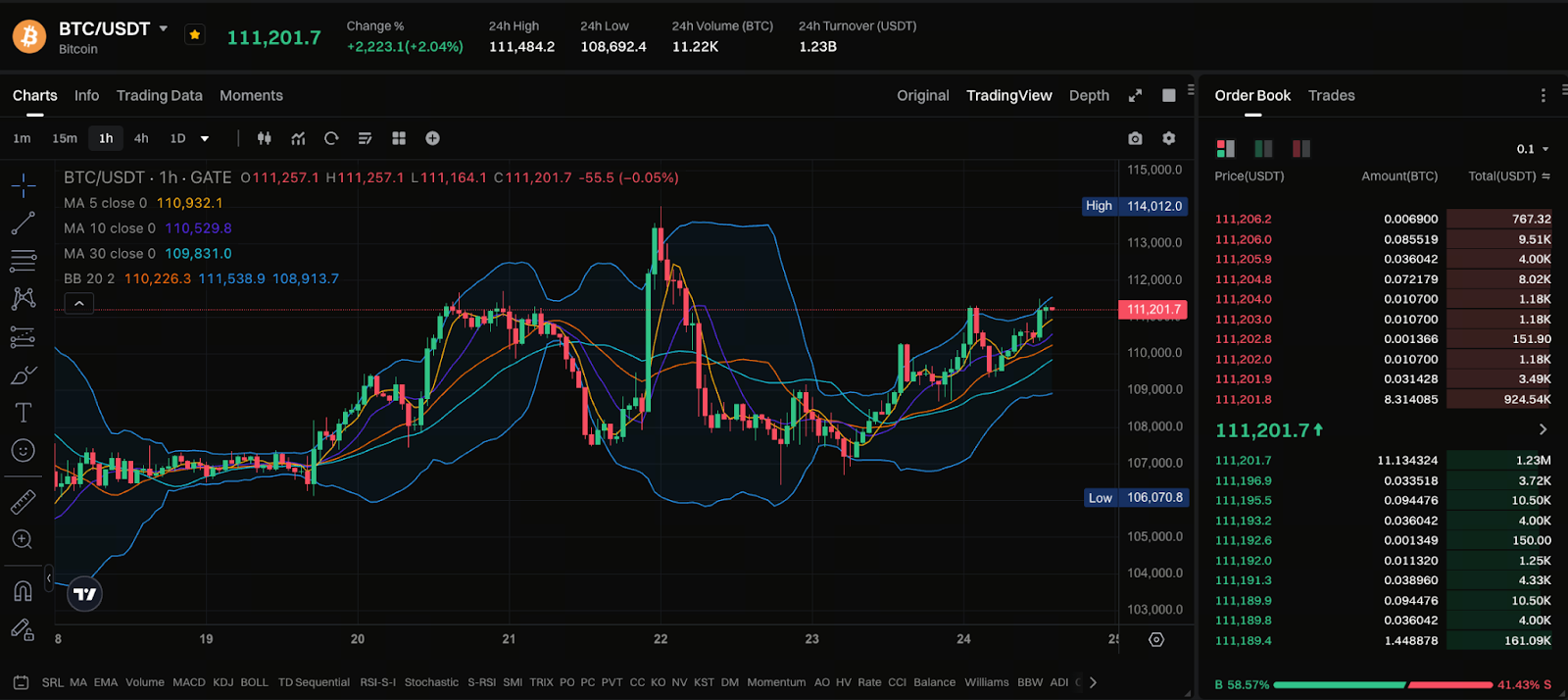
Image: https://www.gate.com/trade/BTC_USDT

If you’re new to Bitcoin (BTC) or considering entering the market, your first question is likely, “How much could I earn if I invest X amount?” Instead of relying on guesswork, leverage profit estimation tools for a rational calculation of your potential returns and risks. This article walks you through why profit estimation matters, which tools to use (such as the Bitcoin Profit Calculator), how to operate them, and how to set an exit strategy—helping newcomers avoid common mistakes.

Why Is It Critical to Estimate Bitcoin Profits First?

  • Avoid impulsive investments: Many beginners see BTC’s past surges and jump in immediately, but without estimating costs, fees, taxes, or exit points, losses often outpace gains.
  • Support goal setting: Estimation helps you see, “If my sell price is Y and fees are Z, what’s my projected return?”—not just hope for a double.
  • Enhance risk awareness: Estimation shows that small price increases may yield minimal profit or even losses, prompting greater caution.
  • Enable strategic planning: With estimation, you can clearly set strategies like, “When will I sell?”, “At what profit do I exit?”, and “At what loss do I stop?”

What Is Bitcoin Profit Estimation?

Bitcoin profit estimation refers to forecasting the potential gains or losses from a BTC investment. The primary tool for this is the Bitcoin Profit Calculator, which allows you to input key data (investment amount, buy price, expected sell price, fees) and instantly calculates net profit or loss. CoinStats, for example, offers a Crypto Profit Calculator—enter your data and receive results. CoinLedger provides similar features, supporting multiple cryptocurrencies and detailed fee inputs.

Recommended Tools and Features

  • CoinCodex Bitcoin Profit Calculator: A web-based tool supporting inputs for initial investment, buy/sell prices, fees, and outputs net profit with historical data references.
  • CoinStats Crypto Profit Calculator: Beyond basic estimations, it can connect wallet or exchange data to monitor multiple assets in your portfolio.
  • Koinly Crypto Profit Calculator: Specializes in profit estimation plus tax preparation, ideal for those needing to handle tax reporting.

Step-by-Step Operation (Five Inputs)

  1. Investment amount: The total fiat you use to buy BTC (e.g., $200,000)
  2. Buy price: The price per BTC when you purchase (e.g., $50,000)
  3. Sell/exit price: The future price per BTC you expect to sell at (e.g., $75,000)
  4. Investment fees: Platform trading fees and potential slippage costs at purchase
  5. Exit fees: Transaction fees, withdrawal fees, and estimated taxes owed upon selling

Click “Calculate” and the tool outputs: total proceeds, net profit, and return on investment (ROI).

Common Mistakes Beginners Make

  • Focusing only on price increases, ignoring investment base: For example, BTC rises 50%, but if your investment is small or you bought in at a high price, your actual profit could be minimal.
  • Overlooking fees/taxes: Even with a strong sell price, high fees or tax rates can significantly erode your returns.
  • Setting sell prices too high/waiting too long: Ambitious targets are tempting but can cause you to miss exit opportunities. Set neutral or conservative targets when estimating.
  • Neglecting take-profit/stop-loss strategies: Estimation is only a forecast; execution matters. Many beginners estimate well but fail to exit properly, missing opportunities.

Using Estimation to Set Exit Strategies

Estimation isn’t just about “how much you can earn”—it’s the foundation for “when to exit.” Here’s how to approach it:

  • Set a target profit range: For example, if you aim to invest $200,000 and net $100,000 (about 50%), use the calculator to reverse-engineer your required sell price.
  • Set a risk stop-loss range: If the sell price falls below a certain level (estimation shows a 20% loss), consider exiting.
  • Staggered exits: Set two sell price targets—sell half at the estimated value, hold the rest for further gains. This way, even if the market dips, you secure part of your profits.

This approach enables you to use estimation tools to script your “when to exit” strategy, rather than waiting for unrealistic price highs.

Summary: Key Steps from Estimation to Execution

For beginners, “investment–expected profit” sounds straightforward, but disciplined, steady investing depends on estimation tools plus sound strategies. First, use a Bitcoin Profit Calculator to estimate potential gains or losses; then set targets, stop-losses, and phased exits based on results; finally, follow through with execution. Remember, estimation is the groundwork—execution is what counts. We hope this article empowers you to progress from “I want to try BTC” to “I know how much I’m investing, what I expect to earn, and when I’m ready to exit.” Wishing you confidence and clarity in your crypto investment journey.

Author: Max
Disclaimer
* The information is not intended to be and does not constitute financial advice or any other recommendation of any sort offered or endorsed by Gate.
* This article may not be reproduced, transmitted or copied without referencing Gate. Contravention is an infringement of Copyright Act and may be subject to legal action.

Related Articles

AI-Native Settlement Layers: How United Stables Is Building the Next Financial Rail
Beginner

AI-Native Settlement Layers: How United Stables Is Building the Next Financial Rail

Stablecoins were originally designed as dollar substitutes within exchanges, primarily used for asset pricing and trade settlement. As on-chain financial ecosystems have matured, their role has expanded beyond simple payments to include collateral assets, cross-chain liquidity mediums, and unified settlement units. In particular, as AI systems and automated agents begin to participate directly in economic activity, demand has risen sharply for programmable value units capable of instant settlement. This shift is pushing stablecoins toward the role of foundational financial infrastructure.
2026-03-25 03:16:17
The ve(3,3) Flywheel Explained: How AERO Tokenomics Powers Aerodrome’s DeFi Economy
Beginner

The ve(3,3) Flywheel Explained: How AERO Tokenomics Powers Aerodrome’s DeFi Economy

In the competition for DeFi liquidity, high-inflation mining alone is no longer enough to build lasting advantages. Aerodrome applies the ve(3,3) economic model to redesign token emissions, voting mechanisms, and revenue distribution, creating a liquidity flywheel centered on governance and cash flow. This article examines AERO tokenomics, the veAERO locking mechanism, and protocol revenue models to explain how Aerodrome builds a sustainable DeFi economic system.
2026-03-25 06:41:58
How Does PAXG Work? In-Depth Overview of the Physical Gold Tokenization Mechanism
Beginner

How Does PAXG Work? In-Depth Overview of the Physical Gold Tokenization Mechanism

PAXG (Pax Gold) is a tokenized asset backed by physical gold, issued by the fintech company Paxos and traded on the Ethereum blockchain as an ERC-20 token. The core concept is to tokenize physical gold on-chain, with each PAXG token representing ownership of a certain amount of gold. This structure enables investors to hold and trade gold in the form of a digital asset.
2026-03-24 19:12:51
Aerodrome Tokenomics: How ve(3,3) Powers Base's Most Profitable DEX
Beginner

Aerodrome Tokenomics: How ve(3,3) Powers Base's Most Profitable DEX

AERO is the native token of Aerodrome Finance, a core decentralized exchange and liquidity protocol in the Base ecosystem. It is primarily used for liquidity incentives and ecosystem operations. veAERO is a governance NFT that users receive by locking AERO, representing both voting power and the right to share protocol revenue. Through a dual track structure of AERO as a utility token and veAERO as a governance credential, Aerodrome separates liquidity usage value from long term governance power, allowing participants to act as liquidity providers, governance decision makers, and revenue sharers within the same system.
2026-03-25 06:40:31
How is the price of PAXG determined? Pegging mechanism, trading depth, and influencing factors
Beginner

How is the price of PAXG determined? Pegging mechanism, trading depth, and influencing factors

PAXG (Pax Gold) is a tokenized asset backed by physical gold reserves, launched by fintech firm Paxos and issued as an ERC-20 token on the Ethereum blockchain. The core concept is to digitally represent real-world gold assets, allowing investors to hold and trade gold via the blockchain network. Because each PAXG token corresponds to a specific quantity of physical gold, its price is theoretically expected to closely track the global gold market.
2026-03-24 19:11:40
Hybrid Collateral Stablecoins: Inside United Stables' Stability and Yield Architecture
Beginner

Hybrid Collateral Stablecoins: Inside United Stables' Stability and Yield Architecture

In the early stages of the crypto market, traditional stablecoins mainly relied on single-reserve or single-collateral models. Their primary focus was price stability and payment convenience, which allowed them to become foundational tools for on-chain trading and capital flows. As the market has entered a more mature financial phase, however, this structure has begun to reveal limitations, including high concentration risk and the difficulty of balancing liquidity with yield. These constraints have driven the evolution toward multi-layer collateral and portfolio-based designs, such as the dual-layer hybrid collateral architecture proposed by United Stables, which seeks to redefine the underlying logic of stable assets.
2026-03-25 03:17:39





