As stablecoins increasingly become a critical value medium in the digital asset market, the industry is turning its attention to improving circulation efficiency, liquidity depth, and application coverage.
Traditional stablecoins typically rely on independent issuers and isolated market building, requiring each stablecoin to acquire its own liquidity and user base. UUSD, however, adopts a networked approach to address these challenges, enabling issuers, liquidity providers, application developers, and end users to operate collaboratively within a single ecosystem.
What Is the Core Architecture of UUSD?
UUSD's core architecture comprises four key participants: Stablecoin Issuers, Liquidity Providers, Applications, and Markets.
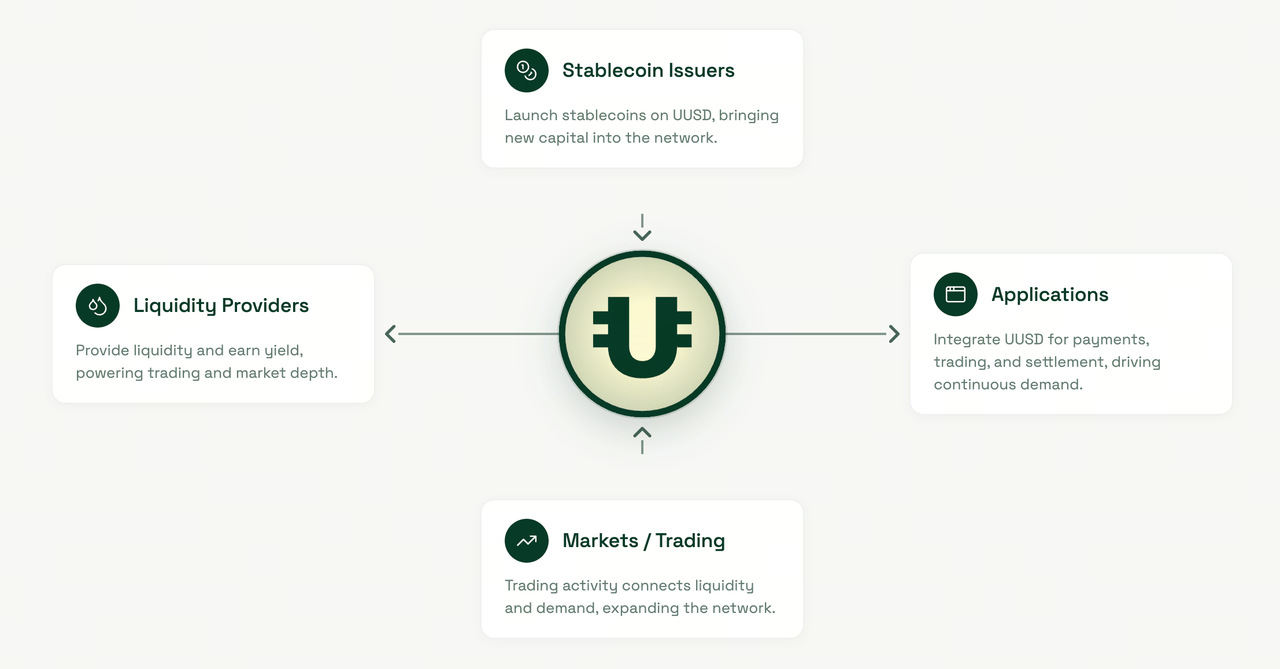
Issuers create and manage stablecoin assets. Liquidity providers supply trading depth and capital support. The application ecosystem includes payment platforms, DeFi protocols, AI Agent systems, and digital markets. Market participants drive asset circulation through trading and settlement.
Together, these roles form a stablecoin network that enables efficient value flow across diverse scenarios.
How Do Stablecoin Issuers Join the UUSD Network?
Stablecoin issuance is the starting point for the entire network.
In the traditional model, new stablecoin projects must independently build trading markets and liquidity pools, incurring high launch costs. UUSD lowers this barrier by offering issuers streamlined market access through a unified infrastructure.
Once issuers join the network, their stablecoin assets can quickly enter trading and payment environments, significantly improving circulation efficiency. For new projects, this model shortens the path from issuance to market adoption.
How Does Liquidity Enter the UUSD Ecosystem?
Liquidity is the foundation of stablecoin network operations.
In most stablecoin systems, each project builds its own liquidity pools, leading to capital fragmentation and reduced capital efficiency. UUSD introduces a shared liquidity network that aggregates market funds through a unified mechanism.
By joining the network, liquidity providers can support multiple stablecoins and use cases without duplicating independent market efforts. This design enhances market depth and mitigates the effects of liquidity fragmentation.
As the network grows, more capital is effectively deployed across the entire ecosystem.
How Does the Application Ecosystem Use UUSD?
Application integration is a key driver of stablecoin demand.
The UUSD network is open to payment platforms, DeFi protocols, digital markets, and AI Agent applications. Developers can leverage the unified currency layer to build payment, settlement, and value exchange functions.
For example, in on-chain payment scenarios, users settle goods and services with stablecoins. In DeFi, stablecoins serve as vital assets for lending and trading. In AI Agent scenarios, autonomous programs use stablecoins for resource procurement and service payments.
As the number of applications grows, the real-world demand for stablecoins continues to rise.
What Happens Inside the Network After a User Trades?
User trading drives value flow within the stablecoin network.
When a user completes a payment or trade with stablecoins, the corresponding assets are transferred and settled within the UUSD network. Trading not only generates real demand but also boosts liquidity utilization.
Simultaneously, market participants create price discovery through buy and sell orders, generating more opportunities for liquidity providers and issuers.
As trading volume increases, the entire ecosystem's activity and network effects strengthen in tandem.
How Does the UUSD Settlement Network Operate?
Settlement is a critical component of the digital economy.
UUSD aims to establish a unified settlement layer that enables efficient stablecoin transfers across different applications and markets. Compared to frequent switching among multiple independent systems, a unified settlement network reduces friction costs and improves capital flow efficiency.
For AI Agents, digital markets, and cross-border payments, fast and reliable settlement is essential. A unified settlement network allows all participants to exchange value within a single infrastructure, boosting overall coordination efficiency.
UUSD's growth model is built on network effects.
First, stablecoin issuers join the network and create assets. Then, liquidity providers offer trading support. Once the application ecosystem connects, users begin using stablecoins for payments and trading. Rising demand attracts more issuers and liquidity into the ecosystem.
This creates the following cycle:
Stablecoin Issuance → Liquidity Growth → Application Expansion → Increased User Demand → More Stablecoin Issuance
As the number of participants continues to grow, so does the network's value.
What Are the Differences Between UUSD and Traditional Stablecoin Models?
Traditional stablecoins are centered around a single asset, with the primary goal of maintaining price stability and serving as a medium of exchange.
UUSD, in contrast, focuses on building a stablecoin network. Beyond issuing stable assets, it encompasses liquidity management, application integration, and settlement infrastructure.
| Comparison Dimension |
UUSD Network Model |
Traditional Stablecoin Model |
| Core Object |
Stablecoin Network |
Stablecoin Asset |
| Liquidity Source |
Shared Liquidity |
Independent Liquidity |
| Settlement System |
Unified Settlement Network |
Decentralized Settlement |
| Application Integration |
Network-Level Access |
Single-Project Access |
| Network Effects |
Strong |
Relatively Limited |
This distinction positions UUSD more as a monetary infrastructure for the digital economy rather than just another stablecoin product.
Summary
UUSD's operational workflow is built on the collaboration of four core modules: issuance, liquidity, application, and settlement. With a unified infrastructure, issuers gain easier access to market liquidity, developers can rapidly integrate payment and settlement functions, and users can use stablecoins for value exchange across an expanding range of scenarios.
FAQs
What are the core steps in UUSD's operational process?
UUSD's core process includes stablecoin issuance, liquidity access, application usage, and on-chain settlement. Together, these steps form a complete stablecoin network ecosystem.
What is the responsibility of issuers in the UUSD network?
Issuers create and manage stablecoin assets, and they leverage the UUSD network to access liquidity and market infrastructure, thereby improving asset circulation efficiency.
Why does UUSD emphasize shared liquidity?
Shared liquidity reduces market fragmentation, enhances capital utilization, and allows new stablecoin projects to gain trading depth and market support more quickly.
What is the role of the UUSD settlement layer?
The UUSD settlement layer connects different applications and markets, enabling seamless stablecoin value transfer and settlement across multiple scenarios, improving overall capital efficiency.
Is UUSD's operation the same as stablecoins like USDT and USDC?
Not exactly. USDT and USDC are primarily single stablecoin assets, whereas UUSD emphasizes building a stablecoin network that connects the entire digital economy through unified issuance, liquidity, and settlement systems.