Stage 2 Output:
As the Web3 entertainment industry evolves from isolated project models toward integrated ecosystems, developers face mounting challenges: rising user acquisition costs, fragmented token economies that lack cohesion, and an inability to sustainably retain value. Power Protocol addresses these issues through a unified value network that enables users, developers, and ecosystem projects to operate under a single, shared incentive and economic infrastructure.
Power Protocol positions itself as an infrastructure-layer project within the broader Web3 entertainment sector. Unlike traditional blockchain games that focus on individual product lifecycles, Power Protocol's core focus is enabling multiple applications to collaboratively create, accumulate, and distribute value. Understanding its operational mechanics is essential for recognizing the trajectory of the next generation of blockchain entertainment ecosystems.
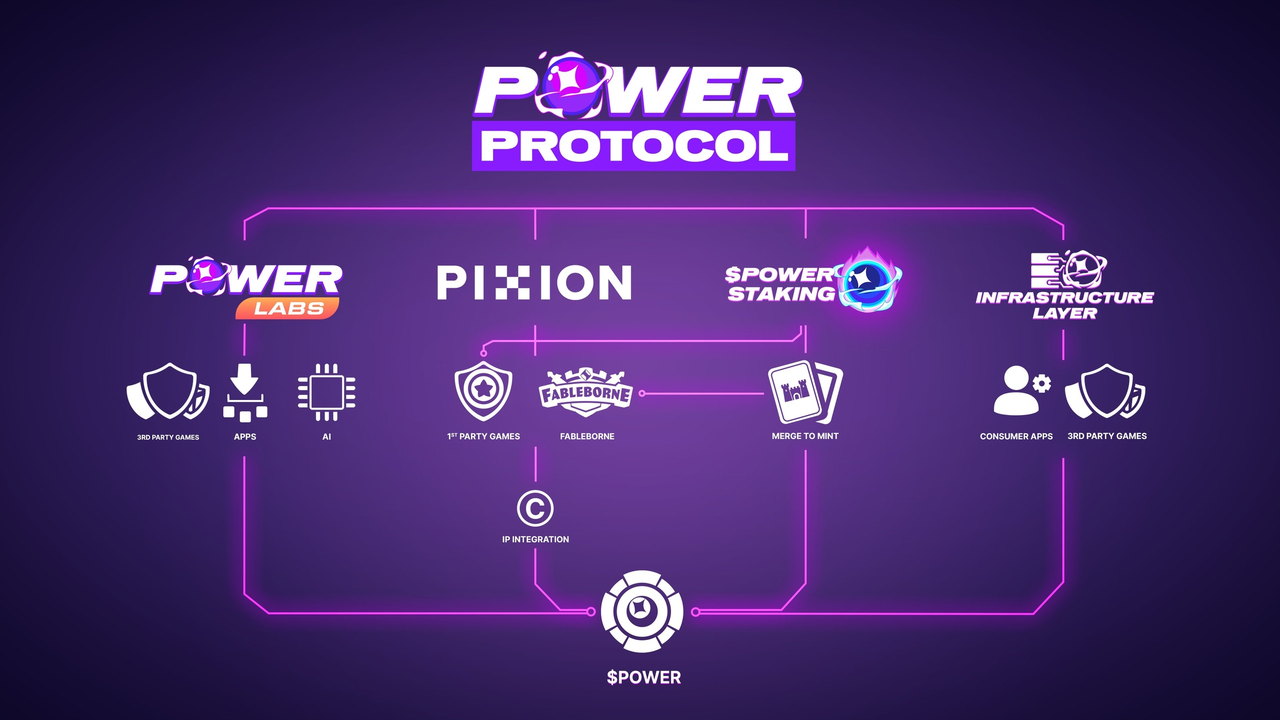
What Are the Core Components of Power Protocol's Architecture?
Power Protocol's operation relies on several interconnected modules: a unified value layer, an incentive network, an application ecosystem, and a governance framework. These components collectively form the foundational infrastructure of the ecosystem.
The unified value layer serves as the protocol's core. All applications integrated into the ecosystem can build economic activity around the POWER token, giving disparate products a common value medium. Value no longer remains trapped within a single application but flows continuously across the entire ecosystem.
The incentive network manages user participation and reward distribution. Developers leverage the protocol's built-in tools to construct task systems, growth frameworks, and user incentive mechanisms, accelerating the economic design of their products.
The application layer is where value is created. Blockchain games, AI applications, digital IP projects, and other consumer-facing products integrate into the ecosystem, bringing new users and diverse use cases to the network. Simultaneously, the governance system coordinates the ecosystem's strategic direction and drives the protocol's long-term evolution through community participation.
What Is Power Protocol's Complete Operational Flow?
Power Protocol's operation can be understood as a self-reinforcing value cycle. From initial application integration to ecosystem expansion, each phase drives the system's continuous growth.
First, development teams integrate their products into the Power Protocol ecosystem. The protocol supplies ready-made economic modules and incentive tools, eliminating the need for developers to design complex token systems or growth mechanisms from scratch. Once integrated, the application becomes part of the unified value network.
Users then enter the ecosystem's products and begin participating in activities. Whether through gameplay, digital content creation, community contributions, or AI service usage, these actions generate value data that ties into the broader ecosystem.
When users complete specific actions, the incentive system activates according to predefined rules. The value users contribute earns proportional rewards. Critically, these reward systems are not siloed to a single application; they are connected to the entire POWER network.
What Role Does the POWER Token Play?
POWER is the core asset that anchors the entire ecosystem's value network. The unified economic layer's functionality depends heavily on POWER's value coordination role.
As a unified value medium, POWER establishes a common economic standard across different applications. When users move between ecosystem products, value exchange does not require separate token systems, significantly reducing collaboration costs across the ecosystem.
POWER also serves as a fundamental component of the incentive system. When users participate in ecosystem activities, complete tasks, or create value, corresponding rewards flow through the POWER network, creating a consistent incentive experience across the entire ecosystem.
Beyond value transfer and incentives, POWER assumes a governance function. Token holders can participate in protocol upgrade proposals, parameter adjustments, and strategic discussions about the ecosystem's direction, empowering the community to shape the network's long-term development.
How Do Developers Integrate with Power Protocol?
A core design goal of Power Protocol is lowering the barrier for Web3 products to build robust economic systems. For development teams, the protocol functions as a plug-and-play economic infrastructure layer.
Traditional projects typically expend substantial resources before launch designing token models, reward logic, and user growth mechanisms. Power Protocol provides these capabilities as modular building blocks, enabling developers to quickly assemble a complete economic system.
Once integrated, development teams can immediately leverage the unified incentive network and value layer for their operational needs. This approach not only reduces redundant development costs but also allows teams to concentrate more resources on product experience and content innovation.
As the ecosystem expands, developers benefit from the existing user network and value system to achieve broader synergies, without depending entirely on independent user acquisition channels.
How Is User Value Accumulated in the Ecosystem?
Traditional internet platforms and most Web3 applications suffer from value silos. Even long-term users of a product see their contributions remain locked within that single platform.
Power Protocol breaks this limitation through its unified economic layer. User actions within ecosystem applications connect to the entire value network, rather than serving only a single project.
When users engage with multiple ecosystem products, their contributions and activity records form a sustained value accumulation process. As the ecosystem scales, this accumulation model gains support from an expanding range of use cases.
The unified value network ensures that users are not merely participants in individual applications—they become integral components of the entire ecosystem.
How Does Power Protocol Differ from Traditional Blockchain Game Economies?
The fundamental difference between Power Protocol and traditional blockchain games lies in how value is organized.
Traditional blockchain games build token economies around single games. User value, reward mechanisms, and asset circulation remain confined within that product. If game activity declines, the associated economic system suffers.
Power Protocol constructs a shared economic layer spanning multiple applications. Different products operate within the same value network, and users and developers share ecosystem resources across applications.
| Comparison Dimension |
Power Protocol |
Traditional Blockchain Game Model |
| Value System |
Unified Economic Layer |
Independent Economic System |
| User Value |
Cross-Application Accumulation |
Single-Game Accumulation |
| Token Model |
Shared Value Network |
Single-Project Token |
| Incentive Source |
Entire Ecosystem |
Single Application |
| Network Effect |
Multi-Product Synergy |
Product-Siloed Operation |
| Scalability |
Sustainable Expansion |
Dependent on Single Project Growth |
In essence, traditional blockchain games are specific products, while Power Protocol functions as infrastructure for the entire entertainment ecosystem.
Summary
Power Protocol's core operational logic is connecting multiple Web3 entertainment applications through a unified economic layer, enabling value to circulate continuously across the ecosystem. Its operational cycle includes application integration, user participation, incentive distribution, value recirculation, and ecosystem expansion. POWER serves critical functions as a value medium, incentive asset, and governance credential.
Unlike traditional blockchain game models that prioritize individual product growth, Power Protocol focuses on ecosystem-level synergy. Through a shared economic network and unified incentive framework, the protocol aims to build more sustainable value infrastructure for the Web3 entertainment industry.
FAQs
What is the unified entertainment economic layer?
The Unified Entertainment Economic Layer is Power Protocol's core architecture. Multiple games, AI applications, and digital products share a single value network and incentive mechanism, eliminating the need for each to build its own independent economic system.
What role does the POWER token play?
POWER facilitates ecosystem value transfer, user incentives, governance participation, and network expansion. It is the critical value medium connecting different applications and ecosystem participants.
Why should developers integrate with Power Protocol?
Power Protocol provides ready-made economic modules and incentive tools that reduce development costs, minimize redundant work, and help teams build complete user growth systems faster.
How does user value accumulate in the ecosystem?
User actions within ecosystem applications connect to the unified value network, ensuring value accumulation extends beyond any single product and continues to function across multiple ecosystem scenarios.
What is the biggest difference between Power Protocol and traditional blockchain games?
Traditional blockchain games build economic models around individual products, whereas Power Protocol provides a shared economic layer spanning multiple applications. Its focus is constructing a unified value network, not operating a single game.