With the growth of the Sui ecosystem, liquidity efficiency has become a key competitive focus among DeFi protocols. Magma Finance addresses the diverse needs of users by offering two liquidity models—ALMM and CLMM—while leveraging its governance system to drive continuous protocol evolution. This approach has steadily positioned it as a vital component of the Sui liquidity landscape.
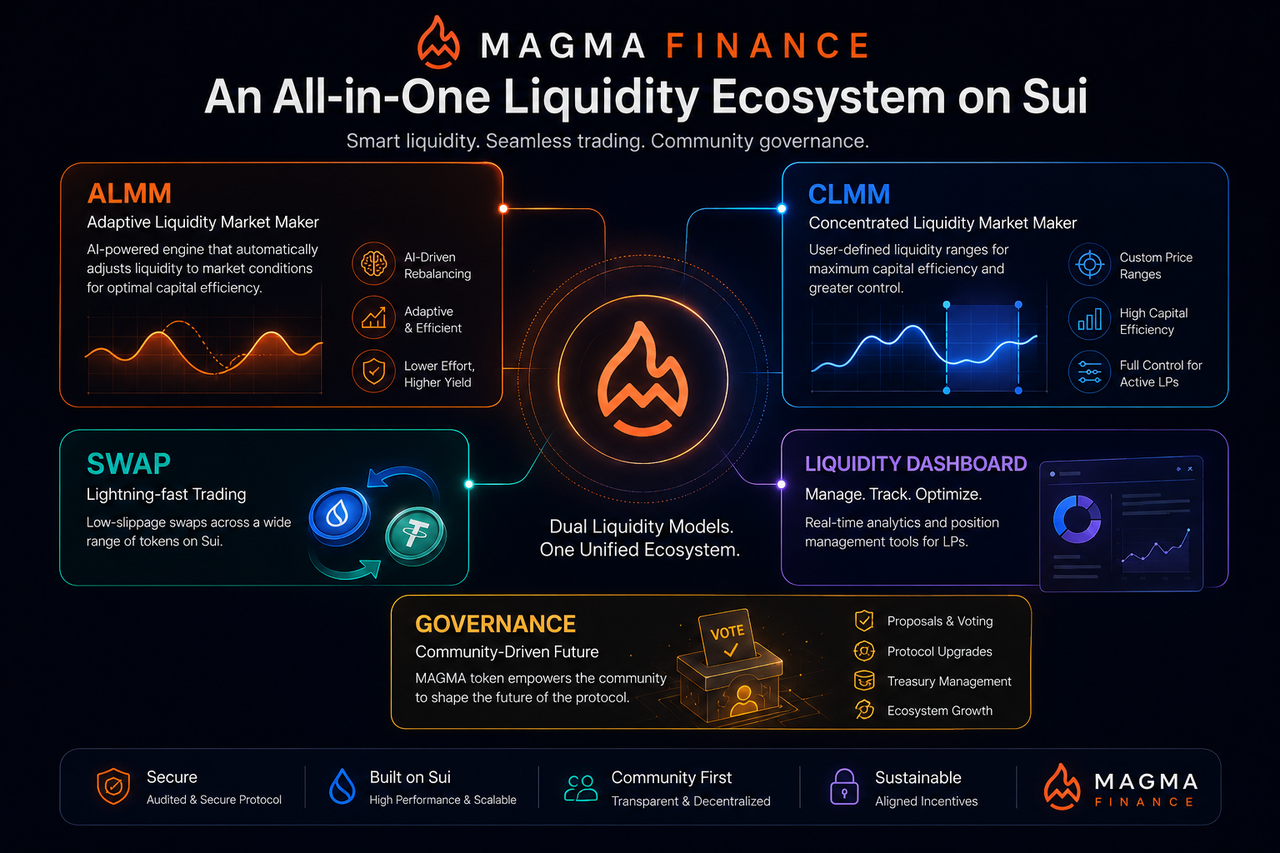
What Is the Magma Finance Ecosystem Architecture?
Magma Finance’s product suite is organized around three core pillars: trading, liquidity, and governance. The trading layer handles asset swaps and market liquidity provision; the liquidity layer enhances capital efficiency through varied market-making mechanisms; and the governance layer oversees protocol upgrades, community decisions, and ecosystem incentives.
This structure enables the protocol to serve both everyday traders and sophisticated liquidity providers, while also offering long-term ecosystem participants multiple ways to engage. Each module works in concert, forming a complete on-chain financial services system.
How Does the Swap Market Work?
Swap is the most fundamental and widely used module within Magma Finance. Users can exchange Sui ecosystem assets, with the system automatically generating quotes and executing trades based on the liquidity pool’s current state.
For everyday users, Swap offers a seamless on-chain trading gateway. For the protocol ecosystem, it generates critical liquidity demand and accumulates trading fees. The more active the trading activity, the richer the yield opportunities for liquidity pools.
As such, Swap serves not only as the primary entry point into Magma Finance but also as a foundational driver of the entire ecosystem.
Why Is ALMM the Core Innovation of Magma Finance?
ALMM (Adaptive Liquidity Market Maker) stands as one of Magma Finance’s most distinctive products. Its design aims to boost capital efficiency while lowering the barriers to liquidity management.
Traditional AMM suffers from underutilized capital, while CLMM improves efficiency but demands constant position management from users. ALMM automates part of the liquidity management process, allowing funds to dynamically adjust positions in response to market movements.
Through automated rebalancing and AI-driven optimization, ALMM enables a broader range of users to participate in high-efficiency liquidity markets. This innovation sets Magma Finance apart from conventional DEXs.
What Role Does CLMM Play in the Ecosystem?
CLMM (Concentrated Liquidity Market Maker) is a widely adopted high-capital-efficiency liquidity model in DeFi. It allows liquidity providers to define their own price ranges, concentrating capital in areas where trades are most likely to occur.
This concentration enables the same amount of capital to support larger trade volumes, significantly improving capital utilization compared to traditional AMM. However, users must actively monitor market conditions and adjust positions to keep liquidity within effective ranges.
CLMM is therefore best suited for experienced users who prefer hands-on liquidity management.
How Do ALMM and CLMM Work Together?
ALMM and CLMM are not competing products—they are complementary liquidity solutions tailored to different user profiles. ALMM prioritizes automation and ease of use, while CLMM offers greater strategic freedom and control.
By supporting both models, Magma Finance serves a broad spectrum of participants, from casual users to professional market makers. The coexistence of diverse liquidity providers also enhances overall market depth and stability.
This dual-liquidity architecture has become a cornerstone of Magma Finance’s product strategy.
Beyond the liquidity pools themselves, Magma Finance provides a dedicated liquidity management tool. This dashboard displays user positions, yield data, liquidity allocation status, and historical performance.
For CLMM users, the platform simplifies monitoring of price ranges and strategy adjustments. For ALMM users, it offers visibility into the performance and fund allocation of automated strategies.
By centralizing data management, the Liquidity Management Platform reduces the complexity of asset oversight and elevates the overall user experience.
How Does the Governance System Drive Ecosystem Growth?
The governance system is a foundational component of Magma Finance’s long-term roadmap. Through this mechanism, community members participate in key decisions—protocol upgrades, parameter adjustments, incentive optimization, and future direction.
This model allows the protocol to gradually transition toward a community-driven governance framework, reducing reliance on a single team. Governance participation also strengthens users’ sense of ownership and long-term commitment.
As the ecosystem scales, the governance system’s role will continue to grow in importance.
What Role Does the MAGMA Token Play in the Product Suite?
The MAGMA token serves as a key value connector across the entire ecosystem. In governance, MAGMA holders can propose and vote on protocol changes. For incentives, the token rewards liquidity providers and community contributors. At the ecosystem level, MAGMA aligns the interests of users with the protocol’s long-term success.
Given its integration across multiple product modules, MAGMA functions not only as a governance asset but also as a bridge linking trading, liquidity, and community. This token-based model fosters a collaborative development dynamic among all ecosystem participants.
Magma Finance Product Matrix Comparison
| Product Module |
Main Function |
Target User |
| Swap |
Asset Exchange |
Everyday Traders |
| ALMM |
Automated Liquidity Management |
Everyday LPs |
| CLMM |
Concentrated Liquidity Market Making |
Advanced LPs |
| Liquidity Dashboard |
Liquidity Monitoring & Management |
All LPs |
| Governance |
Community Governance & Decision-Making |
MAGMA Holders |
| MAGMA Token |
Governance & Incentives |
All Ecosystem Participants |
Summary
Magma Finance’s ecosystem is built around three core pillars: trading, liquidity, and governance. Swap delivers basic trading functionality; ALMM and CLMM form a dual-liquidity model; the Liquidity Dashboard helps users monitor asset performance; and the governance system drives the protocol’s long-term evolution.
By combining AI-driven automated liquidity management with concentrated liquidity models, Magma Finance offers a product matrix that addresses the needs of diverse users. For the Sui DeFi ecosystem, this multi-layered liquidity infrastructure not only enhances market efficiency but also demonstrates a viable path toward more intelligent decentralized finance.
FAQs
What Are the Core Products of Magma Finance?
Magma Finance’s core products include Swap, ALMM, CLMM, the Liquidity Dashboard, the governance system, and the MAGMA token suite. Together, these modules form a complete DeFi liquidity ecosystem.
What Is the Difference Between ALMM and CLMM?
ALMM uses an automated liquidity management mechanism that dynamically adjusts to improve capital efficiency. CLMM, on the other hand, lets users define their own price ranges, making it ideal for advanced liquidity providers who prefer active position management.
Why Does Magma Finance Offer Both Liquidity Models?
Different users have different needs. ALMM lowers operational complexity for everyday users, while CLMM provides greater control for professional liquidity providers. Offering both ensures coverage across a broad user base.
What Role Does Swap Play in the Ecosystem?
Swap serves as the primary gateway for token exchanges and is a major source of liquidity demand and fee revenue. It plays a foundational role in sustaining the entire ecosystem.
What Are the Uses of the MAGMA Token?
MAGMA is primarily used for protocol governance, community incentives, and ecosystem participation. Token holders can vote on proposals and influence the protocol’s future direction through the governance system.







