A medida que el ecosistema Ethereum se expande con rapidez, la congestión de la red y las elevadas comisiones de Gas se han convertido en cuellos de botella críticos para la adopción masiva de blockchain. Las soluciones de escalado de capa 2 mejoran el rendimiento de la red al trasladar la ejecución de transacciones fuera de la cadena principal, manteniendo al mismo tiempo la seguridad de Ethereum. Entre ellas, el rollup optimista se ha consolidado como uno de los enfoques de escalado más maduros y utilizados.
Optimism y Arbitrum son las dos redes de rollup optimista más destacadas en la actualidad. Ambas están construidas sobre Ethereum y cuentan con extensas comunidades de desarrolladores y aplicaciones ecosistémicas. Sin embargo, han desarrollado características distintas en cuanto a arquitectura técnica, modelos de gobernanza, estrategias multicadena y direcciones de desarrollo del ecosistema, lo que las convierte en los proyectos más comparados dentro del espacio de capa 2.
¿Qué es Optimism?
Optimism es una red de capa 2 de Ethereum basada en la arquitectura de rollup optimista, diseñada para mejorar la experiencia del usuario reduciendo los costes de transacción y aumentando la eficiencia de las transacciones.
La misión principal de Optimism va más allá de escalar Ethereum: busca construir un ecosistema multicadena impulsado por estándares abiertos. Para lograrlo, Optimism lanzó el marco de desarrollo modular OP Stack y lo está utilizando para construir la alianza de redes Superchain.
Además del escalado técnico, Optimism ha introducido la financiación retrospectiva (Retro Funding), la gobernanza bicameral y los mecanismos de financiación de bienes públicos, explorando un modelo más sostenible para el desarrollo del ecosistema blockchain.
¿Qué es Arbitrum?
Arbitrum es una red de capa 2 de Ethereum desarrollada por Offchain Labs, que también utiliza la tecnología de rollup optimista para escalar.
El diseño de Arbitrum prioriza la alta compatibilidad y la comodidad para los desarrolladores. Estos pueden migrar aplicaciones de Ethereum a la red Arbitrum con cambios mínimos en el código.
Además de su red principal, Arbitrum One, Arbitrum ha lanzado Arbitrum Nova para casos de uso en juegos y empresas, así como Arbitrum Orbit, que admite el despliegue de cadenas personalizadas, formando un ecosistema de escalado multicapa.
¿En qué se diferencian Optimism y Arbitrum en la arquitectura técnica?
Aunque ambas son rollups optimistas, sus implementaciones subyacentes no son idénticas.
Optimism adoptó inicialmente un diseño de rollup más simple, enfatizando la consistencia y la estandarización con Ethereum. Con la introducción de OP Stack, Optimism modularizó aún más su red, sentando las bases para un ecosistema multicadena a gran escala.
Arbitrum, por otro lado, emplea un sistema de prueba de fraude más complejo con un mecanismo de verificación interactiva de múltiples rondas. Este diseño reduce los costes computacionales de la capa 1 durante las disputas y mejora la eficiencia de la verificación.
Desde una perspectiva de desarrollo, Optimism prioriza la estandarización, mientras que Arbitrum se centra en la flexibilidad y la extensibilidad.
¿Cuál es la diferencia entre OP Stack y Arbitrum Orbit?
OP Stack y Arbitrum Orbit representan las estrategias de expansión de sus respectivos ecosistemas.
OP Stack
OP Stack es un marco de desarrollo de blockchain modular lanzado por Optimism.
Los equipos de desarrollo pueden construir rápidamente redes de capa 2 utilizando componentes estandarizados y unirse al ecosistema Superchain.
Redes como Base, World Chain e Ink están todas construidas sobre OP Stack.
Arbitrum Orbit
Arbitrum Orbit permite a los desarrolladores crear redes de capa 2 o capa 3.
Las cadenas Orbit pueden personalizar los tokens de Gas, los mecanismos de permisos y las soluciones de disponibilidad de datos según necesidades específicas, ofreciendo un alto grado de autonomía.
Diferencias clave
OP Stack enfatiza la unificación de estándares y la sinergia del ecosistema.
Arbitrum Orbit enfatiza la autonomía de la red y una alta capacidad de personalización.
¿En qué se diferencian los ecosistemas Superchain y Orbit?
Optimism y Arbitrum tienen visiones claramente diferentes sobre el futuro del desarrollo multicadena.
Superchain de Optimism busca conectar múltiples redes de capa 2 mediante estándares técnicos unificados, permitiendo infraestructura compartida, mecanismos de actualización y herramientas de desarrollo entre cadenas.
Orbit de Arbitrum es más una colección de redes modulares. Cada cadena Orbit puede operar de forma independiente y elegir diferentes configuraciones según sus propios requisitos.
En términos sencillos:
- Superchain enfatiza estándares unificados.
- Orbit enfatiza la independencia de las cadenas.
- Superchain se asemeja a una red de alianzas.
- Orbit se asemeja a un ecosistema modular.
Esta es una de las diferencias estratégicas más fundamentales entre las dos redes de capa 2.
¿En qué se diferencian Optimism y Arbitrum en la gobernanza?
Ambas adoptan un modelo de gobernanza DAO, pero sus diseños específicos varían.
Gobernanza de Optimism
El Colectivo Optimism utiliza un modelo de gobernanza bicameral:
- Token House: Gestiona la gobernanza del protocolo.
- Citizens' House: Gestiona la financiación de bienes públicos.
Este diseño busca equilibrar los intereses del capital con los intereses públicos.
Gobernanza de Arbitrum
La DAO de Arbitrum gira principalmente en torno al token ARB para la gobernanza.
Los holders de ARB deciden las actualizaciones del protocolo, la asignación de fondos y las políticas del ecosistema mediante propuestas y votaciones.
En comparación, la estructura de gobernanza de Arbitrum es más convencional, mientras que Optimism apuesta por la experimentación en gobernanza y la innovación institucional.
¿En qué se diferencian los ecosistemas de Optimism y Arbitrum?
Ambas redes albergan ricas aplicaciones ecosistémicas.
Características del ecosistema de Optimism
Optimism se centra más en el desarrollo de infraestructuras y la expansión de Superchain.
Los componentes clave del ecosistema incluyen:
- Base
- World Chain
- Ink
- OP Mainnet
A medida que más proyectos adoptan OP Stack, los límites del ecosistema de Optimism siguen expandiéndose.
Características del ecosistema de Arbitrum
Arbitrum ha mantenido durante mucho tiempo una alta actividad en DeFi.
Muchos intercambios descentralizados, protocolos de préstamo y plataformas de derivados se despliegan preferentemente en Arbitrum.
Como resultado, Arbitrum es ampliamente considerada una de las redes de capa 2 más activas en el ecosistema DeFi.
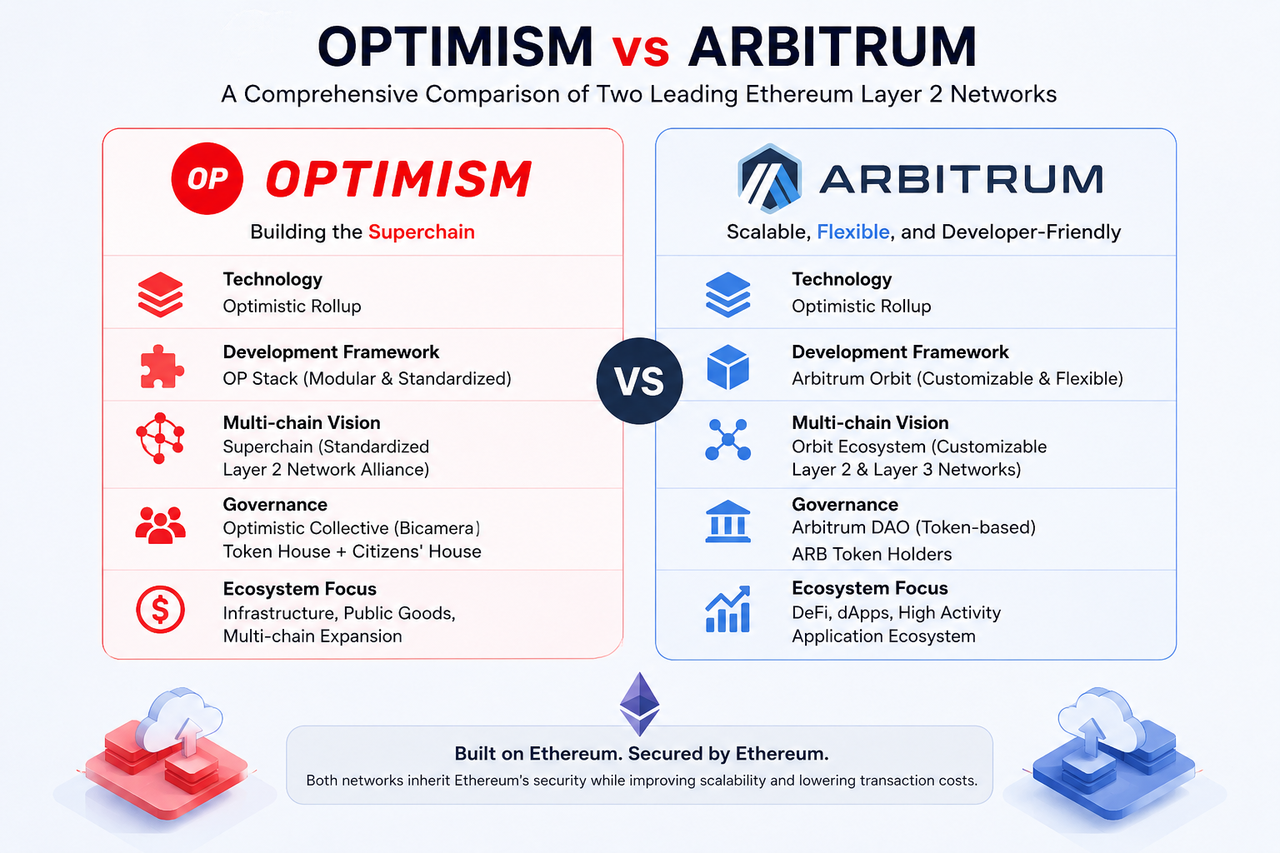
Diferencias clave entre Optimism y Arbitrum
| Dimensión de comparación |
Optimism |
Arbitrum |
| Enfoque técnico |
Rollup optimista |
Rollup optimista |
| Marco de desarrollo |
OP Stack |
Arbitrum Orbit |
| Estrategia multicadena |
Superchain |
Ecosistema Orbit |
| Modelo de gobernanza |
Gobernanza bicameral |
Gobernanza DAO |
| Mecanismo de bienes públicos |
Retro Funding |
Subvenciones DAO |
| Dirección de expansión de la red |
Sinergia estandarizada |
Expansión personalizada |
| Enfoque del ecosistema |
Infraestructura y multicadena |
DeFi y ecosistema de aplicaciones |
| Token representativo |
OP |
ARB |
Conclusión
Optimism y Arbitrum son las redes de capa 2 más importantes de Ethereum y utilizan la tecnología de rollup optimista para escalar. Sin embargo, sus prioridades de desarrollo difieren significativamente. Optimism construye un ecosistema multicadena estandarizado a través de OP Stack y Superchain, explorando continuamente la innovación en gobernanza y la financiación de bienes públicos. Arbitrum impulsa la expansión de la red mediante el marco Orbit y un ecosistema DeFi maduro, enfatizando la personalización flexible.
Desde una perspectiva a largo plazo, las dos representan filosofías de escalado distintas en el espacio de capa 2. Optimism prioriza los estándares unificados y la colaboración ecosistémica, mientras que Arbitrum apuesta por la expansión abierta y la innovación independiente.
Preguntas frecuentes
¿Optimism y Arbitrum usan la misma tecnología?
Ambos usan rollup optimista, pero sus implementaciones difieren. Optimism enfatiza la arquitectura estandarizada, mientras que Arbitrum utiliza un mecanismo interactivo de prueba de fraude.
¿Qué es más importante: OP Stack o Arbitrum Orbit?
Ambos tienen propósitos diferentes. OP Stack es un marco de desarrollo estandarizado de Optimism, mientras que Arbitrum Orbit se centra en el despliegue de redes personalizadas. Cada uno sirve a una estrategia de ecosistema diferente.
¿Cuál es la diferencia entre Superchain y Orbit?
Superchain busca conectar múltiples redes de capa 2 mediante estándares unificados, mientras que Orbit permite a los desarrolladores crear redes de capa 2 o capa 3 con alta autonomía. Difieren en su filosofía de gobernanza y arquitectura.
¿Cuál tiene un ecosistema más grande: Optimism o Arbitrum?
Ambos se encuentran entre los ecosistemas de capa 2 más grandes de Ethereum. Arbitrum ha mantenido durante mucho tiempo una alta actividad en DeFi, mientras que Optimism ha crecido rápidamente gracias a OP Stack y la expansión de Superchain.