Telegram Launches Cocoon: A Decentralized Privacy AI Network Leading a New Era of Shared Computing Power
What Is Cocoon?
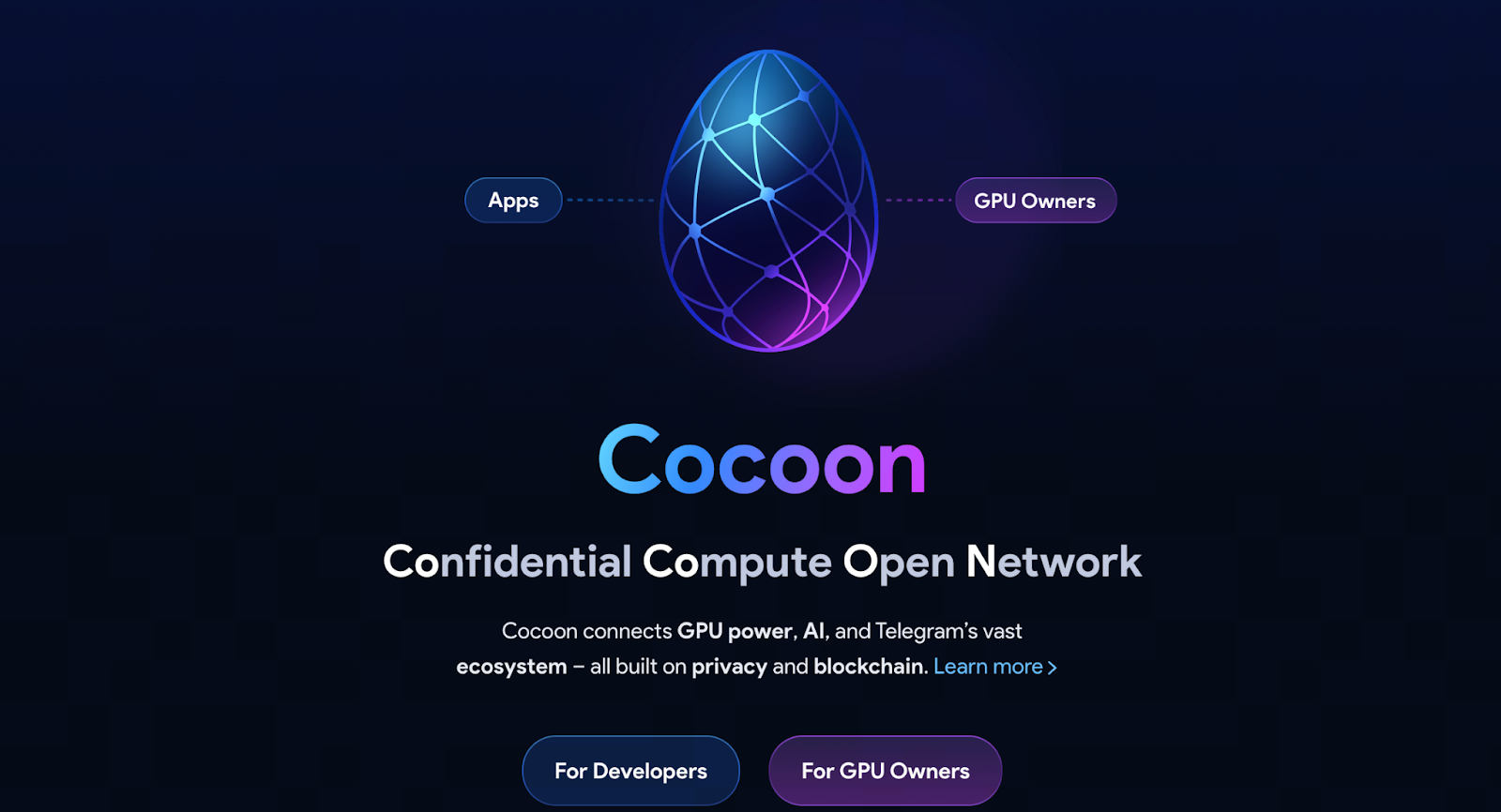
Source: https://cocoon.org/
Cocoon, or Confidential Compute Open Network, is a new initiative unveiled by Telegram founder Pavel Durov at the Blockchain Life 2025 conference on October 29, 2025.
This network’s core mission is to fuse blockchain with confidential computing, distributing AI inference workloads to individuals and organizations worldwide that own GPUs. The goal is to deliver truly decentralized, private, and secure AI computing services.
Telegram will serve as Cocoon’s first major client, with plans to integrate it into Telegram’s Mini App and Bot ecosystem.
Why Cocoon Could Reshape AI Infrastructure
Breaking Free from Centralized Cloud Service Monopolies: Today, most AI services depend on centralized cloud providers like AWS, Azure, and Google Cloud. Cocoon’s decentralized model could disrupt these providers’ dominance over both computing power and data.
Privacy First: All data processed through Cocoon is handled in secure Trusted Execution Environments (TEEs), with encrypted input and output. This guarantees confidentiality—even GPU nodes supplying computing power cannot access user data.
Shared Computing Power and Incentive Economy: Owners of idle GPUs can rent out their computing power to the network and earn TON tokens as rewards. This “sharing plus reward” model has the potential to dramatically boost global computing power utilization.
Cost and Accessibility: For small developers and startups, tapping into global GPU resources through Cocoon and paying on demand could be more affordable and flexible than traditional cloud services.
How Cocoon Works and Paths to Participation
Cocoon operates through several key roles and processes:
- Developers / Application Providers: Submit AI inference requests (such as natural language processing, image generation, or recognition) via Cocoon’s SDK or API.
- Scheduler: Assigns requests to suitable GPU nodes in the network, based on latency and capacity requirements.
- Secure Node: Runs AI models within Trusted Execution Environments (like Intel TDX), ensuring that all input and output remain encrypted and private.
- Response and Settlement: The system returns encrypted inference results to developers or applications. The computing power used is logged on-chain, with TON rewards distributed to computing power providers via smart contracts or blockchain mechanisms.
There are two primary ways to participate:
- As a GPU owner renting out computing power: Register, submit GPU type, VRAM, and expected online duration, and join the computing power pool.
- As a developer or application provider using AI services: Submit model architecture (e.g., DeepSeek, Qwen), request volume, token size, and related information to access the global GPU network for inference tasks.
Recent TON Price Performance and Market Implications
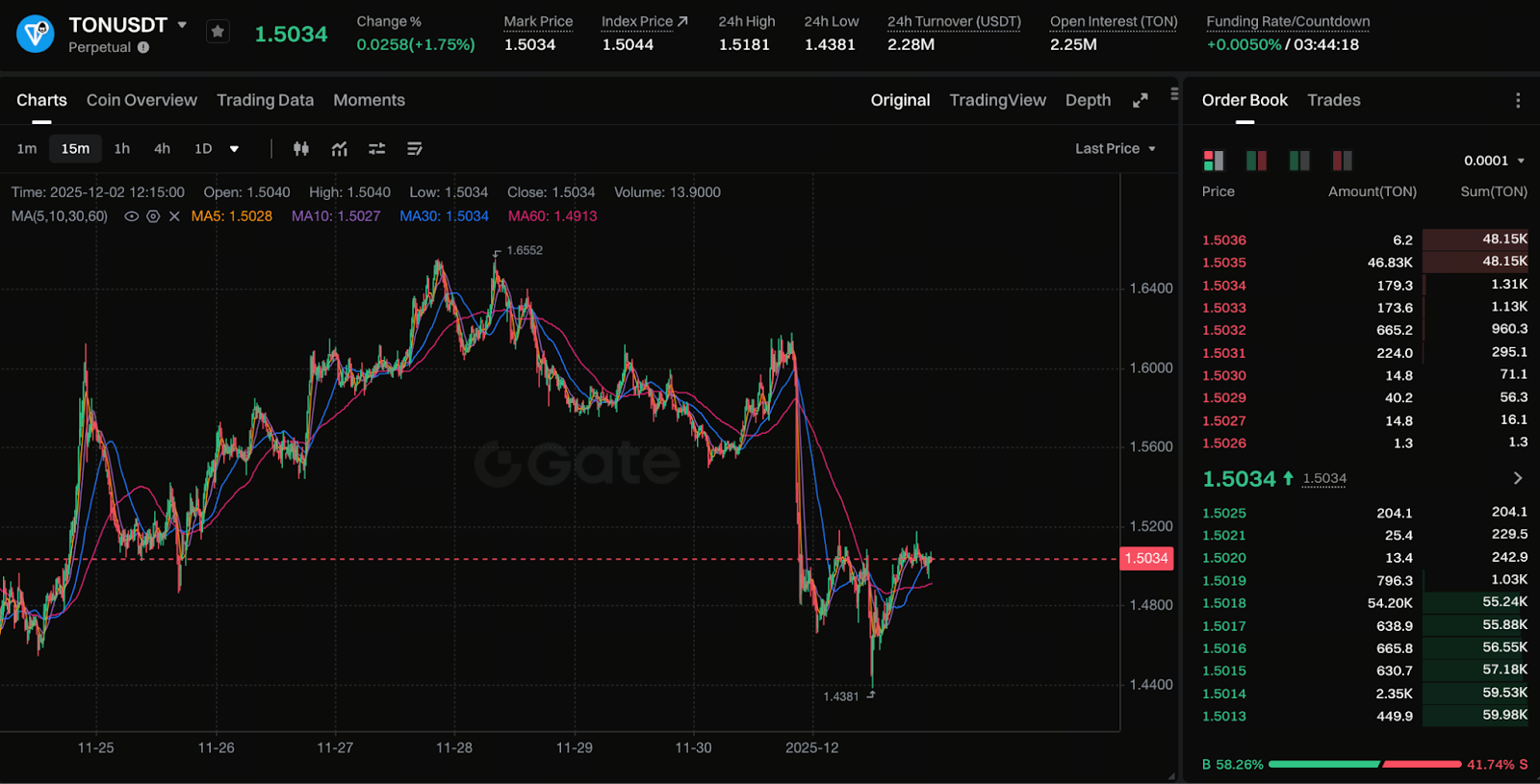
Source: https://www.gate.com/futures/USDT/TON_USDT
Cocoon’s debut has already made a significant impact on Toncoin (TON) market performance. Following Cocoon’s announcement and ecosystem expansion news, TON surged by roughly 8%, briefly exceeding $1.60, according to reports.
This underscores the market’s highly optimistic outlook for Cocoon. If the project succeeds in enabling computing power sharing and real-world AI services, TON will gain true utility, not just speculative value.
Furthermore, as GPU owners rent out computing power and developers or companies leverage AI services, the volume and frequency of TON transactions and settlements on-chain could rise sharply. This could drive greater ecosystem activity and liquidity.
Cocoon’s Potential Impact on Privacy, AI Adoption, and Computing Power Sharing
Privacy Protection: Unlike traditional cloud-based AI, user data never needs to be uploaded to centralized servers, and the computation process cannot be externally viewed or intercepted. This greatly enhances the security of sensitive information such as private conversations, medical records, and financial data.
Democratizing Computing Power: Anyone with a GPU can participate—no need for massive data centers or heavy infrastructure investments. This is particularly advantageous for individuals, small teams, and independent developers.
AI Adoption and Diversity: Lowering the barrier to AI access empowers small teams to build AI applications. Community-driven, decentralized infrastructure fosters broader innovation.
New Economic Model: GPU owners earn TON by renting out idle computing power, while developers pay as they use resources—creating a pay-per-use plus reward sharing economic model.
Future Outlook and Challenges
Despite Cocoon’s ambitious vision, several challenges and uncertainties remain:
Stability and Quality of Computing Power: With GPU nodes distributed globally and varying hardware specs, ensuring consistent inference speed, stability, and reliability is a key challenge.
Security and Trust Frameworks: While TEEs are used, robust mechanisms are still needed to prevent malicious nodes, enable trustworthy auditing, and guarantee output correctness.
Competing with Centralized Cloud Providers: Major cloud companies offer mature infrastructure, global reach, and extreme reliability. Whether Cocoon can truly compete on performance and price remains to be proven.
Ecosystem Growth and Adoption: Attracting enough GPU providers and developers is critical to building a healthy ecosystem. Otherwise, issues such as supply-demand imbalances and ecosystem bootstrapping difficulties could arise.
Cocoon’s launch could profoundly influence AI infrastructure, computing power sharing, privacy protection, and the blockchain economy. If it succeeds in building a decentralized, privacy-first, and economically shared AI ecosystem, it would mark a major leap in the convergence of AI and blockchain. The development of Cocoon will be closely monitored in the coming months.
Share
Content


Related Articles

2025 BTC Price Prediction: BTC Trend Forecast Based on Technical and Macroeconomic Data

Pi Coin Transaction Guide: How to Transfer to Gate.com

Flare Crypto Explained: What Is Flare Network and Why It Matters in 2025

How to Use a Crypto Whale Tracker: Top Tool Recommendation for 2025 to Follow Whale Moves

What is N2: An AI-Driven Layer 2 Solution