À medida que a indústria de blockchain deixa de ser uma simples rede de transferência de valor para se tornar uma infraestrutura de longo prazo, a eficiência energética dos mecanismos de consenso e a equidade de hardware passam a ser questões críticas. O modelo PoW do Bitcoin oferece segurança extremamente alta, mas há tempos enfrenta controvérsias em torno da centralização de ASICs e do alto consumo de energia. O PoS reduz o gasto energético, porém introduz a concentração de poder de staking.
Nesse cenário, o PoST da Chia Network representa um caminho inovador entre PoW e PoS, incorporando um design alinhado a blockchain verde e infraestrutura sustentável.

O que é Proof of Space
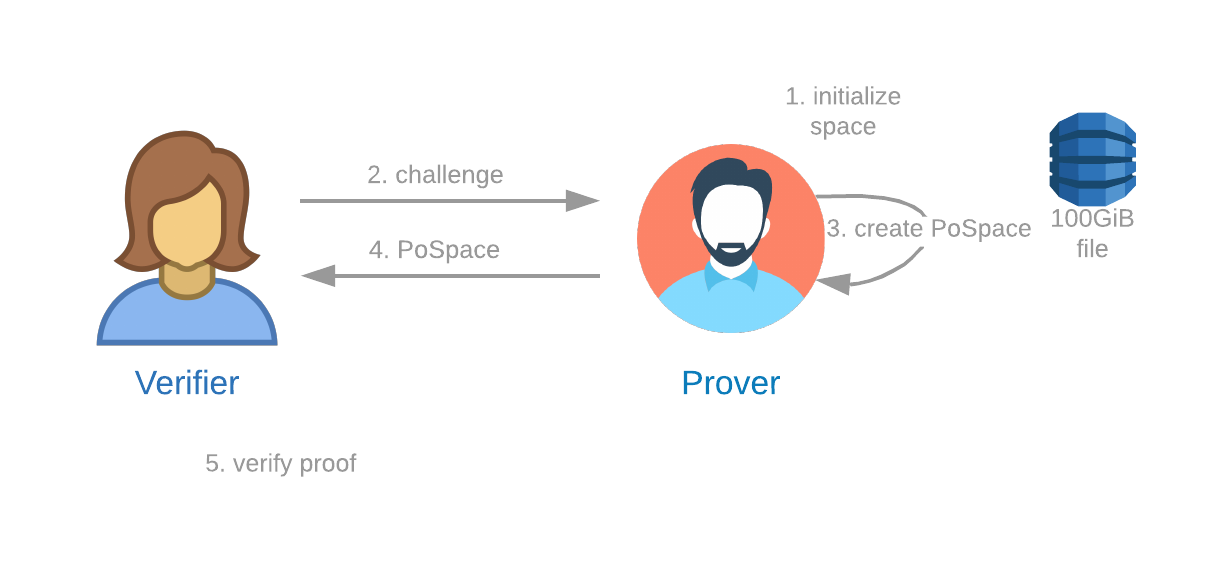
Proof of Space (PoS, não confundir com Proof of Stake) é o primeiro componente do PoST. Sua lógica central utiliza espaço de armazenamento em disco rígido para participar da validação de blocos.
Na rede Chia, o usuário precisa gerar arquivos Plot com antecedência. Um Plot é uma estrutura de dados criptográfica pré-computada, armazenada no disco rígido. Quando a rede emite um novo desafio de bloco, os nós varrem rapidamente os Plots locais e submetem a Prova mais próxima do valor alvo.
A rede determina a probabilidade de recompensa do bloco com base na proporção de espaço de armazenamento efetivo de um nó.
$P(\text{recompensa de bloco}) \propto \frac{\text{Espaço de Armazenamento Alocado}}{\text{Espaço Total da Rede}}$
Ao contrário do PoW tradicional, o Proof of Space não exige computação contínua de alta frequência; portanto, os nós consomem muito menos energia durante as fases normais de farming.
No entanto, o Proof of Space apresenta problemas potenciais. Por exemplo, um atacante que consiga reconstruir rapidamente grandes volumes de provas de armazenamento pode comprometer a segurança da rede. Por isso, a Chia introduz um mecanismo de segunda camada: o Proof of Time.
O que é Proof of Time
Proof of Time é o componente de verificação temporal do PoST. Seu objetivo principal é garantir que os blocos sejam gerados em ordem cronológica real.
A Chia utiliza uma estrutura criptográfica chamada Verifiable Delay Function (VDF) para implementar a prova de tempo. Características da VDF:
- O cálculo não pode ser paralelizado para ganho de velocidade.
- A verificação é muito mais rápida que a geração.
- As operações devem ser executadas de forma sequencial.
Isso significa que mesmo um atacante com recursos massivos de hardware não consegue gerar rapidamente múltiplas provas de tempo por meio de computação paralela.
Na rede Chia, os nós que geram VDFs são chamados de Timelords. Os Timelords não determinam os proponentes de blocos; eles fornecem uma ordem temporal unificada para toda a rede, aumentando a resistência a reorganizações de cadeia.
Estruturalmente, o Proof of Space determina "quem pode gerar um bloco", enquanto o Proof of Time determina "a ordem cronológica em que os blocos devem ser finalizados".
Qual é o processo completo de operação do PoST?
A operação do PoST normalmente compreende quatro etapas:
Etapa de Plotting
Os usuários geram primeiro os arquivos Plot. Esse processo envolve extensa pré-computação e gravação no disco rígido local. Depois de gerados, os arquivos Plot permanecem utilizáveis por longo prazo.
Etapa de Farming
Quando a rede emite um novo desafio de bloco, os Farmers buscam em seus arquivos Plot locais e submetem a Prova mais próxima do alvo do desafio.
Etapa de Verificação Temporal VDF
O Timelord gera uma prova de tempo VDF com base no resultado do bloco atual, impedindo que blocos sejam rapidamente reconstruídos em paralelo.
Etapa de Confirmação de Bloco
A rede confirma o novo bloco com base no resultado combinado do Proof of Space e do Proof of Time, distribuindo recompensas XCH ao Farmer.
Ao longo de todo o processo, o consumo sustentado de energia vem principalmente do Plotting, não do Farming diário. Consequentemente, o uso de energia operacional de longo prazo da Chia costuma ser menor do que o das redes PoW tradicionais.
Por que o PoST é chamado de mecanismo de consenso verde?
O PoST é amplamente considerado um mecanismo de consenso verde porque não depende de competição contínua de alta taxa de hash.
A mineração de Bitcoin exige que ASICs operem ininterruptamente, consumindo eletricidade em grande quantidade. Em contraste, a fase de Farming da Chia envolve basicamente leituras de disco rígido, tornando o consumo diário de energia significativamente menor.
Além disso, o PoST permite que dispositivos HDD comuns participem, reduzindo o risco de monopólios por máquinas de mineração de alto desempenho.
No entanto, "verde" não significa consumo zero de recursos. O frenesi inicial da Chia causou um uso massivo de SSDs para Plotting de alta frequência, levando alguns SSDs de nível consumidor a se desgastarem rapidamente devido à pressão de gravação. Isso levou o mercado a reavaliar os benefícios ambientais de longo prazo do PoST.
Assim, os atributos verdes do PoST são mais evidentes em sua fase operacional de longo prazo do que na fase inicial de Plotting.
Como PoST, PoW e PoS diferem?
O PoST é frequentemente comparado ao PoW do Bitcoin e ao PoS do Ethereum.
| Dimensão de Comparação |
PoST |
PoW |
PoS |
| Recurso Central |
Espaço de armazenamento |
Taxa de hash |
Ativos em Stake |
| Consumo de Energia |
Menor |
Maior |
Menor |
| Fonte de Segurança |
Provas de Espaço + Tempo |
Competição de taxa de hash |
Penalidades econômicas |
| Rede Representativa |
Chia |
Bitcoin |
Ethereum |
| Requisito de Hardware |
HDD / SSD |
ASIC / GPU |
Nós validadores |
| Risco de Centralização |
Concentração de recursos de armazenamento |
Concentração de ASICs |
Concentração de staking por grandes investidores |
A principal vantagem do PoW é a segurança verificada há muito tempo, mas com alto consumo de energia. O PoS melhora a eficiência, porém depende mais de incentivos econômicos e estruturas de governança.
O PoST tenta utilizar recursos de armazenamento de baixo consumo para alcançar um modelo de segurança semelhante ao Consenso de Nakamoto, ganhando o rótulo de "terceiro caminho de consenso".
O PoST resolve completamente a centralização da blockchain?
O PoST reduz a centralização de ASICs, mas não elimina totalmente os riscos de concentração de recursos.
À medida que a rede Chia cresce, grandes data centers e farms de armazenamento profissionais entram em cena, o que significa que os recursos de armazenamento também podem alcançar economias de escala.
Além disso, os nós Timelord exigem CPUs de maior desempenho, criando uma barreira técnica.
Portanto, o PoST redistribui os custos entre diferentes recursos, em vez de eliminar totalmente a centralização.
No entanto, comparado às redes PoW dominadas por ASICs, o PoST ainda melhora as oportunidades de participação de usuários comuns.
Resumo
Proof of Space and Time (PoST), o mecanismo de consenso blockchain utilizado pela Chia Network, mantém a segurança da rede por meio de provas de espaço e tempo. Sua estrutura central inclui Proof of Space, Proof of Time, VDF e nós Timelord, visando encontrar um novo equilíbrio entre segurança, descentralização e eficiência energética.
Perguntas Frequentes
Proof of Space é o mesmo que Proof of Stake?
Não. Proof of Space utiliza espaço de armazenamento; Proof of Stake utiliza Ativos em Stake. São mecanismos diferentes.
Por que a Chia precisa do Proof of Time?
Porque confiar apenas no espaço de armazenamento não consegue prevenir eficazmente certos ataques baseados em tempo e reorganizações de cadeia. A VDF fornece uma ordem temporal unificada.
O que é VDF?
VDF (Verifiable Delay Function) é uma estrutura criptográfica de prova de tempo que não pode ser paralelizada para aceleração.
O que o Timelord faz na Chia?
O Timelord gera provas de tempo VDF e mantém uma ordem temporal unificada para a rede.
O PoST é realmente mais ecológico?
Comparado ao PoW tradicional, o PoST tem menor consumo de energia operacional de longo prazo, mas a fase de Plotting ainda gera alta pressão de gravação em SSDs.