In the traditional internet landscape, centralized platforms collect and manage vast amounts of data. Data contributors rarely know how their data is used or participate in value distribution. Meanwhile, AI model training faces challenges such as copyright verification, data quality assessment, and privacy protection, making trustworthy data infrastructure a crucial direction for the AI industry.
As Web3 and AI converge, the Data Network introduces a new model for the data economy. Leveraging technical components like Trace, Data Network aims to record the data lifecycle, authorization status, and usage, enabling data to serve the AI ecosystem in a more transparent and secure environment and providing foundational support for the future AI data marketplace.
Why High-Quality Data Is the Key to AI Advancement
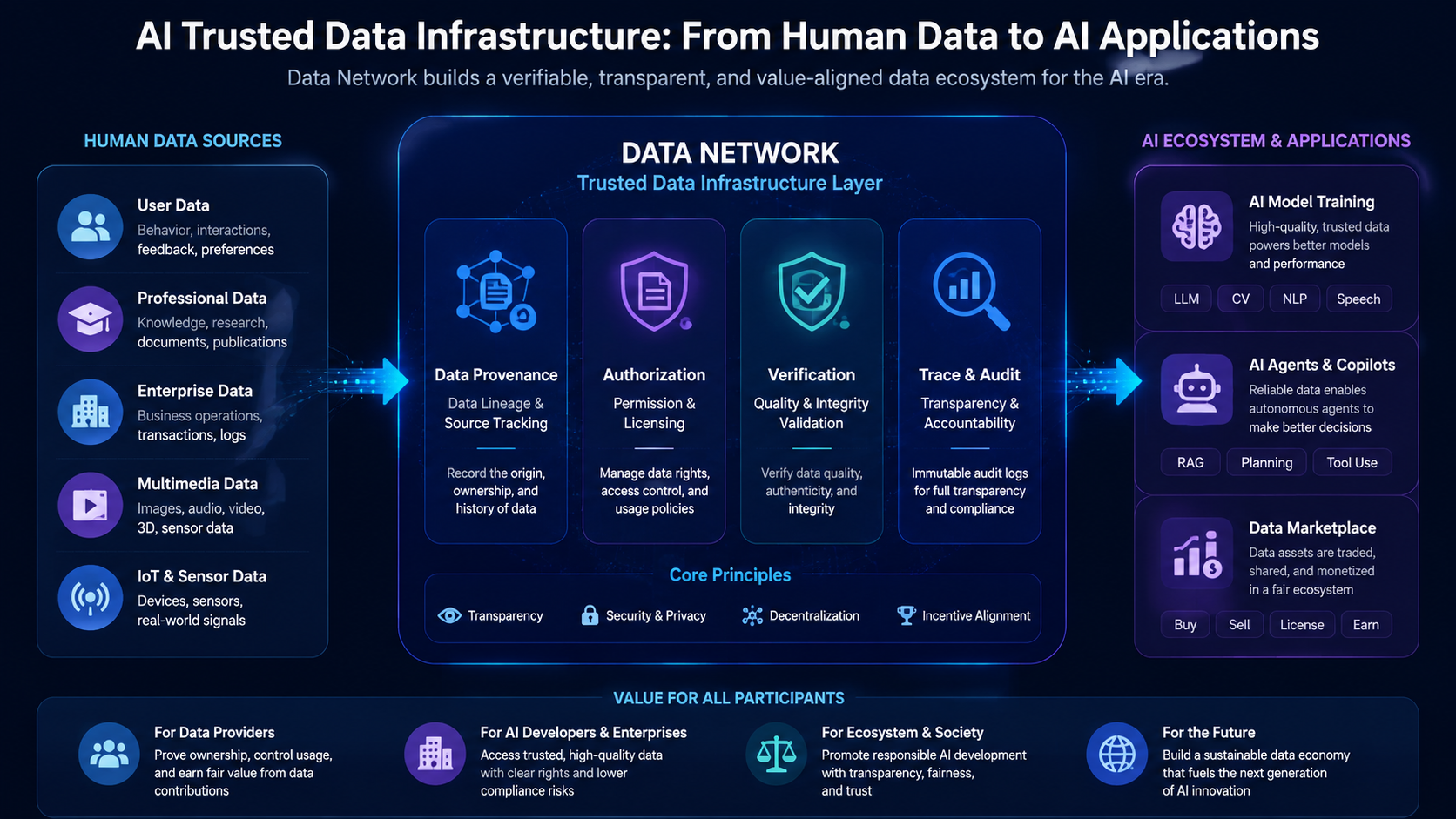
Data Network is a data infrastructure network designed for the AI era, with a core mission to enhance the efficiency of artificial intelligence systems in acquiring and utilizing data through trusted verification, traceability, and authorization mechanisms.
AI development hinges on three core elements: algorithms, computing power, and data resources. In recent years, market focus has centered on boosting GPU hashrate and expanding model parameters. However, as large language models (LLMs) reach maturity, data quality is becoming the primary factor influencing AI capabilities.
For AI models, data is not just training material—it defines the model’s knowledge scope, reasoning abilities, and output quality. Large volumes of foundational data help models understand language structure, while high-quality, specialized datasets empower models to operate in vertical domains such as healthcare, finance, law, and scientific research.
For instance, a general AI model can learn language patterns from extensive text, but to function as a professional medical assistant, it needs substantial volumes of validated medical data. If training data sources are unclear or contain errors, the model may make incorrect decisions, undermining its practical value.
Thus, the future of AI competition may shift from “having more data” to “having more trustworthy, high-quality data.”
In the traditional internet era, data was primarily managed by large platforms. Users generated data across search, social, and e-commerce scenarios, but platforms typically captured most of its commercial value. As the AI industry evolves, enabling data contributors to receive fair value and establishing transparent, trustworthy data flows have become new industry challenges.
Data Network’s approach is to build new data infrastructure for more transparent source tracking, clearer authorization relationships, and a more open value distribution mechanism.
Data Challenges Facing AI Model Training
AI model development is increasingly confronted by data-related challenges.
Data source verification is difficult. Many AI models rely on publicly available internet data for training, including web content, images, code, and other materials. These data sets often lack complete provenance, making it hard for developers to confirm authorization and compliance.
This issue is especially pronounced in generative AI. As AI’s content generation capabilities advance, copyright, ownership, and commercial authorization of training data have become critical concerns. Without transparent data management, companies risk compliance issues.
Data quality is hard to guarantee. AI models don’t simply depend on data quantity. Large volumes of low-quality, duplicate, or erroneous data can degrade model performance.
High-value data typically features:
- Clearly defined provenance;
- Accurate and reliable content;
- Professional domain relevance;
- Continuous updates.
For example, in financial AI, real-time market data, corporate financials, and professional analysis are more valuable than generic text. In medical AI, validated clinical data is far more important than publicly available web information.
Data contributors lack value feedback. In today’s internet data ecosystem, users generate content and information, but most value accrues to platforms and tech companies. As AI commercialization accelerates, enabling contributors to participate in value distribution may become a key direction for the future data economy.
Privacy protection is a major constraint. AI needs real-world data, but must also safeguard personal privacy and corporate secrets. Effectively utilizing data while preventing sensitive information leaks is a critical challenge for AI data infrastructure.
Why Data Provenance Matters More Than Ever
Data provenance is becoming a fundamental capability in AI infrastructure. It involves confirming where data originates, what processing it undergoes, who authorizes it, and how it is ultimately used. In traditional systems, data passes through multiple stages: user generation → platform collection → processing → enterprise usage → AI model training.
However, this lifecycle is often opaque. Once data enters a platform, contributors rarely know if their data is reused or how much value it generates.
For AI enterprises, lacking provenance brings several risks:
- Copyright risk: Data without clear authorization may lead to legal trouble.
- Model reliability risk: Unverified training data undermines trust in AI outputs.
- Transparency: Data source transparency is essential, especially in finance, healthcare, and government. Enterprises need not only AI capabilities but also proof that their data usage complies with regulations.
Trustworthy data infrastructure must establish comprehensive data records to make the entire lifecycle—from creation to usage—transparent.
How Data Network Tracks Data Traceability and Authorization
A core strategy of Data Network is establishing comprehensive data lifecycle management.
Traditional data transactions are typically one-off transfers; once the buyer obtains the data, subsequent usage is hard to trace. Data Network leverages technical mechanisms to keep data verifiable from generation to consumption.
A complete data lifecycle includes: generation, submission, verification, authorization management, invocation, and value feedback. By recording each stage, Data Network helps participants track data status.
For example, a user contributes a set of authorized data resources—the network records the source, creation time, and usage rights. When AI enterprises use this data for model training, its usage can be tracked.
This approach transforms data from static files into dynamic assets. Providers can prove their contributions, users can verify provenance, and ecosystem participants are incentivized according to established rules. Compared to traditional data markets, this model emphasizes data ownership and value flow over simple exchange.
How Trace Enables Data Audit and Transparent Management
Trace is a key component of Data Network’s infrastructure, designed for data audit, provenance tracking, and transparent management. As AI applications enter commercial deployment, enterprises increasingly need to know which data their models use and whether it meets compliance requirements. For example, a company building an AI customer service system must confirm: Is the training data from reliable sources? Is it authorized? Is the model influenced by specific data?
Trace addresses these questions by recording the data lifecycle.
For data sources, Trace helps document the generation path, enabling participants to verify authenticity.
For data usage, Trace records invocation processes, enhancing transparency in data circulation.
For ecosystem incentives, Trace confirms the value of contributions, supporting revenue distribution.
For enterprises, this audit capability reduces AI risk; for contributors, it strengthens their ability to prove data value.
As global AI regulations evolve, data audit may become a core element of future AI infrastructure.
The Future of AI Data Markets
With growing demand for AI models, data markets are evolving from simple transactions to sophisticated infrastructure. Future AI data markets may include multiple participant roles:
- Data providers supply resources;
- Validators confirm quality;
- AI enterprises acquire data for model training and development;
- Infrastructure networks record and coordinate data flows.
Compared to traditional markets, this model emphasizes the data lifecycle.
Segmented markets may emerge, including professional knowledge data, enterprise private data authorization, multimodal data, and AI Agent data services. As AI Agents advance, the need for trustworthy data will grow. Intelligent agents will require ongoing access to external information to complete tasks—financial agents need market data, research agents need specialized materials, enterprise agents need internal knowledge bases.
All these applications demand reliable data sources. Thus, AI data markets may shift from “selling data files” to “providing trustworthy data services.”
How Data Network Differs from Traditional Data Supply Chains
Traditional supply chains are managed by centralized platforms that collect, organize, and provide data services to enterprises. While efficient, this model suffers from limited transparency and concentrated value distribution. Data Network aims to build a more open data ecosystem.
Traditional models focus on collection, storage, and commercial utilization.
Data Network emphasizes provenance verification, authorization management, usage tracking, and value distribution.
The main difference lies in control. In traditional models, platforms retain strong management rights over data. Data Network seeks to empower contributors, enabling data to flow according to authorization rules.
Compared to decentralized storage projects, Data Network has a distinct focus.
Decentralized storage solves “where is data stored?”
Data Network addresses “Is the data trustworthy? How is it authorized? How does it generate value?”
Future AI infrastructure may comprise multiple layers: computing networks for hashrate, storage networks for data preservation, data networks for trusted data, and model platforms for AI capabilities. Data Network focuses on connecting data value.
Trends in AI Data Infrastructure
As AI technology advances, trustworthy data infrastructure will become increasingly important.
Several trends are emerging:
- Competition for data quality intensifies. As large model numbers grow, performance gaps will depend more on data quality than parameter size.
- Data assetization accelerates. Data generated by individuals and enterprises will increasingly become valuable digital assets.
- Authorization systems mature. Regulatory changes will require AI enterprises to provide transparent data provenance and usage records.
- AI and Web3 infrastructure converge. Blockchain enables transparent records, cryptography safeguards privacy, and token mechanisms drive incentives—together fostering new data economy models.
Data Network’s mission is to build a trusted data connection layer within these trends.
Conclusion
Data competition in the AI era is evolving. High-quality, trustworthy data is becoming the core resource driving artificial intelligence development.
Data Network is pioneering new AI data infrastructure through traceability, authorization management, and transparent verification, enabling safer and more efficient participation in the AI ecosystem.
Technical components like Trace record the data lifecycle, enhance audit capabilities, and increase transparency in data provenance and usage.
However, trustworthy data infrastructure still faces challenges in ecosystem building, technical competition, regulatory changes, and commercial adoption. Whether Data Network can deliver lasting value depends on its network scale, enterprise adoption, and AI market growth.
As AI shifts from model competition to data competition, trusted data networks may become a critical element of next-generation AI infrastructure.







