Zcash vs Monero: A Comparative Analysis of the Technical Pathways of Two Privacy Coins

Last Updated 2026-05-14 10:51:14
Reading Time: 2m
Zcash and Monero are both cryptocurrencies focused on on-chain privacy, but they follow fundamentally different technical paths. Zcash uses zk-SNARKs zero-knowledge proofs to enable transactions that are "verifiable but invisible," whereas Monero leverages ring signatures and obfuscation mechanisms to deliver a transaction model that is "anonymous by default." These differences result in unique attributes for each, affecting their methods of privacy implementation, traceability, performance architecture, and regulatory compliance adaptability.

The foundational principle of blockchain systems is openness and transparency, but this also means that all trading data is inherently traceable. In situations involving financial privacy, business information protection, or identity security, such transparency can introduce potential risks. As a result, privacy coins have become a significant branch in the blockchain ecosystem, aiming to conceal trading information through cryptographic techniques.

Among privacy coins, Zcash and Monero are two of the most prominent projects, each adopting distinct technical approaches to privacy: Zcash relies on zero-knowledge proofs, while Monero employs obfuscation and anonymity mechanisms.

Overview of Zcash and Monero

Zcash is a privacy coin built on zero-knowledge proof technology, utilizing zk-SNARKs to conceal trading data, and allows users to choose between transparent and private transactions. This design prioritizes a balance between privacy protection and verifiability.

Monero leverages ring signatures, stealth addresses, and confidential transactions to ensure all transactions are private by default. Its core objective is to deliver consistent privacy protection, making all user transactions indistinguishable.

These two projects represent the primary directions in privacy coin development: one is grounded in rigorous mathematical proofs, while the other is based on anonymity sets and obfuscation.

monero-vs-zcash

Zcash vs Monero: Key Differences

With fundamentally different design philosophies—Zcash based on zero-knowledge proofs and Monero on anonymity and obfuscation—these projects demonstrate distinct characteristics in terms of flexibility, privacy strength, and system trade-offs.

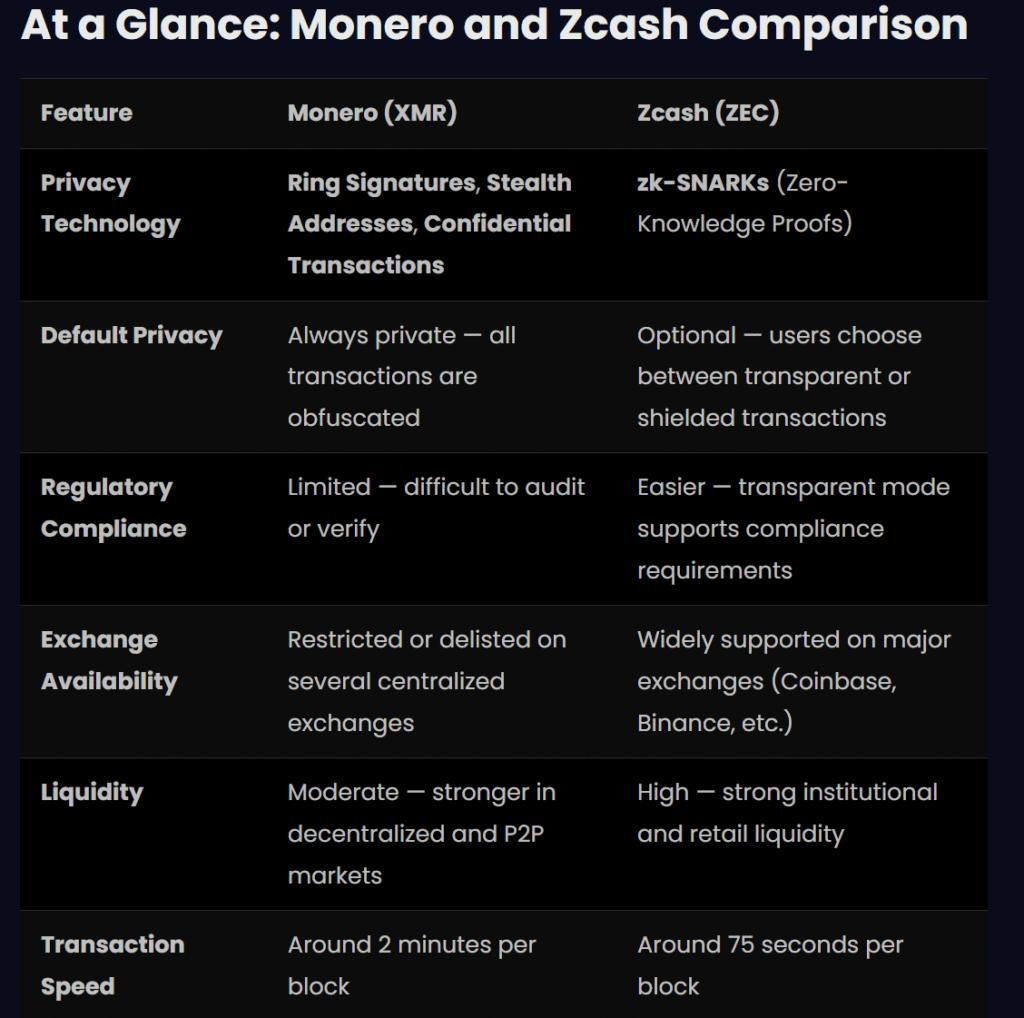
Dimension Zcash Monero
Privacy Technology zk-SNARKs Ring Signatures + Stealth Addresses + RingCT
Privacy Mode Optional Privacy Mandatory Privacy
Transaction Transparency Supports Transparent Transactions Fully Anonymous
Traceability Transparent Transactions Are Traceable Highly Obfuscated
Trusted Setup Required (Improved) Not Required
Auditability Supports View Key Difficult to Achieve
Performance Characteristics High Proof Generation Cost Larger Transaction Size

Technical Pathways: zk-SNARKs vs Ring Signatures

Zcash’s privacy model is built on zk-SNARKs, a zero-knowledge proof protocol that enables validation of transaction legitimacy without revealing any trading data. This delivers “precise” privacy—transaction information is entirely hidden yet remains verifiable.

Monero, on the other hand, uses ring signatures to mix real transactions with multiple potential participants, obscuring the sender’s identity. Combined with stealth addresses and confidential transactions, it also hides the recipient and transaction amount. This approach delivers “obfuscated privacy,” relying on the size of the anonymity set to enhance privacy.

In essence, Zcash focuses on privacy through cryptographic proofs, while Monero achieves anonymity through data obfuscation.

Privacy Models: Optional vs Mandatory Privacy

Zcash features an optional privacy model, allowing users to choose between transparent and private addresses for transactions. This flexibility enables adaptation to various scenarios, such as public audits or privacy protection.

Monero implements a mandatory privacy model, with all transactions hidden by default and no option for public transactions. This ensures uniform privacy for all users, eliminating information leakage due to transaction type differences.

The distinction between optional and mandatory privacy reflects different priorities—flexibility versus consistency.

Transaction Structure and Traceability

Zcash supports both transparent and private transactions. Transparent transactions function like those on traditional blockchains and are fully traceable, while private transactions conceal all data.

All Monero transactions are obfuscated, making it extremely difficult for external observers to trace transaction paths. This design enhances overall anonymity but also means transactions cannot be directly audited.

In summary, Zcash offers “selective privacy,” while Monero provides “unified anonymity.”

Performance and Efficiency

Zcash’s private transactions require generating zk-SNARKs proofs, a process that is computationally intensive and resource-demanding. However, the verification process is efficient, supporting rapid transaction confirmation on the network.

Monero transactions do not require complex proof generation, but their transaction size is larger. As the anonymity set grows, so does the data size, which can impact block size and synchronization costs.

Performance differences between the two are a trade-off between computational complexity and data volume.

Trusted Setup and Security Models

Zcash’s zk-SNARKs initially required a Trusted Setup—a generation of initial parameters. If compromised, this could undermine system security. Zcash has mitigated this risk through multi-party computation and other improvements.

Monero does not require a trusted setup; its security is rooted in cryptographic algorithms and the structure of the anonymity set. This avoids initial trust issues, but privacy strength depends on the size of the anonymity set.

These two approaches reflect fundamentally different trust models.

Compliance and Regulatory Perspectives

Zcash provides a “view key” feature, enabling users to disclose transaction details to third parties when necessary, supporting audit and compliance requirements.

Monero’s default anonymous design makes similar auditing functions difficult, which can pose regulatory challenges in some jurisdictions.

Thus, Zcash is designed for controllable privacy, whereas Monero prioritizes absolute anonymity.

Application Scenarios

Zcash’s optional privacy makes it suitable for a variety of scenarios, including private payments and compliance use cases requiring transparency.

Monero is better suited for scenarios demanding consistently high anonymity, ensuring all transactions remain private.

These differing use cases highlight the practical distinctions between the two technical paths.

Conclusion

Zcash and Monero each represent a core technical route for privacy coins: Zcash delivers “precise privacy” through zero-knowledge proofs, while Monero achieves “default anonymity” via anonymity sets and obfuscation.

This distinction influences not just technical implementation, but also transaction structure, performance, and real-world applications. Understanding both approaches is essential for a comprehensive view of blockchain privacy technologies.

FAQs

Which is more anonymous: Zcash or Monero?

Zcash and Monero use different privacy mechanisms—Zcash provides fully hidden private transactions, while Monero delivers default, obfuscated anonymity for all transactions.

What’s the difference between zk-SNARKs and ring signatures?

zk-SNARKs use mathematical proofs to validate transactions, while ring signatures achieve anonymity by mixing multiple participants.

Why doesn’t Monero support transparent transactions?

Monero is designed to provide uniform privacy for all users, preventing information leakage from differing transaction types.

Is Zcash’s Trusted Setup secure?

Risk is reduced through multi-party computation and similar methods, but it remains an inherent part of the system’s design.

Which privacy model is better for compliance?

Optional privacy is generally more suitable for compliance, as information can be disclosed when necessary.

Are privacy coins completely untraceable?

Different technical approaches offer varying degrees of privacy, but none are absolutely immune to analysis.

Author: Jayne
Translator: Jared
Reviewer(s): Ida
Disclaimer
* The information is not intended to be and does not constitute financial advice or any other recommendation of any sort offered or endorsed by Gate.
* This article may not be reproduced, transmitted or copied without referencing Gate. Contravention is an infringement of Copyright Act and may be subject to legal action.

Related Articles

The Future of Cross-Chain Bridges: Full-Chain Interoperability Becomes Inevitable, Liquidity Bridges Will Decline
Beginner

The Future of Cross-Chain Bridges: Full-Chain Interoperability Becomes Inevitable, Liquidity Bridges Will Decline

This article explores the development trends, applications, and prospects of cross-chain bridges.
2026-04-08 17:11:27
Solana Need L2s And Appchains?
Advanced

Solana Need L2s And Appchains?

Solana faces both opportunities and challenges in its development. Recently, severe network congestion has led to a high transaction failure rate and increased fees. Consequently, some have suggested using Layer 2 and appchain technologies to address this issue. This article explores the feasibility of this strategy.
2026-04-06 23:31:03
Sui: How are users leveraging its speed, security, & scalability?
Intermediate

Sui: How are users leveraging its speed, security, & scalability?

Sui is a PoS L1 blockchain with a novel architecture whose object-centric model enables parallelization of transactions through verifier level scaling. In this research paper the unique features of the Sui blockchain will be introduced, the economic prospects of SUI tokens will be presented, and it will be explained how investors can learn about which dApps are driving the use of the chain through the Sui application campaign.
2026-04-07 01:11:45
Navigating the Zero Knowledge Landscape
Advanced

Navigating the Zero Knowledge Landscape

This article introduces the technical principles, framework, and applications of Zero-Knowledge (ZK) technology, covering aspects from privacy, identity (ID), decentralized exchanges (DEX), to oracles.
2026-04-08 15:08:18
What is Tronscan and How Can You Use it in 2025?
Beginner

What is Tronscan and How Can You Use it in 2025?

Tronscan is a blockchain explorer that goes beyond the basics, offering wallet management, token tracking, smart contract insights, and governance participation. By 2025, it has evolved with enhanced security features, expanded analytics, cross-chain integration, and improved mobile experience. The platform now includes advanced biometric authentication, real-time transaction monitoring, and a comprehensive DeFi dashboard. Developers benefit from AI-powered smart contract analysis and improved testing environments, while users enjoy a unified multi-chain portfolio view and gesture-based navigation on mobile devices.
2026-03-24 11:52:42
What Is Ethereum 2.0? Understanding The Merge
Intermediate

What Is Ethereum 2.0? Understanding The Merge

A change in one of the top cryptocurrencies that might impact the whole ecosystem
2026-04-09 09:17:06