What is PLANCK: Unveiling the Cosmic Microwave Background Explorer Satellite

2025-11-23 06:43:35
AI
Blockchain
Crypto Ecosystem
Macro Trends
Web 3.0
Article Rating : 3.7
half-star
0 ratings
The article "What is PLANCK: Unveiling the Cosmic Microwave Background Explorer Satellite" explores the significance of Planck (PLANCK) in AI computing infrastructure, focusing on its decentralized architecture and intersection with blockchain technology. It discusses Planck's impact on AI applications, cloud computing, and market performance, highlighting its strategic collaborations across regions. The article addresses key challenges like technical hurdles and regulatory risks, and offers insights into Planck's community dynamics and future roadmap. Key topics include AI infrastructure security and the role of Planck in advancing decentralized technology. The article serves startups, enterprises, scientists, and tech enthusiasts.
What is PLANCK: Unveiling the Cosmic Microwave Background Explorer Satellite

Planck's Positioning and Significance

In 2025, Planck (PLANCK) was introduced to address the challenges in AI computing infrastructure. As a pioneering AI computing stack provider, Planck plays a crucial role in AI infrastructure, cloud computing, foundational models, and AI-powered applications.

As of 2025, Planck has become a notable player in the AI and blockchain intersection, offering solutions for consumers, startups, enterprises, and scientists across the US, Asia, and globally. This article will delve into its technological architecture, market performance, and future potential.

Origin and Development History

Birth Background

Planck was created in 2025 to tackle the growing demands in AI computing. It emerged during the AI technology boom, aiming to deliver a state-of-the-art AI computing stack that encompasses various aspects of AI development and application.

Planck's launch brought new possibilities for AI researchers, developers, and businesses across different industry domains.

Important Milestones

  • 2025: Launch of the Planck network, introducing advanced AI computing infrastructure.
  • 2025: Development of two major platforms enabling AI research and development across industry domains.

Supported by its development team and community, Planck continues to optimize its technology, security, and real-world applications in the AI sector.

How Does Planck Work?

Decentralized Control

Planck operates on a decentralized network of computers (nodes) worldwide, free from centralized control. These nodes collaborate to validate transactions, ensuring system transparency and attack resistance, granting users greater autonomy and enhancing network resilience.

Blockchain Core

Planck's blockchain is a public, immutable digital ledger that records every transaction. Transactions are grouped into blocks and linked through cryptographic hashes, forming a secure chain. Anyone can view the records, establishing trust without intermediaries.

Ensuring Fairness

Planck uses a consensus mechanism to validate transactions and prevent fraudulent activities like double-spending. Participants maintain network security through activities such as staking or running nodes and receive PLANCK tokens as rewards.

Secure Transactions

Planck utilizes public-private key encryption to protect transactions:

  • Private keys (like secret passwords) are used to sign transactions
  • Public keys (like account numbers) are used to verify ownership

This mechanism ensures fund security while maintaining transaction privacy.

PLANCK's Market Performance

Circulation Overview

As of November 23, 2025, PLANCK's circulating supply is 76,550,000 tokens, with a total supply of 500,000,000. The maximum supply is capped at 500,000,000, indicating a fixed supply model.

Price Fluctuations

PLANCK reached its all-time high of $0.2348 on November 14, 2025. Its lowest price was $0.04145, occurring on November 22, 2025. These fluctuations reflect market sentiment, adoption trends, and external factors.

Click to view the current market price of PLANCK
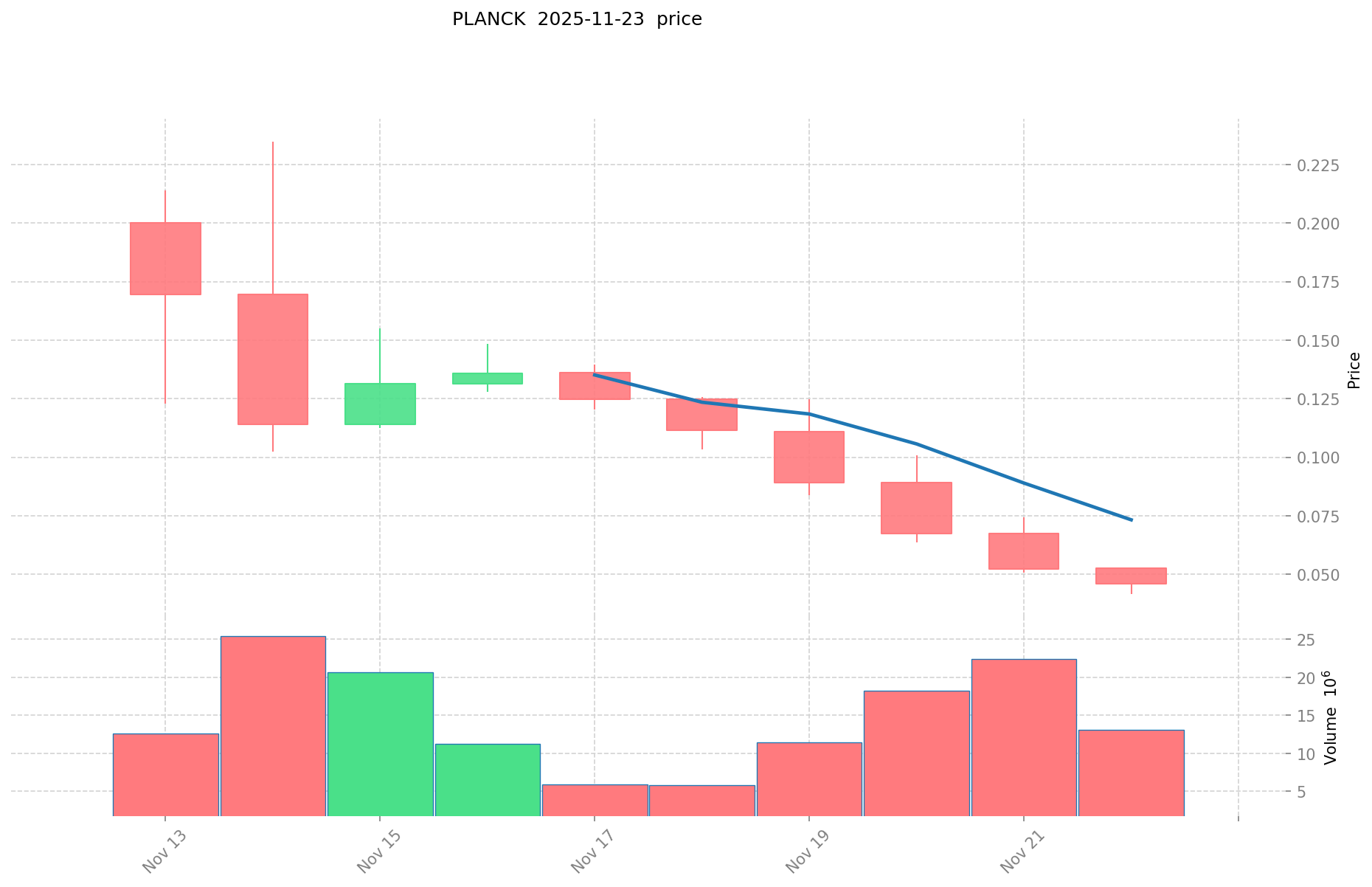
price-image

On-Chain Metrics

  • Number of Holders: 8,929 (indicating community engagement)

PLANCK Ecosystem Applications and Partnerships

Core Use Cases

PLANCK's ecosystem supports multiple applications:

  • AI Infrastructure: Providing state-of-the-art AI computing solutions.
  • AI Cloud: Offering cloud-based AI services for various industries.

Strategic Collaborations

PLANCK has established partnerships across the US, Asia, and globally to enhance its technological capabilities and market influence. These partnerships provide a solid foundation for PLANCK's ecosystem expansion.

Controversies and Challenges

PLANCK faces the following challenges:

  • Technical Hurdles: Developing and maintaining cutting-edge AI infrastructure.
  • Regulatory Risks: Potential AI regulations in different jurisdictions.
  • Competitive Pressure: Rapid advancements in the AI field by tech giants.

These issues have sparked discussions within the community and market, driving PLANCK's continuous innovation.

PLANCK Community and Social Media Atmosphere

Fan Enthusiasm

PLANCK's community is vibrant, with active participation in AI research and development across industry domains. On X platform, related posts and hashtags (such as #PLANCK) frequently trend, reflecting the growing interest in AI computing solutions.

Social Media Sentiment

Sentiment on X shows a mix of excitement and caution:

  • Supporters praise PLANCK's advanced AI computing stack and its potential to revolutionize various industries.
  • Critics express concerns about the rapid development of AI and its societal implications.

Recent trends indicate a growing recognition of AI's importance in future technological advancements.

Hot Topics

X users actively discuss PLANCK's role in AI democratization, ethical AI development, and the potential impact on job markets. These discussions highlight both the transformative potential of AI and the challenges in its mainstream adoption.

More Information Sources for PLANCK

  • Official Website: Visit PLANCK's official website for features, use cases, and latest updates.
  • White Paper: PLANCK's white paper details its technical architecture, goals, and vision.
  • X Updates: On X platform, PLANCK uses @plancknetwork, covering topics such as technological advancements, community events, and partnership news.

PLANCK's Future Roadmap

  • AI Compute Infrastructure: Continuous improvement and expansion of AI computing capabilities.
  • Ecosystem Goals: Supporting AI research and development across various industry sectors.
  • Long-term Vision: Becoming a leading provider of AI computing solutions globally.

How to Participate in PLANCK?

  1. Purchase Channels: Buy PLANCK on Gate.com
  2. Storage Solutions: Use secure wallets recommended by PLANCK for token storage
  3. Participate in Governance: Join community discussions and decision-making processes
  4. Build on the Ecosystem: Access developer resources to contribute to PLANCK's AI ecosystem

Summary

PLANCK is redefining AI computing through its comprehensive AI stack, offering transparency, security, and efficient AI solutions. Its active community, rich resources, and strong market performance make it stand out in the AI and blockchain sectors. Despite facing challenges such as regulatory uncertainties and technological hurdles, PLANCK's innovative spirit and clear roadmap position it as a significant player in the future of decentralized AI technology. Whether you're a newcomer or an experienced player, PLANCK is worth watching and participating in.

FAQ

What is the meaning of Planck?

Planck refers to the smallest unit of cryptocurrency, named after physicist Max Planck. It's used to measure tiny fractions of digital assets, similar to satoshis for Bitcoin.

Is Planck length the smallest?

Yes, Planck length is theoretically the smallest measurable length in physics, approximately 1.6 x 10^-35 meters.

What is 1 Planck time?

1 Planck time is the smallest measurable unit of time, approximately 5.39 × 10^-44 seconds. It's the time light takes to travel one Planck length in a vacuum.

What is Planck's constant in simple terms?

Planck's constant is a fundamental physical constant that relates the energy of a photon to its frequency. It's crucial in quantum mechanics, describing the smallest possible unit of energy.

* The information is not intended to be and does not constitute financial advice or any other recommendation of any sort offered or endorsed by Gate.
Related Articles
When will the Quantum Financial System Start?

When will the Quantum Financial System Start?

The article discusses the Quantum Financial System (QFS) as a transformative leap in finance combining quantum computing, AI, and blockchain, enhancing security, transaction speed, and decentralization. From 2025 onward, QFS begins reshaping global finance with quantum-resistant cryptography and blockchain integration, solving security and scalability issues for cryptocurrencies. The phased timeline from 2025 to 2045 outlines developments such as deploying quantum-resistant cryptography and integrating quantum computing in financial applications. Targeted at financial institutions, tech companies, and crypto markets, this article provides insights into how QFS transforms global finance and cryptocurrencies.
2025-09-07 14:35:37
When Will the Quantum Financial System Launch?

When Will the Quantum Financial System Launch?

This article explores the Quantum Financial System (QFS), a transformative technology merging quantum computing, AI, and blockchain, set to redefine banking with unparalleled security and efficiency. It delves into the QFS's launch timeline, showcasing a gradual adoption expected over the next two decades, emphasizing its impact on cryptocurrencies and Web3 ecosystems through enhanced transaction processing and capability. Banks and investors are advised to prepare by adopting quantum-resistant strategies and diversifying portfolios. Success in this quantum era demands embracing agility and innovation across the financial sector.
2025-08-20 07:01:34
How Does China's NPC Enhance Cybersecurity and Emergency Response Laws in 2025?

How Does China's NPC Enhance Cybersecurity and Emergency Response Laws in 2025?

The article delves into China's National People's Congress (NPC) enhancements to cybersecurity and emergency response laws set for 2025. It highlights significant amendments to the Cybersecurity Law, focusing on AI security, critical infrastructure, and alignment with the Personal Information Protection Law (PIPL). Additionally, it discusses updates to the Emergency Response Law to bolster disaster management, emphasizing increased penalties and improved prevention measures. The piece also examines the broader context of over 40 national security-related laws enacted in the past decade under Xi Jinping's "Comprehensive National Security Concept." This content is crucial for policymakers, technology businesses, and stakeholders interested in China's evolving legal landscape and its implications on digital and emergency management sectors. Keywords include cybersecurity, emergency response, AI security, PIPL, and national security.
2025-11-01 08:45:17
How Do CROs Gain a Competitive Edge in the Growing Global Market by 2032?

How Do CROs Gain a Competitive Edge in the Growing Global Market by 2032?

The article explores how Contract Research Organizations (CROs) can gain a competitive edge in the rapidly growing global market, anticipated to reach $36.96 billion by 2032 at a CAGR of 8.48%. It examines the role North America plays with dominant market shares and highlights emerging trends like specialized CROs disrupting traditional providers. Key areas of focus include data-driven strategies enhancing efficiency and patient outcomes, and how niche specialization is creating new value pools. This content targets industry stakeholders seeking insight into optimizing clinical research and maintaining competitive advantages.
2025-10-28 12:50:00
How Has DOGE's Security Been Compromised by Unauthorized Data Access?

How Has DOGE's Security Been Compromised by Unauthorized Data Access?

The article examines the security compromising effects of unauthorized data access by DOGE on critical US systems. It outlines the scope of compromised data across various federal agencies, highlighting serious national security risks. It addresses legal and audit tool-related concerns, warning of vulnerabilities that foreign adversaries may exploit. Furthermore, it critiques DOGE's short-term focus and lack of oversight in government reform, emphasizing the long-term adverse effects on efficiency and security. This piece is crucial for stakeholders in cybersecurity, government operations, and policy-making, offering insights into systemic faults and potential legal ramifications.
2025-11-04 08:52:50
What is AGI: Understanding the Whitepaper Logic, Use Cases, and Roadmap Progress in 2026

What is AGI: Understanding the Whitepaper Logic, Use Cases, and Roadmap Progress in 2026

# Article Introduction **What is AGI: Understanding the Whitepaper Logic, Use Cases, and Roadmap Progress in 2026** This comprehensive guide explores Artificial General Intelligence through a pragmatic generalist-specialist fusion framework that bridges narrow AI specialization with broad reasoning capabilities. The whitepaper demonstrates how SGI (Specialized Generalist Intelligence) achieves 90% expert-level performance while maintaining cross-domain knowledge transfer—essential for AGI development. Discover AGI's transformative applications across autonomous driving, scientific discovery, and professional knowledge integration, supported by an innovative three-layer architecture combining foundation models, human-AI fusion collaboration, and embodied exploration. This resource serves researchers, technologists, enterprise leaders, and AI enthusiasts seeking clarity on AGI's technical progression, competitive positioning against major tech giants, and critical 2026 milestones that define the pathway towar
2026-01-04 08:25:13
Recommended for You
Global Cryptocurrency Regulations: Compliance Guide for Web3 Investors

Global Cryptocurrency Regulations: Compliance Guide for Web3 Investors

This comprehensive compliance guide navigates the rapidly evolving global cryptocurrency regulatory landscape essential for Web3 investors, blockchain developers, and compliance professionals. The article examines how regulatory frameworks differ across major jurisdictions—Europe's unified MiCA Regulation, Asia-Pacific's streamlined licensing requirements, and the US fragmented federal-state approach—while addressing critical compliance elements including tax obligations, AML/KYC standards, and licensing requirements. The guide demonstrates how regulatory clarity attracts institutional capital and creates competitive advantages for compliant platforms on Gate and other regulated exchanges. It explores blockchain adoption barriers within DeFi ecosystems and identifies substantial market opportunities for organizations embracing regulatory requirements. By understanding jurisdiction-specific regulatory frameworks and operational standards, Web3 participants can achieve sustainable market participation while avo
2026-01-08 02:44:38
Token Custody Security: Comprehensive Risk Analysis and Best Practices
Token Custody Security: Comprehensive Risk Analysis and Best Practices

This comprehensive guide addresses critical cryptocurrency custody risk management strategies essential for protecting digital assets. It outlines three primary risk categories affecting token custody: operational risks from superuser privileges including blacklisting and fund confiscation; implementation risks involving smart contract vulnerabilities such as arithmetic errors and non-standard logic; and design risks including self-destruct functionality and missing decimal implementation. The article provides actionable security guidelines for token users covering due diligence, continuous monitoring, and accounting awareness. Major mitigation strategies include implementing decentralized governance, requiring external security audits, and developing specialized backend integrations for unique token mechanisms. With practical examples and FAQ sections, this resource empowers both individual traders and institutional custodians on Gate and other platforms to make informed custody decisions through rigorous ri
2026-01-08 02:43:31
How Federal Reserve Interest Rate Cuts Impact Crypto Markets in 2026
How Federal Reserve Interest Rate Cuts Impact Crypto Markets in 2026

This article examines how Federal Reserve interest rate cuts drive cryptocurrency market movements in 2026, revealing mechanisms that extend beyond traditional monetary policy. The core relationship involves opportunity cost: declining Fed rates reduce bond yields, making digital assets more attractive alternatives for yield-seeking investors. However, 2026 presents complexity where fiscal policy complications offset monetary stimulus—Treasury borrowing can push long-term yields higher despite rate cuts, limiting crypto gains. The article demonstrates why recent rate cuts produced muted responses, analyzing the asymmetrical relationship where rate hikes clearly harm crypto but rate cuts don't automatically generate rallies without accompanying economic stability. Strategic recommendations for retail investors trading on Gate emphasize monitoring real yields, maintaining disciplined position sizing during policy uncertainty, and synthesizing Fed policy with fiscal developments and market sentiment rather than
2026-01-08 02:40:26
How US Inflation Impacts Bitcoin: Understanding the Connection Between Macroeconomics and Crypto
How US Inflation Impacts Bitcoin: Understanding the Connection Between Macroeconomics and Crypto

This article explores how US inflation dynamics fundamentally shape Bitcoin valuations and investment demand through multiple macroeconomic transmission channels. It examines Bitcoin's deflationary design with its 21 million coin cap as a counterpoint to government money printing, analyzing how credibility erosion in fiat systems drives cryptocurrency adoption. The piece presents empirical evidence showing that inflation expectations correlate strongly with Bitcoin purchases, establishing cryptocurrency as a demonstrable inflation hedge. The analysis decodes the Fed policy-Bitcoin relationship, explaining how monetary easing creates bullish pressure while rate tightening generates temporary headwinds. Finally, it provides practical portfolio strategies for 2026, recommending 1-5% Bitcoin allocations through Gate's institutional infrastructure as macro uncertainty persists. Designed for investors seeking understanding of crypto-macroeconomics linkages and portfolio protection mechanisms.
2026-01-08 02:37:37
Paxos Highlights Tokenized USD as Key to Digital Asset Adoption
Paxos Highlights Tokenized USD as Key to Digital Asset Adoption

This article explores how Paxos tokenized stablecoins are reshaping digital asset adoption in Web3. Led by insights from Paxos's product leadership, the piece examines the strategic importance of tokenized U.S. dollars as critical infrastructure bridging traditional finance and blockchain ecosystems. It showcases Paxos's innovation track record, including USDP and PAXG, while analyzing accelerating institutional adoption of tokenized financial instruments like money market funds and securities. The article emphasizes pragmatic tokenization principles—prioritizing genuine value creation through improved settlement speed, enhanced liquidity, and cost reduction rather than pursuing tokenization for its own sake. Readers will discover how tokenized assets enable 24/7 trading, instant settlement, and institutional-grade security, along with practical applications across DeFi, cross-border payments, and financial infrastructure modernization.
2026-01-08 02:36:43
What Is the BRC App (BRCT)?

What Is the BRC App (BRCT)?

Discover BRC App (BRCT), the all-in-one blockchain ecosystem on Bitcoin. See how .btc domains function, access Launchpad capabilities, trade BRC-20 tokens, and earn BRCT staking rewards on a reputable platform.
2026-01-08 02:35:20
