ADA Price Prediction: Short-Term Technical Outlook and Year-End Market Forecast
Current Market Overview
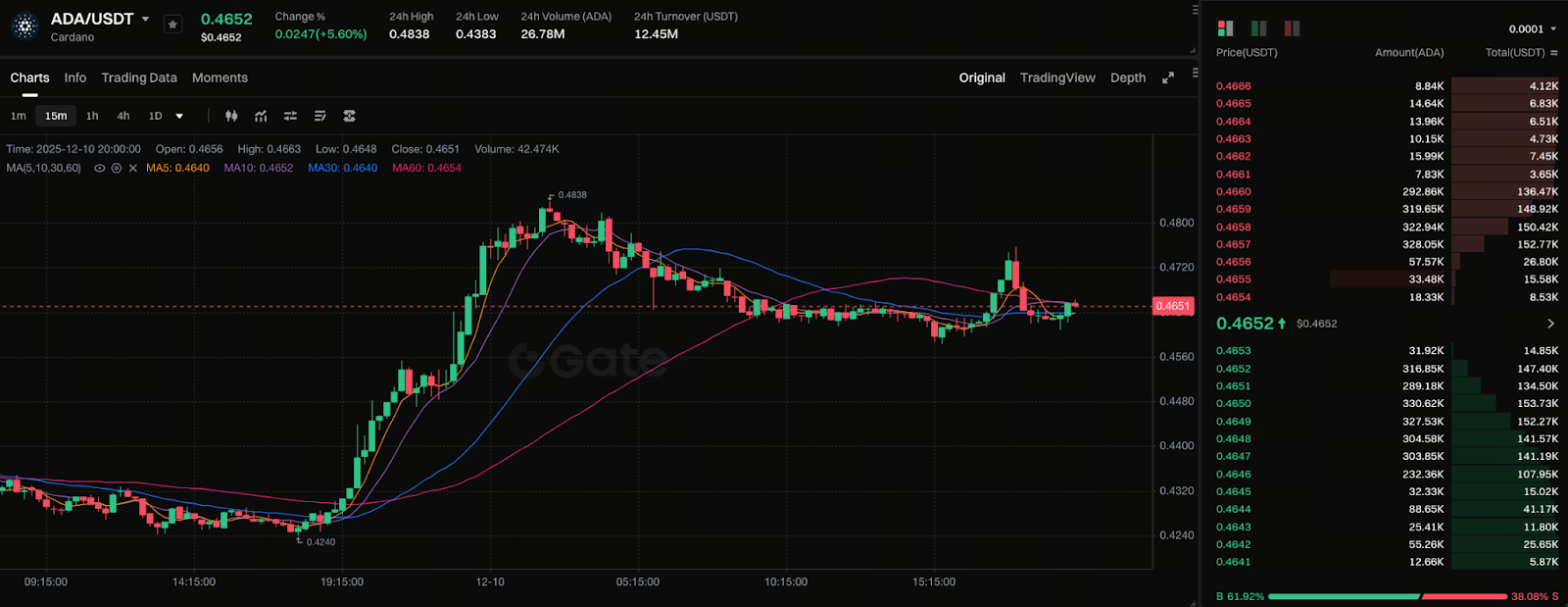
Chart: https://www.gate.com/trade/ADA_USDT
ADA has recently been consolidating in the $0.40–$0.48 range. The overall momentum is subdued, but buyers are actively accumulating at key support levels, resulting in a classic range-bound scenario with buying interest below and selling pressure above. On the daily chart, the price has repeatedly tested the bottom without making new lows, which suggests that the support level is widely recognized by market participants. Meanwhile, the moving averages are starting to converge, potentially setting the stage for the next directional move.
From a liquidity perspective, short-term trading volume surges as ADA nears support, reflecting a consensus in market sentiment. Conversely, as the price approaches strong resistance, volume tapers off, indicating that buyers currently lack the momentum to break through. Although a short-term trend reversal has yet to materialize, an improvement in broader market sentiment could trigger a technical rebound for ADA.
Key Support and Resistance Analysis
Short-term support is holding in the $0.37–$0.41 range, which aligns with several previous cycle lows and is favored by institutional buyers for accumulation. A break below this level would expose ADA to the risk of testing earlier lows, making this the most critical area for short-term monitoring.
Short-term resistance is concentrated in the $0.45–$0.47 range, consistently acting as a ceiling during rebounds and representing a dense trading zone. If ADA can break out with increased volume and hold above this threshold, the daily chart may form a W-bottom or double-bottom breakout pattern, paving the way for further upside.
If the breakout is sustained, the next target zone is $0.60–$0.67, derived from pattern measurement and the consolidation range height. It’s important to note that these targets are not guaranteed, but they help traders plan profit-taking levels and adjust their positions accordingly.
Key Year-End Catalysts
1. Shifts in Market Risk Appetite
Year-end typically brings fund settlements, institutional portfolio rebalancing, and changes in macroeconomic expectations. If Bitcoin and other major assets strengthen, risk appetite often quickly spreads to altcoins, with ADA frequently among the beneficiaries.
2. Cardano Ecosystem Updates and Technical Developments
The Cardano ecosystem is advancing decentralized governance and attracting more developers.
- Additional DApp launches,
- or significant growth in TVL,
will enhance ADA’s long-term value assessment and drive short-term price action.
3. Impact from Global Macroeconomic Events
Interest rate policies, regulatory changes, and movements in the US Dollar Index all shape market narratives and drive sentiment. As a major asset, ADA is highly sensitive to shifts in the broader environment.
Short-Term Trading Strategies and Risk Management
1. Staggered Position Building
Actively accumulating positions in batches within the $0.37–$0.41 range is a common low-entry strategy in the current market. Increase allocations as prices approach the lower end of the range, and decrease exposure near the upper end to manage overall risk.
2. Stop-Loss Placement
Set stop-losses 3%–8% below the support level, tailored to your risk tolerance. This helps avoid being forced out by short-term false breakdowns while keeping risk in check.
3. Staggered Profit-Taking
The $0.45–$0.47 resistance zone is a pressure area suitable for initial profit-taking. If a breakout occurs, set staggered exit points at $0.55, $0.60, and similar levels to optimize capital efficiency.
4. Avoid Full Allocation on Rallies
ADA is highly volatile; chasing rallies often leads to substantial pullbacks. Regardless of how strong the market appears, always maintain liquidity.
Summary and Trading Recommendations
In the short term, ADA remains in a consolidation range, but the support structure is firm. A rebound could develop at any time, especially if major cryptocurrencies rally. Traders should closely monitor:
- Whether the $0.37–$0.41 support holds
- Whether the $0.45–$0.47 resistance is decisively broken
A successful breakout could pave the way for a year-end rally, while a breakdown of support calls for prompt position reduction. Overall, prudent investors may opt for staggered accumulation at lower levels and tiered profit-taking at higher levels to adapt to current market volatility.
Share
Content


Related Articles

2025 BTC Price Prediction: BTC Trend Forecast Based on Technical and Macroeconomic Data

Flare Crypto Explained: What Is Flare Network and Why It Matters in 2025

Pi Coin Transaction Guide: How to Transfer to Gate.com

How to Use a Crypto Whale Tracker: Top Tool Recommendation for 2025 to Follow Whale Moves

What is N2: An AI-Driven Layer 2 Solution