Crypto Market Roars Back: ETF Inflows Hit $1.1 Billion, a Seven-Week High
The past week saw the cryptocurrency market stage a strong comeback. According to the latest reports, cryptocurrency ETFs attracted approximately $1.1 billion in net inflows, the highest level in nearly seven weeks. This development stands out, as the market had previously experienced about $4.7 billion in outflows over four straight weeks. The renewed inflows signal more than just a numerical reversal—they mark a critical shift in market sentiment from cautious and bearish to increasingly optimistic.
ETF Inflows Rebound: What’s Driving Capital Back?
Globally, US crypto ETFs saw net inflows of roughly $994 million this week. Canada reported about $98 million in net inflows, Switzerland $24 million, while Germany posted net outflows of approximately $57 million. From a structural standpoint, BTC remains the primary focus for institutional investors, with net inflows of $461 million. ETH followed with about $308 million in net inflows.
Short Bitcoin ETPs (exchange-traded products) recorded substantial net outflows of approximately $1.9 billion this week. This suggests that capital previously betting on declines is now exiting, and the overall market direction has shifted decisively from bearish to bullish. For institutions, such a reversal in capital flows is rarely a short-term sentiment play; it’s typically based on a reassessment of expectations for the coming months or even the next year.
In essence, this capital return is best seen as a “trend reversal signal” rather than a simple technical rebound.
Major Coins Rally in Sync, Market Cap Recovers Swiftly
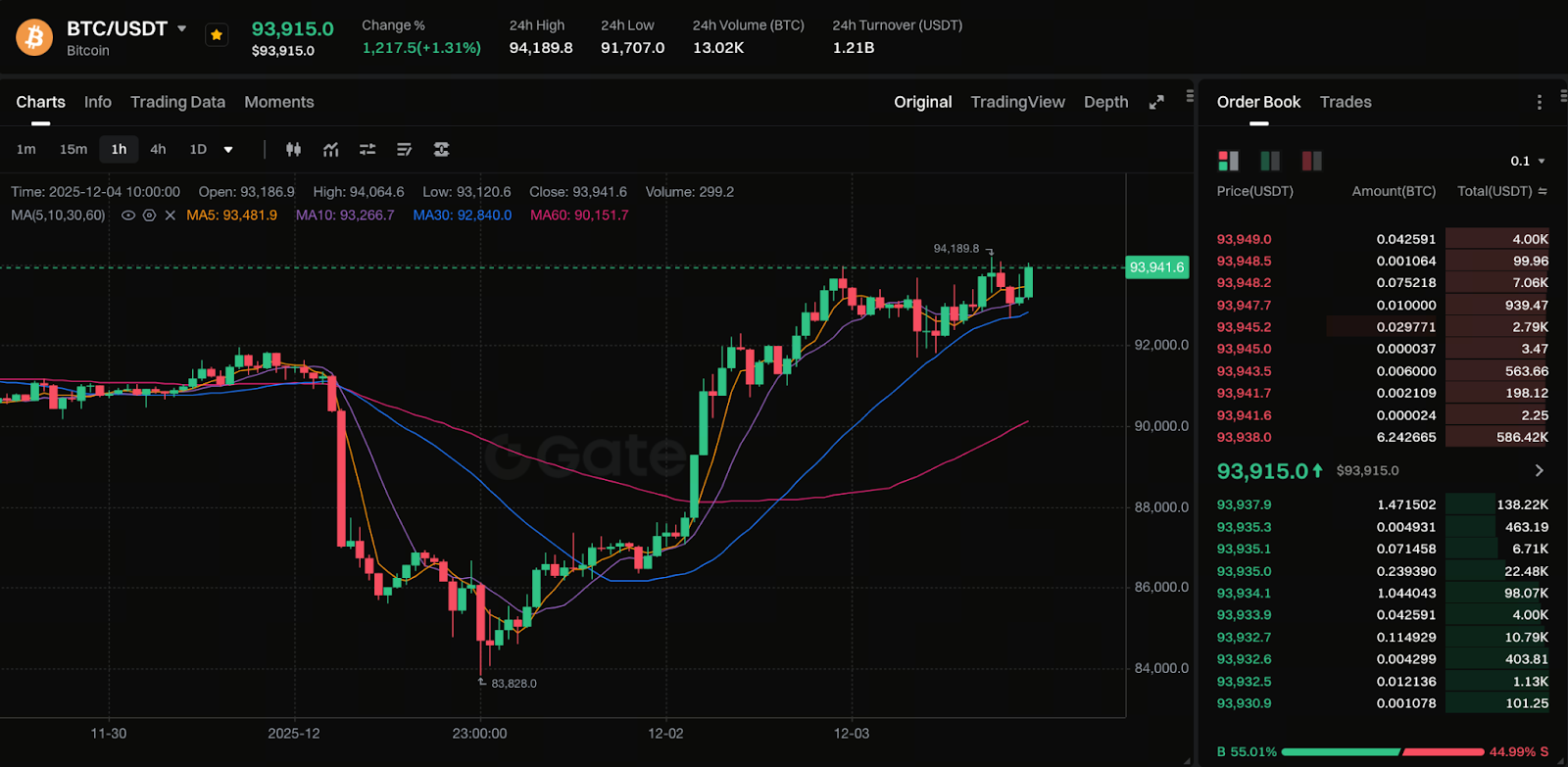
Chart: https://www.gate.com/trade/BTC_USDT
ETF inflows directly triggered a broad-based price recovery. Recently, BTC reached around $93,000—a new high for the period. ETH also gained strength, contributing to a recovery in overall market sentiment. The total crypto market cap surged rapidly, and major altcoins likewise posted significant double-digit gains.
This clear chain reaction—driven by ETF capital inflows, major coins leading the rally, and altcoins following—characterizes the current rebound. While price gains matter, renewed confidence is even more important. This rebound has clearly resonated with both institutional and retail participants.
Institutional and Macro Tailwinds: Why Is Capital Heating Up?
To understand why capital has rapidly rotated back into crypto, consider two factors: institutional behavior and the macro environment.
1. Shifting Attitudes Among Traditional Financial Institutions
Several major asset managers have recently changed internal policies, relaxing restrictions on crypto ETFs and allowing clients to invest in third-party crypto ETFs and mutual funds. This opens “legitimate access” to crypto assets for a broader range of capital pools, including pension funds, charitable foundations, certain insurance funds, and high-net-worth client accounts.
This shift brings not only real inflows but, more importantly, signals that traditional finance (TradFi) is becoming more receptive to crypto assets.
Historically, each time institutional attitudes shift structurally, the crypto market tends to enter a longer-term growth cycle.
2. Macro Policy and Monetary Easing Expectations
Markets now widely expect the Federal Reserve to begin an interest rate cutting cycle or adopt more accommodative monetary policy in the coming months. For investors, this means two things:
- Lower risk-free rates, boosting asset valuations
- Cheaper capital, increasing risk appetite
In this environment, crypto assets—though non-yielding—stand out for their high growth potential. Investors are also turning to BTC as “digital gold” to hedge against future inflation risks.
Institutional behavior and shifting macro expectations together underpin the rapid capital inflows seen in this cycle. This separation improves pacing.
Risks Remain: Short-Term Rally Isn’t a Full Bull Market
Despite the strong performance, it’s important to remain objective and cautious.
- This round of inflows is mainly concentrated in BTC and ETH. If institutions don’t broaden allocations to altcoins, the market could see structural divergence. In other words, major coins may stay resilient, but altcoins could face renewed pressure.
- Crypto assets remain highly volatile, especially during periods of strong macroeconomic correlation. If the Federal Reserve turns hawkish, global liquidity tightens, or geopolitical risks rise, capital may once again exit en masse.
- Part of the recent rally has been driven by short covering and forced liquidations of high-leverage positions. While this amplifies gains, it also increases short-term volatility. A market reversal could trigger new waves of cascading liquidations.
This rally does not necessarily signal the return of a full bull market. It is better to view this as a phase of recovery following a period of weakness.
Conclusion: Stay Level-Headed Amid the Rally, Focus on the Trend
All things considered, this week’s sizable ETF net inflows are the core engine of the current rebound, highlighting renewed institutional focus on major crypto assets like BTC and ETH. Improved macro expectations have also created a more favorable backdrop for the crypto market.
However, the sustainability of this rally hinges on three key variables:
- Whether institutions continue to increase exposure, especially to altcoins
- Whether the Federal Reserve and global monetary policy shift to easing as expected
- Whether the market can avoid another liquidity crunch amid heightened volatility
For individual investors, rational risk assessment and close attention to capital flows and macro signals are often more important than pursuing short-term price swings.
Share
Content


Related Articles

2025 BTC Price Prediction: BTC Trend Forecast Based on Technical and Macroeconomic Data

Pi Coin Transaction Guide: How to Transfer to Gate.com

Flare Crypto Explained: What Is Flare Network and Why It Matters in 2025

How to Use a Crypto Whale Tracker: Top Tool Recommendation for 2025 to Follow Whale Moves

What is N2: An AI-Driven Layer 2 Solution