Litecoin (LTC), as one of the earliest mainstream cryptocurrencies, features an economic model similar to Bitcoin, utilizing a fixed supply cap and a periodic halving mechanism. The halving process is central to maintaining Litecoin’s scarcity and is a key event for market participants. Each halving reduces the new coin rewards for miners, decreasing the amount of LTC entering circulation and influencing price expectations.
In the crypto market, halving is widely recognized as a major factor affecting the long-term supply and demand dynamics of assets. For Litecoin, halving impacts not only miner returns and the network’s issuance schedule, but also market sentiment and investor behavior.
What Is Litecoin Halving?
Litecoin halving occurs every 840,000 blocks mined on the network, cutting the block reward for miners by half. For example, the initial block reward was 50 LTC; after the first halving, it dropped to 25 LTC; after the second halving, it fell to 12.5 LTC, and so forth. With an average block time of 2.5 min, halving takes place approximately every four years.
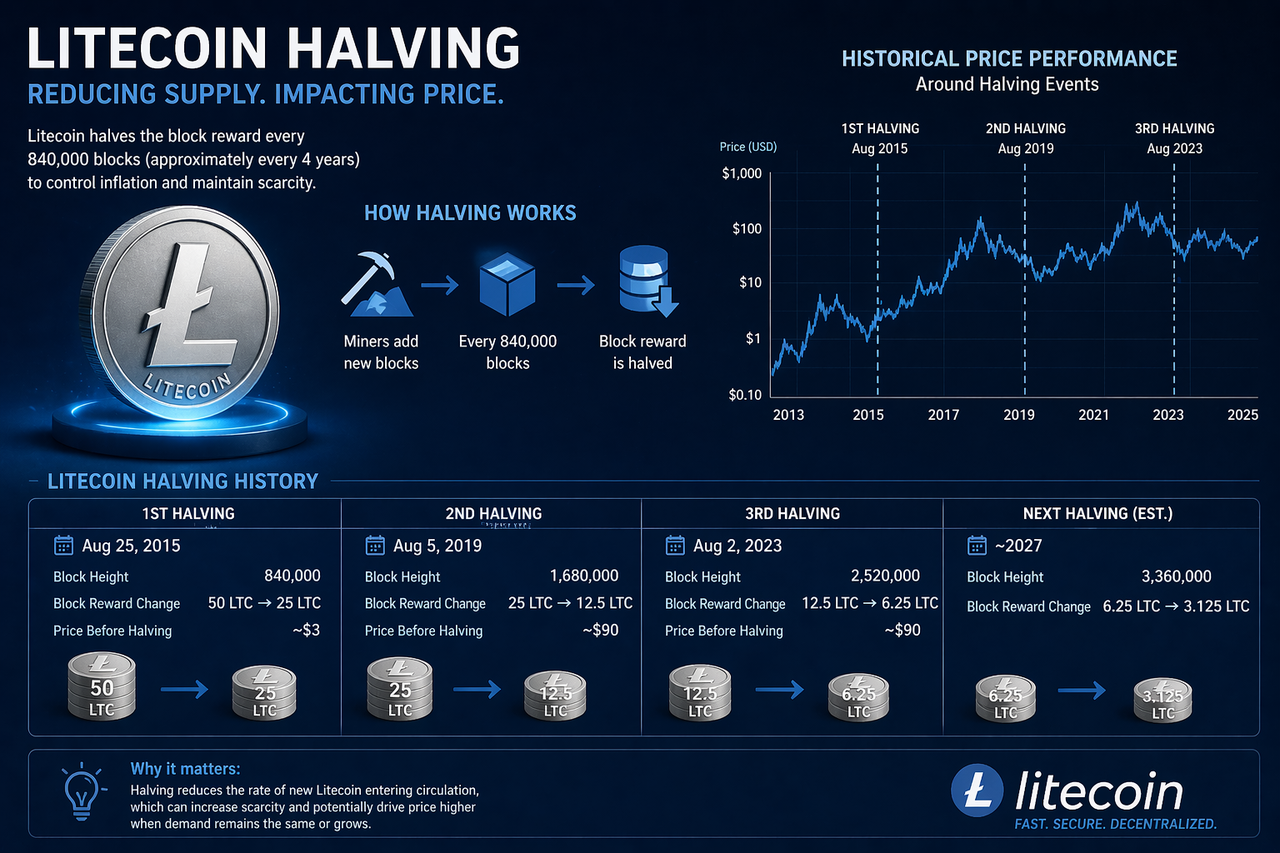
This mechanism primarily serves to control the issuance rate of new coins, gradually slowing LTC supply growth. By reducing new supply, Litecoin maintains long-term scarcity, which is a fundamental aspect of its economic model.
Why Does Litecoin Implement a Halving Mechanism?
The main purpose of Litecoin’s halving mechanism is to control inflation and reinforce asset scarcity. If block rewards remained constant, LTC supply would quickly expand, undermining its store of value function. By periodically halving rewards, Litecoin steadily reduces new supply, bringing total circulation closer to the maximum cap of 84 million coins.
Halving also shapes market expectations. When investors anticipate reduced future supply, their perception of LTC’s scarcity increases, boosting market attention. Thus, halving is both a technical issuance process and a critical driver of market sentiment.
Since launch, Litecoin has undergone several halvings, each affecting market supply and demand. While halving typically leads to price appreciation expectations, actual price performance varies across cycles depending on broader market conditions.
LTC Halving Data Overview
| Halving Number |
Date |
Block Reward Change |
Pre-Halving Price (approx.) |
Post-Halving Price Performance |
Market Impact |
| First Halving |
Aug. 2015 |
50 LTC → 25 LTC |
~$3 |
Short-term rise, then decline |
Market began focusing on LTC scarcity; halving expectations drove price up |
| Second Halving |
Aug. 2019 |
25 LTC → 12.5 LTC |
~$90 |
Pronounced correction after halving |
Positive news was priced in early, resulting in “buy the rumor, sell the fact” |
| Third Halving |
Aug. 2023 |
12.5 LTC → 6.25 LTC |
~$90 |
Volatility, then consolidation |
Market maturity increased; halving impact became more rational |
Historical data indicates that LTC often sees price appreciation expectations ahead of halving, but post-halving price action does not always sustain the rally. As the market matures, the price impact of halving events is diminishing, with greater focus on overall capital flows and demand trends.
How Does Litecoin Halving Affect Price?
Litecoin halving influences price primarily through supply and demand shifts. When block rewards are halved, miners receive fewer new LTC daily, reducing new selling pressure. If demand remains stable or rises, reduced supply may drive prices higher.
However, price is not determined by supply alone. Market sentiment, liquidity, and broader crypto trends also play significant roles in post-halving price behavior. While halving improves supply dynamics, it does not guarantee price appreciation. Historically, LTC often rallies before halving, followed by corrections afterward, reflecting the tendency for market expectations to be realized in advance.
What Does LTC Halving Mean for Miners?
Halving reduces block rewards for miners, directly impacting their returns. If LTC price does not rise to offset lower rewards, profit margins shrink, and higher-cost miners may exit the network, affecting hash rate.
Over the long term, halving helps boost LTC scarcity, and price increases can offset reward reductions, allowing miner returns to stabilize. Thus, halving presents both short-term challenges and key opportunities for long-term value reassessment for miners.
Will Litecoin Price Always Rise After Halving?
Halving does not guarantee price increases. Although reduced supply is theoretically bullish, market outcomes depend on demand growth. If demand is weak, prices may stagnate or decline despite lower supply.
Additionally, halving is often anticipated by the market, with investors buying ahead of the event and taking profits afterward. As a result, halving is more of a long-term positive than a short-term price catalyst.
Summary
Litecoin halving is a pivotal mechanism in the LTC economic model, periodically reducing block rewards and new supply to reinforce asset scarcity. Historically, halving has generated price appreciation expectations, but actual post-halving price performance depends on market conditions and demand shifts. For investors, halving is a key reference point for assessing LTC’s long-term supply and demand structure, but it should not be viewed as a guaranteed price signal. Understanding halving logic enables more rational evaluation of LTC’s long-term value.
FAQs
How often does Litecoin halve?
Litecoin halves every 840,000 blocks, which is roughly every four years.
Does Litecoin price always rise after halving?
No. Halving reduces new supply, but price depends on market demand and broader conditions.
How many times has Litecoin halved?
To date, Litecoin has completed three halvings, with the most recent in 2023.
Why is Litecoin halving important?
Halving slows the rate of new LTC supply, reinforces scarcity, and may affect market supply and demand dynamics.
What impact does Litecoin halving have on miners?
Halving reduces block rewards, compressing short-term returns, but price increases may offset losses.







