With the rapid growth in demand for AI computing and 3D rendering, computing power has gradually become a critical resource in the digital economy. Against this backdrop, how to effectively mobilize distributed computing supply through token mechanisms while ensuring long-term stable network operation has become an important topic in the DePIN track.
Render Network has built an economic system centered on "computing power trading" using the RENDER token. The token not only serves as a payment medium, but also plays a core role in incentivizing nodes, regulating supply, and capturing value, making it highly representative in the GPU DePIN space.
Render Network Overview: The Foundations of RENDER Tokenomics
Render Network is a decentralized computing market for rendering and AI computation, with its core being the coordination of the relationship between creators and GPU nodes through a token mechanism.
Within this system, the RENDER token serves as a value exchange medium: the demand side obtains computing services by paying tokens, the supply side receives rewards by providing GPU resources, while the network maintains a dynamic balance between the two through rule design.
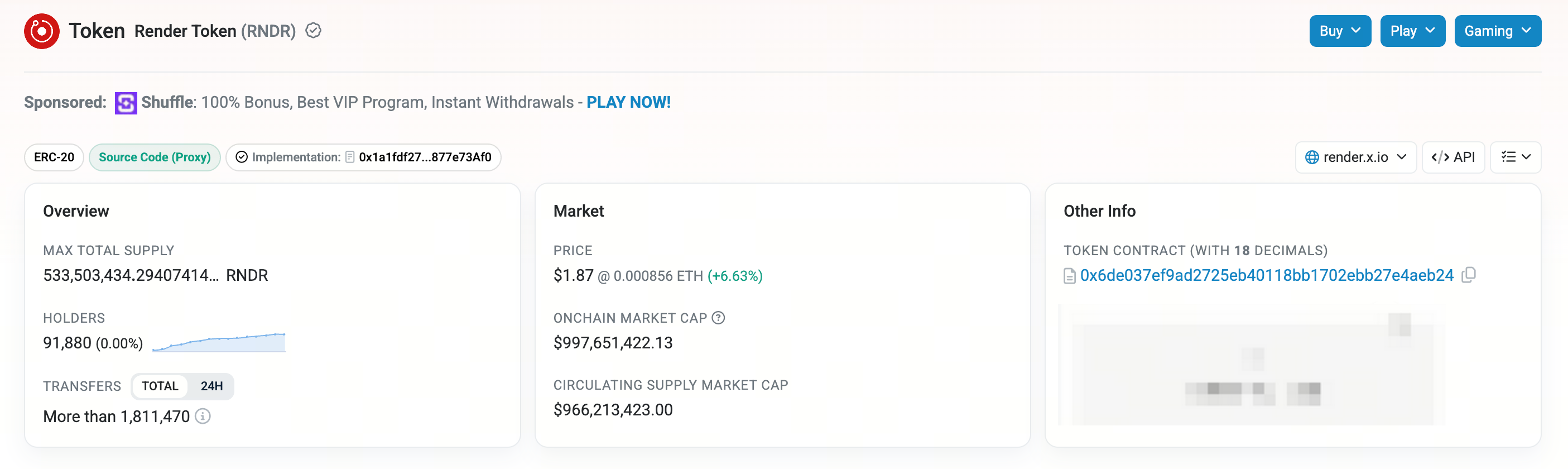
RENDER's initial supply was approximately 536 million (burned in 2020), and after migrating to Solana, the total circulating supply exceeded 900 million (including newly minted tokens), with no hard cap but subject to BME regulation.
BME Model (RNP-001): Task payments burn RENDER equivalent to USD value (minus 5% fee), and the network mints a fixed amount of rewards per epoch, balancing supply dynamically with demand.
Migration: In 2023, Ethereum RNDR was swapped 1:1 to Solana RENDER.
RENDER Token Core Functions & Use Cases
RENDER's functions can be understood from three levels: payment, incentives, and governance.
First, at the payment layer, creators need to use RENDER to purchase rendering or AI computing resources — this is the most direct source of demand for the token.
Second, at the incentive layer, nodes earn RENDER rewards by completing tasks, forming an economic driver for the sustained provision of computing power. This "pay-by-contribution" mechanism makes resource allocation more market-oriented.
Additionally, RENDER also has a certain governance function, where holders can participate in network parameter adjustments and protocol upgrades, thereby influencing the direction of the system's development.
RENDER Supply Mechanism in Detail
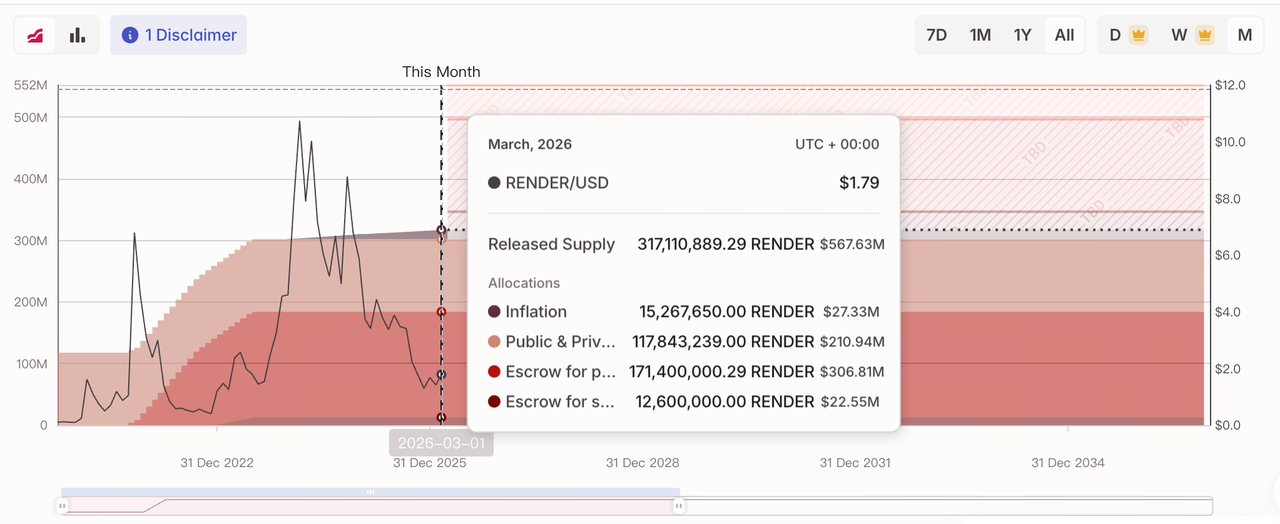
RENDER's supply mechanism has evolved from an early fixed-issuance model to a dynamic adjustment model.
Currently, the core design of RENDER revolves around the BME. Under this mechanism, when users pay for computing fees, a portion of the tokens are burned, thereby reducing the circulating supply; at the same time, the system mints new tokens as rewards based on node contributions.
This "burn + mint" dual-regulation mechanism allows the token supply to dynamically adjust with changes in network usage, thereby avoiding the instability brought by purely inflationary or deflationary models.
 Source: Tokenomist
RENDER Token Allocation Structure
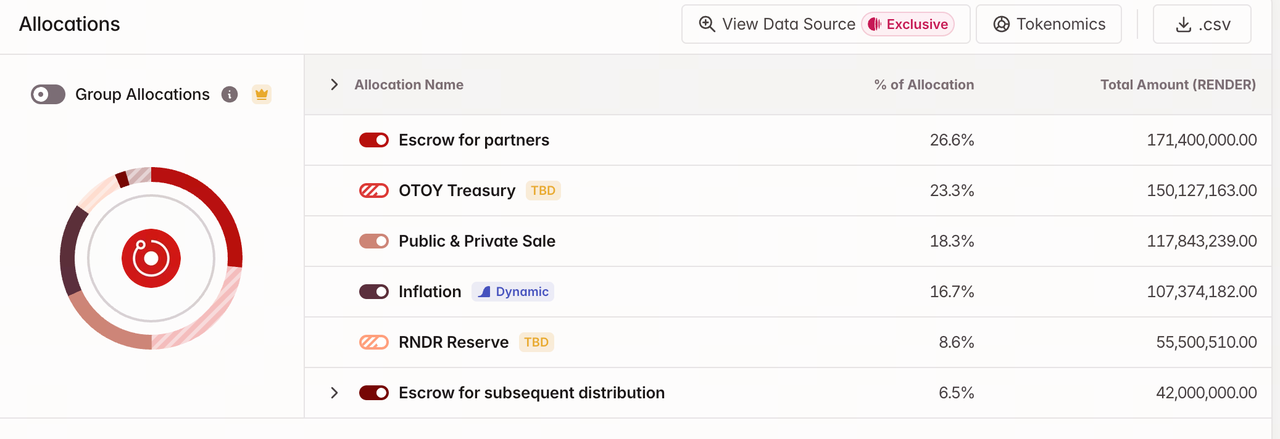
Overall, RENDER's allocation typically covers multiple stakeholders, including the team, early investors, ecosystem incentives, and node rewards.
 Source: Tokenomist
| Category |
Ratio |
Purpose |
| Node Operators |
~50% newly minted |
Task completion and availability incentives |
| Foundation/Ecosystem |
~25-30% |
Operations, development, supporting burn |
| Liquidity Providers |
Partial release |
Exchange pools, supporting burn |
| Team/Early Investors |
Initial 25-30% (vested) |
Released on schedule |
| Community/Airdrop |
Remainder |
Governance and growth |
Among these, node incentives and ecosystem development generally account for the largest proportion, used to continuously attract GPU resources and developers to join the network; while team and investor shares gradually enter the market through vesting and release mechanisms, to reduce short-term price impact.
The core objective of this allocation structure is to drive network launch in the early stages while preserving sufficient incentive space for long-term ecosystem expansion.
RENDER Economic Cycle Model: Demand, Consumption & Circulation Pathways
RENDER's economic cycle can be understood as a closed-loop system that revolves around "computing power demand."
On the demand side, creators purchase RENDER to complete rendering or AI tasks, thereby forming token demand; on the consumption side, a portion of the tokens are burned during the payment process; on the supply side, nodes obtain newly issued token rewards by providing computing power.
These tokens may subsequently circulate in the market, or be used again to purchase computing services, thereby forming a continuous cycle. The key to this model is: the stronger the real computing demand, the more stable the token circulation and value support.
RENDER Value Capture Mechanism
RENDER's value capture ability is primarily embodied in its binding relationship with "actual computing power usage."
Unlike purely financial tokens, RENDER's demand comes directly from rendering and AI computing tasks. This means that as network usage increases, token demand also rises accordingly.
At the same time, the BME mechanism converts usage behavior into supply contraction by burning a portion of the payment tokens, thereby to a certain extent strengthening value support. This "demand-driven + supply regulation" design gives RENDER the ability to capture value in sync with network growth.
Render Network Node Incentive Mechanism & Revenue Model Analysis
Nodes are the core of Render Network's operation, and their incentive mechanism directly determines the stability of computing power supply.
In the revenue model, nodes earn RENDER rewards by completing rendering or computing tasks, and earnings depend on hardware performance, task volume, and network pricing levels. At the same time, node reputation scores also affect the probability of receiving orders, thereby forming long-term incentives.
This mechanism on one hand encourages nodes to continuously provide high-quality services, and on the other hand also optimizes resource allocation through market competition, allowing high-efficiency nodes to gain more revenue opportunities.
Advantages & Potential Risks of RENDER Tokenomics
In terms of advantages, RENDER binds token value with real computing power demand, giving it a certain fundamental support. At the same time, the dynamic supply mechanism helps alleviate extreme inflation or deflation problems, while market-based pricing also improves resource allocation efficiency.
However, its potential risks should not be ignored. For example, when network demand is insufficient, token demand may drop, thereby affecting price stability; the equilibrium effectiveness of the BME model in actual operation also depends on parameter design and market environment; additionally, fluctuations in node earnings and the token price risk may also affect the positivity of supply-side participation.
Summary
Overall, RENDER has built a token economic system centered on computing power trading, achieving a dynamic balance between supply and demand through payment, incentive, and burn mechanisms.
Its value logic lies in binding the token with real computing demand, enabling network growth to be converted into token demand and value support. However, its long-term performance still depends on actual usage scale, ecosystem expansion capacity, and continuous optimization of the economic model.
FAQs
What is the main use of the RENDER token?
Primarily used to pay for rendering and AI computing fees, incentivize nodes to provide computing power, and to participate in network governance.
What is Burn-Mint Equilibrium (BME)?
It is a mechanism that burns user payment tokens and mints new tokens to reward nodes, used to dynamically regulate supply.
Where does RENDER's value come from?
Primarily from real computing power demand, i.e., users' usage of GPU rendering and AI computing services.
How do nodes earn revenue?
By completing tasks to earn RENDER rewards, earnings depend on computing performance, task volume, and market pricing.
Does RENDER have inflationary risk?
There is a certain inflationary pressure, but the BME mechanism balances it through burning and minting, aimed at mitigating the long-term supply-demand imbalance.







