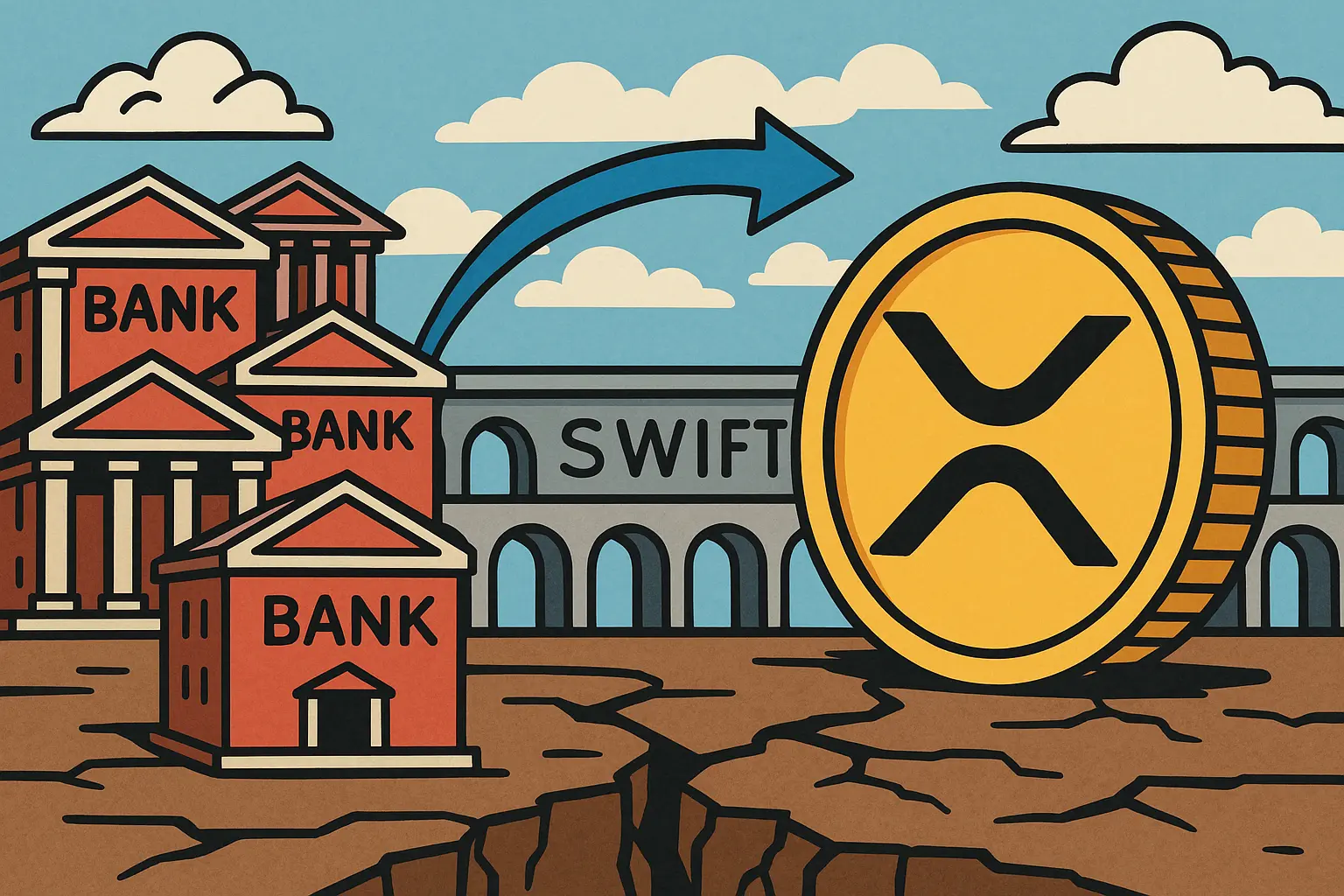
Swift confirms that before June, more than 25 banks will launch blockchain-based 24/7 cross-border payment functions through Swift-Thunes integration. Ripple’s XRP Ledger (XRPL) is now accessible to over 11,000 banks worldwide. However, XRP is still trading around $1.40, down more than 40% from its January high, with only 16% of ETF institutional funds.
Swift-Thunes Integration: A Selective Path for XRP into the Global Banking System
Swift has incorporated payment company Thunes into its network, seen as a potential breakthrough for Ripple. The fund routing structure is as follows: businesses initiate cross-border payments via Swift → Swift connects to Thunes → Thunes accesses Ripple payment products → Ripple products can choose to use XRP as on-demand liquidity bridging asset.
The key premise is that this integration offers a choice, not an obligation; banks are not forced to use XRP. If XRP can effectively speed up settlement and reduce costs for trillions of dollars in cross-border transactions, some institutions may gradually route funds through XRP or Ripple’s stablecoin RLUSD. Among the approximately 50 banks participating in the Swift crypto plan, Ripple is reported to have established partnerships or pilot programs with over 30, including major institutions like Bank of America and TD Bank.
Regulatory Good News Has Materialized, but Institutional Entry Is Still Far Below Market Expectations
Despite clearing a series of regulatory hurdles, XRP’s market response has been noticeably subdued.
Recent Key Developments for XRP
- SEC Case Concludes: Ripple’s long-standing lawsuit with the SEC has officially ended, removing legal uncertainty.
- Spot ETF Approved: XRP spot ETF approved in the US, with total ETF inflows reaching $1.44 billion.
- Digital Commodity Recognition: XRP, along with Bitcoin, is officially recognized as a “digital commodity,” with the “Clearance Act” expected to be implemented by 2026.
- Insufficient Institutional Participation: Only 16% of ETF assets come from institutional investors, far below industry expectations for large-scale institutional entry.
Changelly analysts note that Ripple’s business momentum is strong, but token prices remain stagnant, indicating the market may have re-evaluated XRP’s relative value compared to Ripple’s company fundamentals.
Technical Perspective: $1.40 Is a Key Support/Resistance Level, Long-term Predictions Vary Widely
From a technical analysis standpoint, XRP’s RSI has reached oversold levels not seen since the 2022 bear market, which some technical analysts see as a potential short-term bottom signal. However, if XRP cannot hold $1.40 as support on the weekly chart, the next psychological level to test is $1.00.
Long-term forecasts vary greatly: conservative estimates for 2030 target prices range from $4 to $10, implying a market cap of $244 billion to $610 billion; extreme predictions of $1,000 target price imply a market cap exceeding $61 trillion, surpassing all global stock markets combined, which many analysts consider mathematically impossible.
Frequently Asked Questions
How does Swift-Thunes integration open banking channels for XRP?
This integration makes Ripple’s payment products part of the Swift ecosystem, providing over 11,000 Swift member banks worldwide with an optional path to adopt XRP via Thunes. The key is that this is not mandatory; banks can choose based on cost and efficiency considerations.
Why did XRP’s price decline despite positive regulatory developments?
Main reasons include: positive news being priced in early; only 16% of ETF assets are from institutional investors, far below expectations; and the ongoing crypto bear market continues to suppress token valuations.
What are XRP’s key technical support and resistance levels?
Currently, $1.40 is a critical support/resistance level. If weekly candles fail to hold this level, the market may test the psychological support at $1.00. If XRP can hold and break above $1.40, resistance is around $1.50.
Disclaimer: The information on this page may come from third parties and does not represent the views or opinions of Gate. The content displayed on this page is for reference only and does not constitute any financial, investment, or legal advice. Gate does not guarantee the accuracy or completeness of the information and shall not be liable for any losses arising from the use of this information. Virtual asset investments carry high risks and are subject to significant price volatility. You may lose all of your invested principal. Please fully understand the relevant risks and make prudent decisions based on your own financial situation and risk tolerance. For details, please refer to
Disclaimer.


