
Members of the Ethereum Foundation officially launched the “Post-Quantum Ethereum” resource center this Tuesday, announcing the formation of a dedicated post-quantum security team. The plan is to implement quantum-safe solutions at the protocol layer by 2029, followed by advancing upgrades at the execution layer. The team pointed out that quantum computing currently does not pose an immediate threat to cryptocurrencies, but given the complexity of the upgrade process involving multiple coordinated efforts, early preparation is necessary.
Why Quantum Computing Is a Long-Term Security Issue for Ethereum
Once quantum computers reach sufficient computational power, existing elliptic curve cryptography (ECC) could theoretically be broken, directly threatening private key security and wallet protection mechanisms. Galaxy Digital analyst Will Owens noted that the primary risk is concentrated on wallets with exposed public keys; meanwhile, Charles Edwards of Capriole Investments believes that, in the long run, all crypto assets face quantum threats.
The post-quantum team emphasizes that the real challenge of the upgrade is not algorithm selection but the complexity of implementation itself: “Migrating a decentralized global protocol requires years of coordination, engineering design, and formal verification. This work must begin before the threat becomes imminent.” Ethereum currently safeguards billions of dollars in assets, and any delay in upgrades could create a significant security exposure window once quantum technology matures.
SNARK Architecture and Three-Phase Upgrade Roadmap
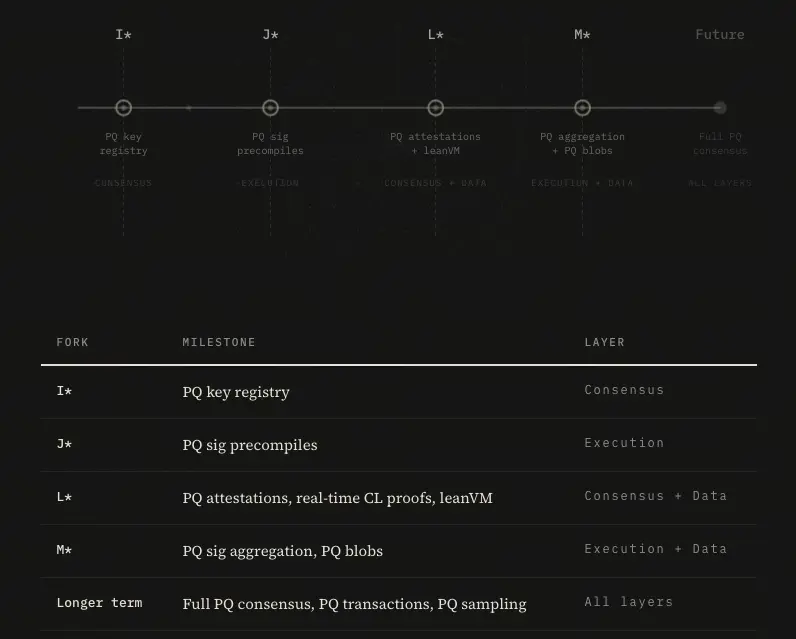
(Source: Ethereum Post-Quantum Security Team)
The post-quantum team plans to integrate SNARK (Succinct Non-Interactive Argument of Knowledge) technology as the core approach for quantum-safe signatures, addressing issues where some quantum-secure signature schemes require large computational resources, leading to increased bandwidth and storage demands that impact network performance. The upgrade will cover three core technical layers of Ethereum:
Consensus Layer: Post-quantum modifications to validator signatures and block confirmation mechanisms
Execution Layer: Quantum-safe upgrades to smart contract execution environments and transaction signatures, to be implemented after protocol layer deployment
Data Layer: Reinforcement measures related to data availability and storage security
In terms of asset protection priority, standard Ethereum wallets are the primary target due to their concentration of the largest value holdings, followed by high-value operational wallets associated with cryptocurrency exchanges, cross-chain bridges, and custody solutions.
Major Challenge: How to Complete Upgrades Without Network Disruption
The post-quantum team states that algorithm selection is just the starting point. More complex issues include securely upgrading hundreds of millions of existing accounts, ensuring the migration process does not introduce new vulnerabilities, avoiding creating new attack surfaces, maintaining current performance levels, and coordinating ecosystem-wide adoption. This series of engineering and coordination challenges forms the core rationale for “initiating now and completing the first phase by 2029.”
Frequently Asked Questions
Q: How significant is the current threat of quantum computers to Ethereum?
The post-quantum Ethereum team clearly states that there is no imminent quantum threat at present. Current quantum computers lack the computational power to break the cryptographic mechanisms used by Ethereum. However, due to the long-term complexity of the upgrade process, early deployment is considered a necessary preventative measure.
Q: Why does the post-quantum upgrade take several years to complete?
Ethereum is a decentralized global protocol. Security upgrades require cross-layer coordination across consensus, execution, and data layers, involving the migration of hundreds of millions of accounts and the adoption of changes across the global ecosystem. Each step requires rigorous formal verification to ensure the upgrade process itself does not introduce new security vulnerabilities.
Q: How does SNARK address the performance issues of quantum-safe signatures?
Some quantum-safe signature schemes are computationally more complex than current mechanisms, potentially significantly increasing network bandwidth and storage requirements. SNARKs use zero-knowledge proofs to compress computational overhead, enabling quantum-safe protection while minimizing performance impact.
Disclaimer: The information on this page may come from third parties and does not represent the views or opinions of Gate. The content displayed on this page is for reference only and does not constitute any financial, investment, or legal advice. Gate does not guarantee the accuracy or completeness of the information and shall not be liable for any losses arising from the use of this information. Virtual asset investments carry high risks and are subject to significant price volatility. You may lose all of your invested principal. Please fully understand the relevant risks and make prudent decisions based on your own financial situation and risk tolerance. For details, please refer to
Disclaimer.
Related Articles
Vitalik and Ethereum Foundation Chair Aya Miyaguchi Confirmed to Speak at Hong Kong Ethereum Community Hub Launch
Vitalik Buterin and Aya Miyaguchi will speak at the Hong Kong Ethereum Community Hub opening on April 21. The hub, Asia's first Ethereum-backed space, aims to connect Eastern and Western ecosystems with discussions on key topics like zero-knowledge proofs and AI.
GateNews1h ago
Justin Sun Deposits 53,660 ETH Worth $125M Into Spark After Aave Withdrawal
Justin Sun deposited 53,660 ETH worth $125 million into Spark, after withdrawing the tokens from Aave. He now holds about $2.13 billion in assets across Sky and Spark, along with $380 million in Aave.
GateNews1h ago
ETH drops 0.76% in 15 minutes: Dual pressure from whales’ proactive deleveraging and ETF fund outflows
Between 07:15 and 07:30 (UTC) on 2026-04-19, the ETH spot price fluctuated in the 2298.13 to 2322.69 USDT range, with an amplitude of 1.06% and a return of -0.76%. During this period, market attention increased; the sharp drop in price triggered widespread user focus, along with a clear surge in trading volume within a short time, indicating a sudden escalation in liquidity pressure.
The main driver behind this deviation is that on-chain whale accounts actively sold ETH to repay DeFi platform borrowings in order to avoid forced liquidation. Based on on-chain tracking and fund-flow monitoring, from April 18 to 19, more than 42,000 ETH per-transaction large transfers were rapidly sent into a certain mainstream exchange, and at the same time there was a sharp spike in net inflows to the exchange. This concentrated sell pressure directly weakened spot market prices. Under proactive deleveraging behavior, selling pressure was released in the short term, creating a sudden market shock.
In addition, during the period of price deviation, the ETH derivatives market saw a significant rise in passive liquidation volume, especially as leveraged long positions encountered strong liquidations during the price decline, further increasing supply pressure in the spot market. Meanwhile, ETH spot ETF funds continued to see net outflows; in mid-April, there were multiple days with single-day outflows exceeding $40-50M, with the largest single day reaching $200M. This reflects a warming of short-term institutional risk-avoidance sentiment, which led to a deeper shift downward in buy-side liquidity depth. The launch of a new public chain ecosystem also attracted some ETH liquidity migration, further weakening the capital protection layer of the mainnet. Multiple structural feedback effects amplified the downside move.
At present, leverage risk in the ETH market remains prominent. Some whales still have large borrowings outstanding; if the price continues to move downward, potential liquidation risks may flare up again. ETF fund flows, on-chain large transfers, and capital-attraction moves tied to the new-chain ecosystem all need close monitoring. With increased short-term volatility risk, it is recommended to watch key support zones, exchange net inflow indicators, and DeFi on-chain liquidation dynamics in order to promptly grasp the latest market signals.
GateNews2h ago
ETH breaks below 2300 USDT
Gate News bot message, Gate market data shows that ETH has broken below 2300 USDT, with the current price at 2298.67 USDT.
CryptoRadar3h ago
ETH drops 0.58% in 15 minutes: derivatives liquidity contraction and proactive position reduction dominate short-term pullback
From 2026-04-19 04:30 to 2026-04-19 04:45 (UTC), within ETH’s 15-minute candlestick chart, the return recorded -0.58%, and the price range was 2321.62 to 2342.04 USDT, with an amplitude of 0.87%. The short-term selloff occurred against a backdrop of increased overall market volatility and a broad decline in the prices of major crypto assets; overall market risk appetite clearly fell, and traders’ wait-and-see sentiment strengthened.
The main driver behind this abnormal move is a sharp contraction in liquidity in the derivatives market and leveraged funds proactively reducing positions. Data shows that over the past 24 hours, the ETH/USD perpetual contract trading volume dropped 67.16% to approximately 74.87 million, open interest edged down 3.33% to 329 million, and liquidation amounts did not expand unusually. This structure indicates that the market lacks the risk of passive cascades; more funds chose to proactively step aside and wait on the sidelines, intensifying short-term selling pressure.
In addition, the long/short structure in which shorts held the upper hand (long/short ratio 47.48%:52.52%) and sentiment synchronization with the panic range reinforced the downward price trend. During the same period, major coins such as BTC and SOL also fell 2%-3.4% in tandem, further showing that this pullback was driven by system-wide risk sentiment. On-chain funds did not show any large abnormal transfers or large-scale liquidations of DeFi protocols; spot and on-chain liquidity remained generally stable, and no sudden system risk resonance was observed.
Current volatility-related risks still need close monitoring, especially as overall risk appetite continues to contract—ETH’s short-term price may face further downside probing. Watch subsequent changes in derivatives trading volume and open interest, extreme shifts in the long/short ratio and funding rate, and promptly monitor on-chain fund flows, large transfers, and any signs of amplified platform net outflows. For more market anomalies and deeper analysis, please continue to follow our upcoming market updates.
GateNews5h ago
Spark Protocol's January delisting of rsETH proves prudent as Aave faces ETH liquidity crisis
Spark Protocol's strategy of delisting low-usage assets and tightening collateral has faced initial backlash but proved wise during market turmoil. While maintaining higher interest rate caps, SparkLend ensures liquidity, unlike Aave, which now faces significant risks.
GateNews6h ago


