Author: Jae, PANews
While Bitcoin remains uncertain at the $70,000 level, Wall Street—the global financial hub—has completed three coordinated moves within 48 hours.
The New York Stock Exchange, Nasdaq, and CME Group—three giants controlling the flow of global capital—have consecutively announced upgrades to their tokenization initiatives. Nasdaq is developing a tokenized collateral management solution, the NYSE is partnering with Securitize to develop a tokenized securities platform, and CME Group is launching an institutional “cash” settlement service based on tokenization.
With these three top exchanges advancing on three fronts, they are leveraging blockchain technology to carry out a profound overhaul of the world’s liquidity “plumbing.”
As Wall Street’s traditional giants proactively embrace tokenization, the rules of the global capital markets are being rewritten.
Goodbye to T+1—Nasdaq mobilizes $35 billion in collateral through tokenization
$35 billion is the estimated amount of “idle” collateral that Nasdaq considers to be “sleeping” within the global financial system.
Due to settlement delays, cross-time-zone operational barriers, and restrictions in traditional banking transactions, large volumes of highly liquid assets—such as stocks and U.S. Treasury ETFs—are trapped in securities accounts and cannot realize their full capital efficiency.
In this wave of Wall Street tokenization, Nasdaq took the lead. On March 23, it announced a strategic partnership with digital asset infrastructure provider Talos. Nasdaq’s Calypso risk and collateral management platform, integrated deeply with Talos’s digital asset front-end architecture, will enable collateral tokenization and real-time transfers.
When markets experience extreme volatility, institutions can reallocate tokenized assets within seconds to meet clearinghouse margin requirements, without waiting for traditional bank transfer windows. For derivatives trading, this signifies a fundamental shift from “T+1” to “atomic settlement,” exponentially improving capital flow efficiency.
Nasdaq’s tokenization solution with Talos transforms collateral from passive, static assets into active liquidity tools. Institutions can use the same asset in the morning as U.S. stock margin collateral and at night as collateral for Asian session stocks.
Additionally, Nasdaq will extend its “Trade Surveillance” system to Talos’s client base, effectively identifying false trades, wash trading, and cross-market manipulation—adding a “compliance safety valve” to digital asset trading.
In fact, before this partnership was announced, Nasdaq’s tokenized stock trading pilot received SEC approval on March 18. Looking back, this also laid the groundwork for future cooperation with Talos, facilitating investors’ use of tokenized collateral for stock financing and securities lending.
The initial batch of tokenized assets is strictly limited to constituents of the Russell 1000 index and mainstream ETFs tracking the S&P 500 and Nasdaq 100.
The choice of these assets is obvious. The Russell 1000 covers the top 1,000 U.S. companies by market capitalization, with sufficient trading depth to absorb the technical shocks during the early phase of tokenization, ensuring the stability of “best bid and offer” prices.
At the same time, these assets will adopt a “dual-track” model. Tokenized securities and traditional stocks will share the same CUSIP codes and trading identifiers, being fully interchangeable and equivalent. This also provides regulators with a suitable control group to observe how blockchain settlement impacts liquidity in traditional markets.
NYSE native on-chain securities versus crypto exchange products
If Nasdaq’s move is about optimizing existing institutional workflows, then the NYSE’s partnership with tokenization leader Securitize represents a fundamental reshaping of securities trading.
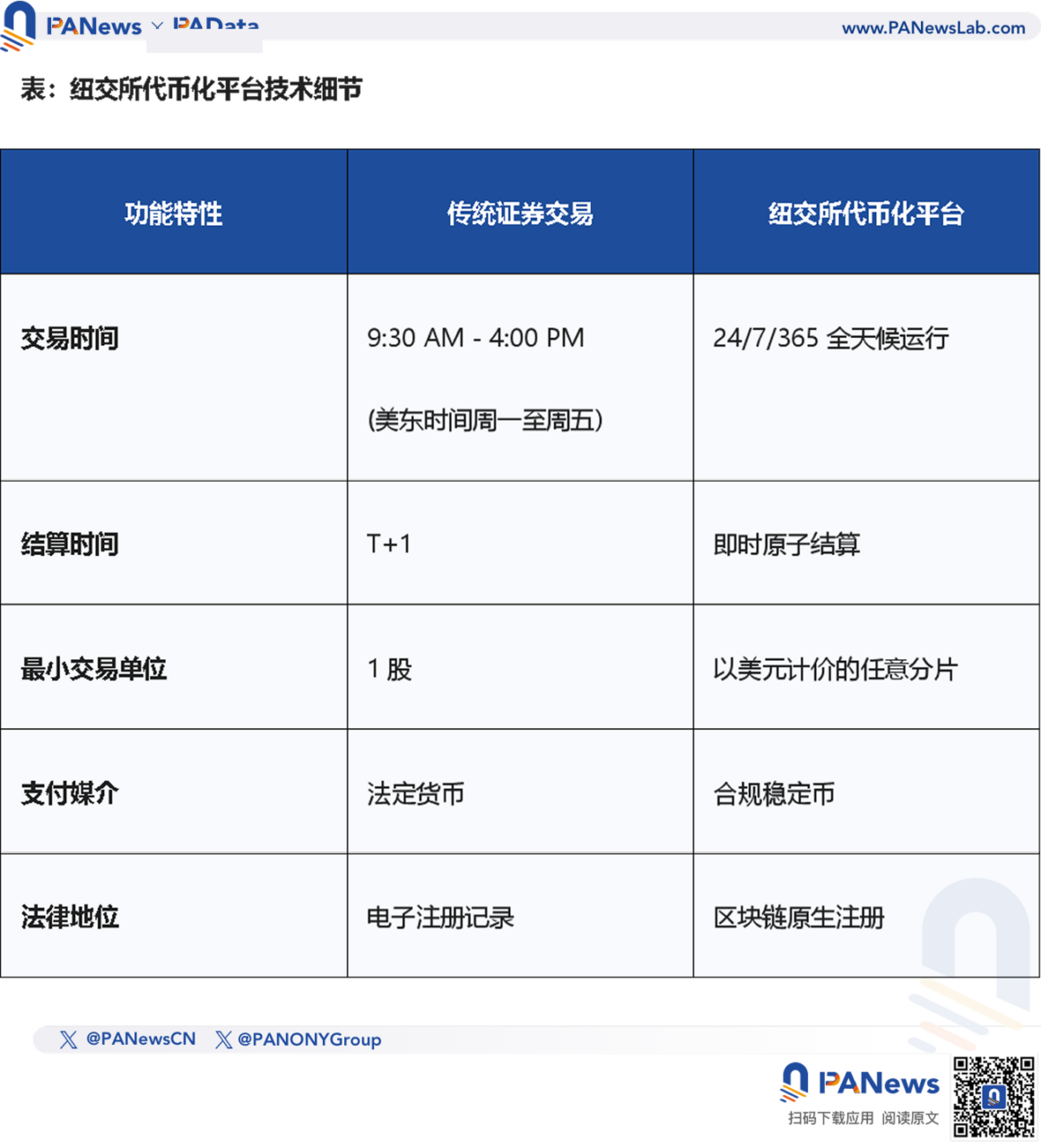
On March 24, the memorandum of understanding (MOU) signed by both parties explicitly proposed developing a tokenized securities platform supporting instant settlement and stablecoin payments.
Securitize, the NYSE’s partner, is a leading player in real-world asset (RWA) tokenization, having previously assisted BlackRock in issuing BUIDL, the largest tokenized U.S. Treasury fund.
Securitize CEO Carlos Domingo clarified the distinction between this collaboration and similar market products: the NYSE’s goal is to achieve “native tokenization,” not the “stock certificate” model typical of crypto exchanges.
Under this model, Securitize will serve as the NYSE’s designated first Digital Transfer Agent, directly maintaining ownership records on the blockchain.
This means that each token held by an investor represents direct legal ownership of the underlying security, with full rights to dividends, voting, and liquidation priority.
This is fundamentally different in legal terms from the model where third-party institutions hold stocks and issue “tokenized certificates.” The latter is merely a rights mapping, while the former is native securities on the blockchain.
It is important to note that although the NYSE aims for native tokenization, if the custodian of the underlying assets makes operational errors or if oracles provide incorrect pricing outside U.S. trading hours, these tokens could deviate significantly from the value of the stocks they are pegged to, potentially triggering a wave of on-chain liquidations.
CME launches tokenized cash to address “additional margin” issues
While Nasdaq optimizes collateral and the NYSE restructures securities trading, CME Group—the world’s largest derivatives exchange—turns its focus to “cash settlement.” On March 24, CME Group partnered with Montreal Bank and Google Cloud to launch a tokenized cash solution targeting the most challenging “funds synchronization” problem in the tokenization ecosystem, laying the foundation for underlying capital flow.
The technical architecture uses Google Cloud Universal Ledger (GCUL), a highly programmable permissioned distributed ledger designed specifically for traditional financial institutions.
Unlike public blockchains like Ethereum, GCUL is a permissioned private network that retains the real-time settlement features of blockchain while ensuring transaction privacy, meeting strict KYC/AML requirements—this is key to its acceptance by traditional financial institutions.
As the first bank to adopt this system, Montreal Bank has opened the door for its institutional clients to “tokenize dollar deposits,” allowing their dollar deposits to be converted into “tokenized cash.”
The primary use of these tokens is as the margin medium for CME Clearing. This change directly addresses a long-standing pain point in derivatives markets: the crisis of additional margin calls.
Futures and options trading require extremely timely margin management. As markets trend toward 24/7 trading, clearinghouses may initiate “intraday margin calls” during extreme volatility.
In traditional systems, if a bank is closed, institutions cannot reallocate cash in time, often resulting in forced liquidation of positions.
Tokenized cash will break this barrier. CME COO Suzanne Sprague stated that tokenized cash will enable institutions to meet margin obligations instantly, freeing up large buffers of capital that were previously idle due to bank closures.
This not only reduces liquidity costs for institutions but also significantly enhances the resilience of the entire clearing system, reducing the risk of systemic, cascading liquidations.
However, integrating a distributed ledger with CME’s clearing system is complex. Network partitions or smart contract vulnerabilities could cause the 24/7 financial system to face “nuclear meltdown” risks, unable to halt operations midstream.
The “triple play” of tokenization involving Nasdaq, the NYSE, and CME Group not only signifies proactive acceptance of tokenization by traditional finance but also embodies the global pursuit of maximum efficiency.
From Nasdaq awakening $35 billion in idle collateral, to the NYSE opening native tokenized securities trading to global investors, and CME laying the tokenized cash foundation for settlement—the grand blueprint of a “value network” is beginning to take shape on Wall Street, flowing ceaselessly across blockchain ledgers running 24/7.
Disclaimer: The information on this page may come from third parties and does not represent the views or opinions of Gate. The content displayed on this page is for reference only and does not constitute any financial, investment, or legal advice. Gate does not guarantee the accuracy or completeness of the information and shall not be liable for any losses arising from the use of this information. Virtual asset investments carry high risks and are subject to significant price volatility. You may lose all of your invested principal. Please fully understand the relevant risks and make prudent decisions based on your own financial situation and risk tolerance. For details, please refer to
Disclaimer.


