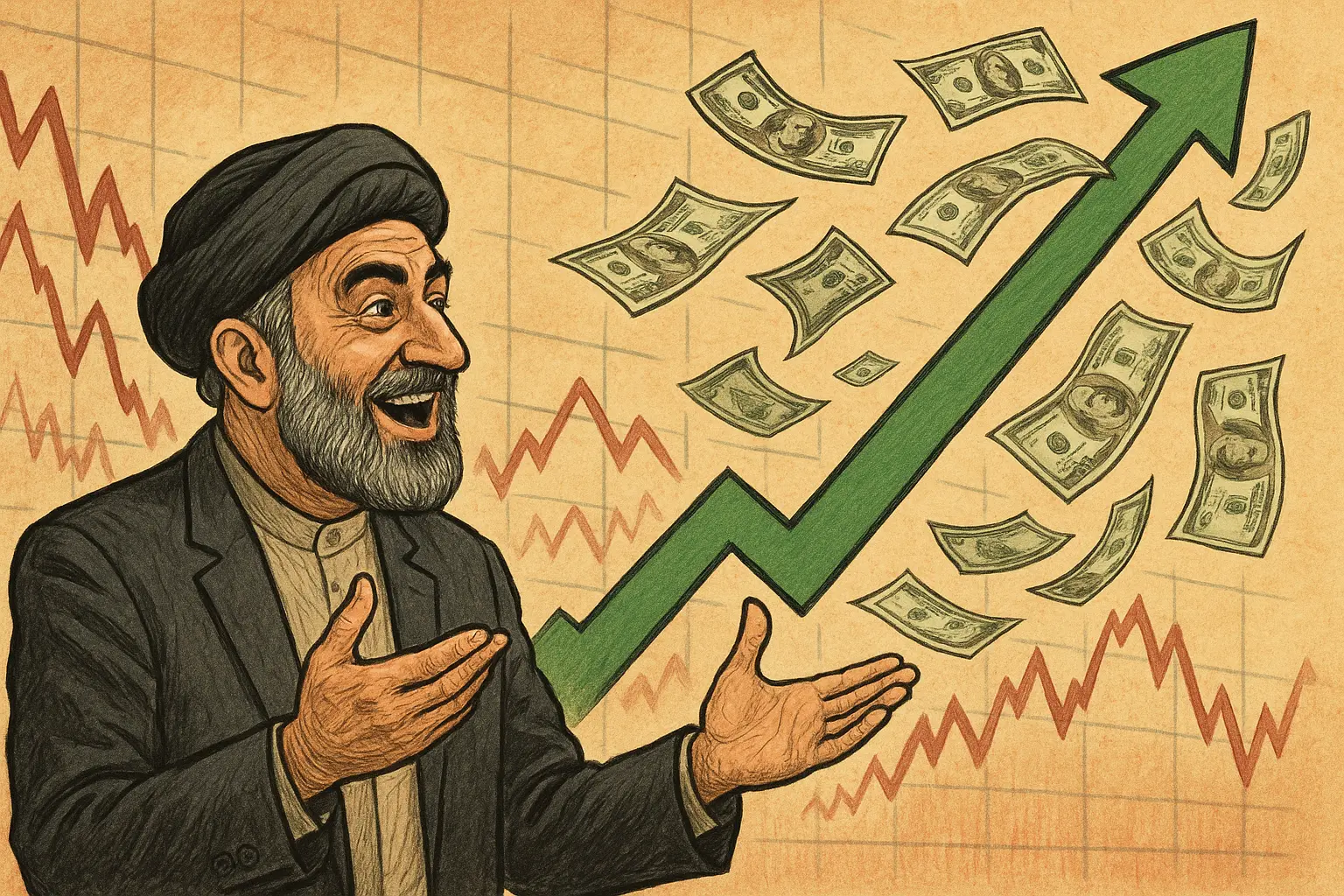
Iranian Parliament Speaker Mohammad Baqer Ghalibaf (Mohammad Baqer Ghalibaf) suggested to investors on Sunday that they should take a long strategy if the market drops. The post precisely matches the market’s next move: U.S. stock market S&P 500 index futures briefly neared a technical pullback zone late Sunday evening, then completely reversed overnight. By Monday’s close, the S&P 500’s market value had recovered by about $90 billion from the prior overnight low.
15-Hour Full Recap: From an Iranian Post to a $90 Billion Market Value Reversal
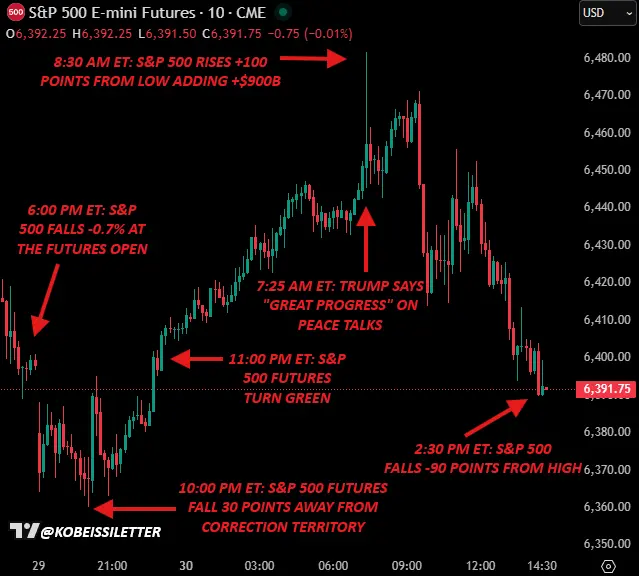 (Source: KobeissiLetter)
As soon as Ghalibaf’s advice went out, the U.S. stock market was in a sensitive moment. Sunday evening, S&P 500 index futures opened with a decline of close to 1%, leaving just 30 points until the official technical pullback definition (a 10% drop from a recent high)—and market sentiment was quite cautious.
However, by late Sunday night, futures prices had fully reversed and turned upward—this reversal happened a full 8 hours earlier than any official policy announcement. At 7:25 a.m. on Monday, Trump posted on Truth Social, claiming the U.S. was negotiating with what he described as a “new, more reasonable regime” to end Iran’s military action, while also warning that if no agreement was reached, it would take action against Iran’s energy and water infrastructure. After that, the S&P 500 index rose a further roughly 100 points from the overnight low, and the market value ultimately recovered by about $90 billion.
15-Hour Event Timeline
Sunday Evening (6:00 PM ET): Ghalibaf posted advice saying to go long “if the market falls”; S&P 500 futures opened down nearly 1%, only 30 points away from a technical pullback
Sunday Late Night (11:00 PM ET): The futures’ decline fully flipped to gains; the reversal occurred a full 8 hours before Trump’s post
Monday Morning (7:25 AM ET): Trump announced on Truth Social that negotiations with Iran had made “major progress”
Monday Day Session: The S&P 500 rebounded by about 100 points from the overnight low; market value rose by about $90 billion
Market Read: A Sentiment Rebound, Not a Structural Shift
Kobeissi Letter analyst commentary said, “We are in the most unusual period in market history.” This assessment precisely describes the essence of this rebound—this is a wave of sentiment swings driven by news headlines, not a structural market signal that genuinely eases the geopolitical situation.
Ghalibaf’s post was widely interpreted as a direct jab at the phenomenon of how U.S. social media can sway financial markets. He has previously criticized Trump’s pre-market Truth Social posts for acting as a “contrarian indicator,” and in this case, the event in reality further validated that observation.
It’s worth noting that fundamental pressures have not disappeared. The oil transport blockade in the Strait of Hormuz is still ongoing; even while U.S. stocks rebounded, the spot oil market remained under pressure. Over the past week, oil prices have continued to hold above $100 per barrel. As of now, there is still no formal agreement between the two sides. Whether this rally’s momentum can continue will depend on whether diplomatic negotiations can achieve substantive progress beyond the level of social media posts.
Frequently Asked Questions
Why could Ghalibaf “predict” the reversal in the U.S. stock market?
Ghalibaf’s advice was based on a practical observation: pre-market posts by U.S. officials on social media often serve as signals to take profits, not a real reflection of changes in policy direction. Therefore, there is room for arbitrage to take the opposite position. In this event, the overnight reversal in futures happened 8 hours before Trump’s post, showing that market sentiment itself has self-correcting momentum; Ghalibaf’s post may have amplified this effect.
Why is this $90 billion rebound called “headline-driven” rather than a structural shift?
Because what drove the rebound was the sentiment effect of diplomatic signals, not substantive progress in the Iran conflict. The Strait of Hormuz remains under blockade, spot oil prices have not shown a significant pullback, and the two sides have not reached any formal agreement. Analysts believe that if diplomatic signals are not followed through into a real ceasefire, this rally may be difficult to sustain.
What do the geopolitical implications between the U.S. and Iran mean for the U.S. stock market in the medium term?
The ongoing conflict between Iran and the U.S. keeps pushing up energy costs. The oil price environment above $100 per barrel constrains the Federal Reserve’s ability to cut rates, creating systemic inflation pressure. The medium-term direction of U.S. stocks will depend heavily on substantive progress in diplomatic negotiations. Every geopolitical signal could trigger sharp two-way short-term volatility, and uncertainty is the core feature of the current market.
Disclaimer: The information on this page may come from third parties and does not represent the views or opinions of Gate. The content displayed on this page is for reference only and does not constitute any financial, investment, or legal advice. Gate does not guarantee the accuracy or completeness of the information and shall not be liable for any losses arising from the use of this information. Virtual asset investments carry high risks and are subject to significant price volatility. You may lose all of your invested principal. Please fully understand the relevant risks and make prudent decisions based on your own financial situation and risk tolerance. For details, please refer to
Disclaimer.


