On April 3, filings from the U.S. Securities and Exchange Commission (SEC) show that Grayscale has submitted an S-1/A amendment (S-1/A) for its Bittensor (TAO) trust. The Grayscale Bittensor Trust is currently one of the few investment vehicles that allows investors to gain TAO token exposure in the form of securities.
Current Structure and Known Limitations of the Grayscale Bittensor Trust
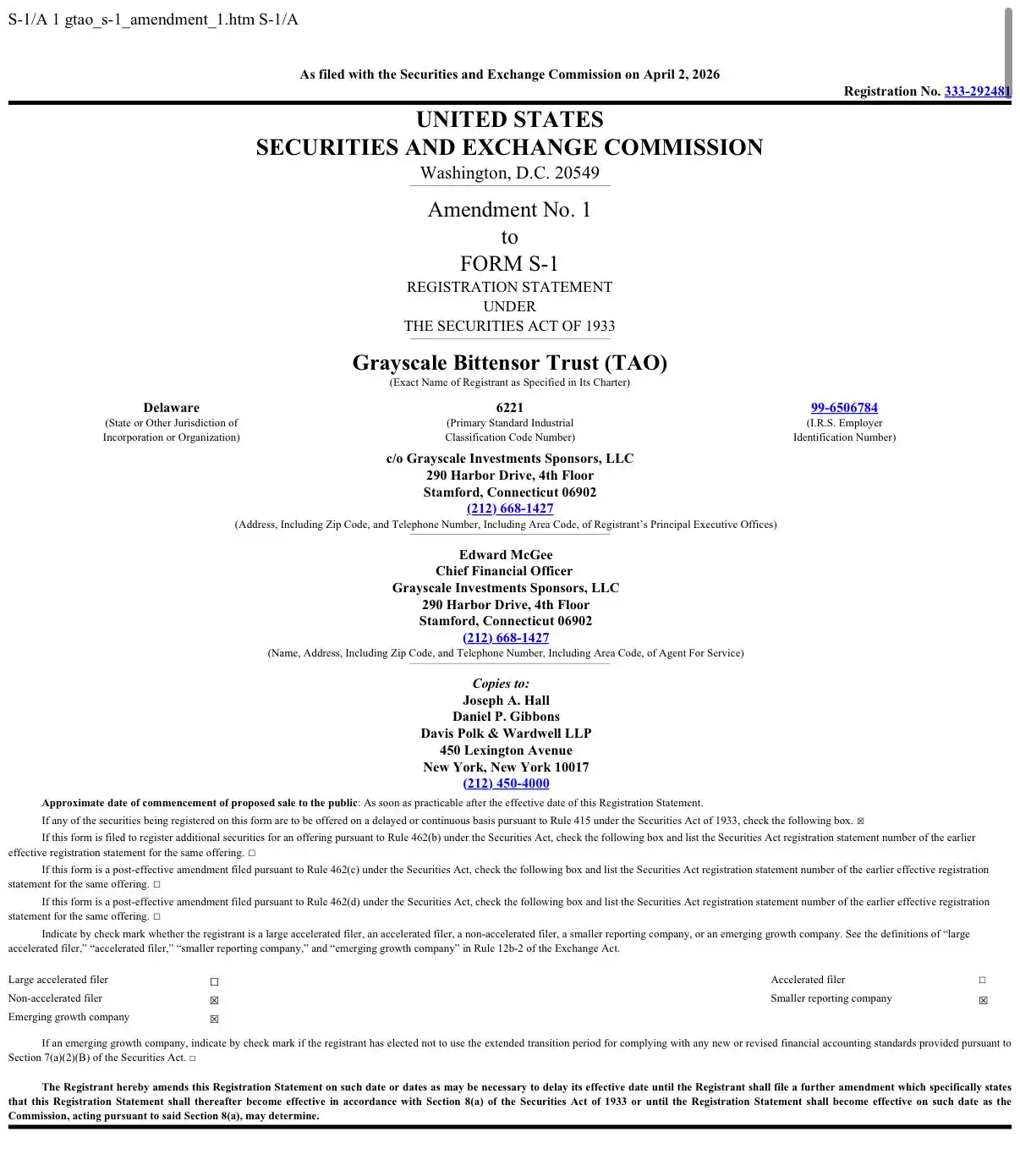 (Source: SEC)
According to the SEC filing, the Grayscale Bittensor Trust currently has the following structural characteristics that investors should fully understand:
NAV premium/discount risk: The trust share’s trading price on the OTC market may not reflect the actual net asset value (NAV) of the holdings, and it may trade at a premium or discount; the magnitude of fluctuations can sometimes be significant
Investment objectives have not been met: As of the filing date, the trust has not yet achieved its stated investment objective of tracking the market price of TAO
OTC liquidity constraints: Trading volume and market depth on OTC Markets Group are typically lower than those of products listed on major exchanges, so investors’ costs for entering and exiting positions are relatively higher
Implications of the S-1/A Amendment: The Path for OTC Trusts Toward Compliant Investment Tools
Under the U.S. securities regulatory framework, S-1 is the standard securities registration form that companies submit to the SEC, and S-1/A represents updates or supplements to a prior filing. For Grayscale’s crypto trust products, the submission of an S-1/A typically appears as part of a compliant advancement process in which the trust attempts to list on a formal exchange or explores an ETF conversion.
Grayscale’s representative prior cases include its Bitcoin Trust (GBTC) and Ethereum Trust (ETHE). Both underwent S-1 application update procedures and ultimately completed conversion to spot ETFs in 2024. Whether the TAO trust’s submission of an S-1/A indicates a similar upgrade pathway is still subject to the SEC’s subsequent review responses and confirmations, so it should not be directly equated with an ETF conversion application.
Market Backdrop for Institutionalization of AI Tokens
The timing of Grayscale’s push to file the TAO trust S-1 coincides with the period when the Bittensor ecosystem’s technological breakthroughs sparked widespread attention. The Subnet 3 Covenant-72B model successfully completed training using more than 70 globally distributed nodes, and in the MMLU benchmark test it reached a level comparable to Meta Llama 2 70B, for the first time validating the practical feasibility of decentralized AI training. Public attention from NVIDIA (Jensen Huang) CEO Jensen Huang and well-known investor Chamath Palihapitiya toward Bittensor further strengthened the institutional narrative momentum behind TAO, driving the TAO token to nearly double in March; as of the recent period it was around $317, with market capitalization slightly above $3 billion.
The investment narrative around decentralized AI infrastructure is attracting the attention of an increasing amount of institutional capital. Grayscale’s continued progress on the SEC compliance filing for the TAO trust indicates that its view of institutional demand for AI tokens is taking shape, and that there is market groundwork to build compliant investment channels.
Frequently Asked Questions
What is the Grayscale Bittensor Trust?
The Grayscale Bittensor Trust is a TAO token trust product launched by Grayscale. It allows investors to obtain exposure to TAO price performance through traditional brokerage accounts, without having to directly manage crypto wallets or private keys. Trust shares are currently listed for trading on OTC Markets Group under alternative reporting standards.
What does the S-1/A amendment mean for the Grayscale TAO Trust?
S-1/A is an update to the securities registration documents submitted to the SEC, and it is a standard legal step in the process of advancing the trust toward compliance. Based on precedents set by GBTC and ETHE, S-1/A submissions typically appear during workflows related to listing on a formal exchange or converting to an ETF, but the specific outcome still depends on the SEC’s review decision. At present, it should not be directly interpreted as an ETF application being approved.
How does the Grayscale TAO Trust differ from directly buying TAO?
The trust allows investors to hold positions indirectly through familiar brokerage accounts without having to deal with token custody; however, the market price of the trust shares may deviate from the actual NAV at a premium or discount. In addition, it currently still has not achieved the full objective of tracking the TAO market price, so investors need to evaluate the related risks themselves.
Disclaimer: The information on this page may come from third parties and does not represent the views or opinions of Gate. The content displayed on this page is for reference only and does not constitute any financial, investment, or legal advice. Gate does not guarantee the accuracy or completeness of the information and shall not be liable for any losses arising from the use of this information. Virtual asset investments carry high risks and are subject to significant price volatility. You may lose all of your invested principal. Please fully understand the relevant risks and make prudent decisions based on your own financial situation and risk tolerance. For details, please refer to
Disclaimer.


