Anthropic has officially put a price tag on the AI agent infrastructure: $0.08 per active execution hour. Notion, Rakuten, Asana, and Sentry are already among the first adopting companies.
(Background: Anthropic has taken over the underlying AI agent architecture: Notion and Rakuten went live in the first batch, with latency reduced by up to 90%)
(Additional context: Top AI models are moving toward divergence: ChatGPT to C, Claude to B)
Table of Contents
Toggle
- Compressing from “months” to “days”
- The $0.08 bill
- The move toward managed services, and the first market pricing benchmark
Eight cents per hour doesn’t sound like much. But if an AI agent runs 8 hours a day and runs full 30 days a month, the bill comes to $19.20. That’s for just a single agent, not including token fees. This (9) morning, Anthropic officially announced that Claude Managed Agents are entering public beta, and published the company’s pricing benchmark for its hosted AI agents.
Introducing Claude Managed Agents: everything you need to build and deploy agents at scale.
It pairs an agent harness tuned for performance with production infrastructure, so you can go from prototype to launch in days.
Now in public beta on the Claude Platform. pic.twitter.com/vHYfiC1G56
— Claude (@claudeai) April 8, 2026
From “months” to “days”
The core positioning of Claude Managed Agents isn’t a better language model—it’s an API bundle that lets enterprises skip the infrastructure build phase. According to Anthropic, traditionally, taking an AI agent prototype to official production requires “months of infrastructure work”: sandbox environments, identity verification, a tool-execution pipeline, and state management for long-running execution—each one requires engineers to build from scratch.
With Managed Agents, Anthropic’s claim is: they handle all of that. What enterprises have left is to define what the agent should do, and then deploy it.
Anthropic has shared performance data from multiple customers:
Sentry paired their debugging agent, Seer, with a Claude-powered agent. The latter is responsible for writing patches and opening PRs, enabling developers to complete the entire flow—from finding a bug to getting a reviewable patch—in one process.
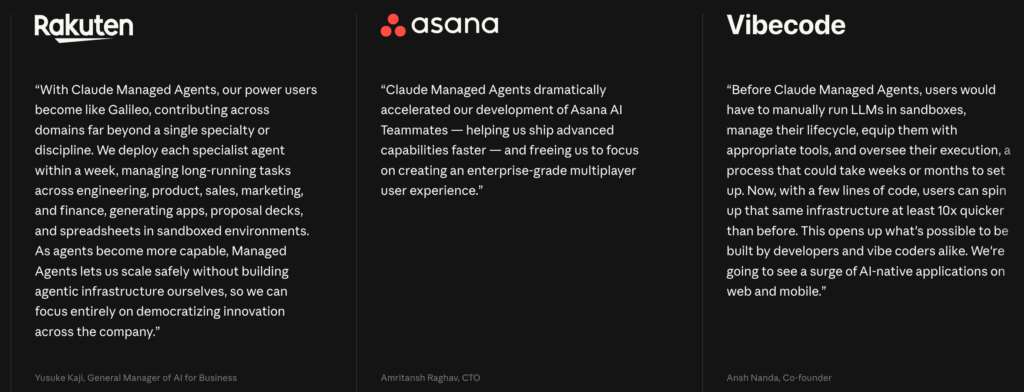
Rakuten is even more extreme: enterprise agents spanning product, sales, and marketing, as well as finance, are deployed within “a week” each. They connect Slack and Teams, allowing employees to hand tasks to the agent and get back finished outputs like spreadsheets, slide decks, or applications.
Vibecode said that after integrating Managed Agents as the default, they help customers go from prompt to deploying a complete app at a speed “at least 10x faster” than getting the same infrastructure running.
The veracity of these numbers can’t be independently verified, but the logic is consistent: Anthropic sells engineering time. The complexity is absorbed by the hosted service, and the price is that $0.08/session-hour.
The $0.08 bill
The pricing structure has two layers: the token fees of the standard Claude Platform (billed based on usage), and an added $0.08 execution-time fee.
If a single agent runs 8 hours per working day, the monthly fee is about $14. With token usage added, the actual bill depends on the type of task. But for enterprise-level deployments, the number of agents is the key multiplier. If Rakuten runs multiple agents across four departments, the number of sessions executed has a fairly direct impact on the monthly fee.
Anthropic’s internal testing shows that for structured file-generation tasks, the task success rate of Managed Agents is “up to 10 percentage points” higher than a standard prompting loop, with the biggest improvements on the hardest problems. However, that represents a best-case scenario rather than an average, and the baseline task difficulty settings aren’t disclosed.
From a customer-side procurement logic standpoint, the reason for adopting it is unlikely to be those 10 percentage points. More central is the compression of the development cycle. Asana built “AI Teammates” to collaborate with humans within projects, handling tasks and drafting deliverables, saying that using Managed Agents significantly accelerated advanced feature development.
Notion lets users directly delegate work to Claude within their workspace; dozens of tasks can run in parallel (still in private alpha for now).
For the product teams at these two companies, not having to build session management and multi-agent coordination frameworks from scratch effectively means engineers spend their time on product differentiation rather than infrastructure maintenance.
The key trade-off is scale. For small usage, building in-house costs more; for large-scale deployments, the cumulative effect of $0.08 is what gets re-examined.
The move toward managed services, and the first market pricing benchmark
Taking a bigger view, the release of Claude Managed Agents is a concrete signal that the AI agent market is moving toward “SaaS-ification.”
In the past two years, the mainstream path for enterprises building AI agents has been: pick a model API, build an orchestration layer in-house, manage the tool-execution environment yourself, and handle state for long-running execution yourself.
Anthropic’s approach is to absorb that layer of complexity into the subscription. This isn’t a new idea—AWS, Azure, and GCP have been doing it for over a decade. But at the level of AI agents, $0.08/session-hour is the first openly transparent market pricing benchmark seen so far.
Multi-agent coordination is still in the research preview stage and requires an application to use, meaning the most complex task scenarios—where agents can launch and direct other agents to process work in parallel—aren’t fully open yet.
That’s also the most worth watching variable in how pricing evolves next: when agents can automatically spawn more agents, how should the $0.08 billing unit be adjusted accordingly?
Anthropic hasn’t answered that question. But the existence of the public beta suggests they’re willing to let the market start running first and let the numbers speak.

Disclaimer: The information on this page may come from third parties and does not represent the views or opinions of Gate. The content displayed on this page is for reference only and does not constitute any financial, investment, or legal advice. Gate does not guarantee the accuracy or completeness of the information and shall not be liable for any losses arising from the use of this information. Virtual asset investments carry high risks and are subject to significant price volatility. You may lose all of your invested principal. Please fully understand the relevant risks and make prudent decisions based on your own financial situation and risk tolerance. For details, please refer to
Disclaimer.


