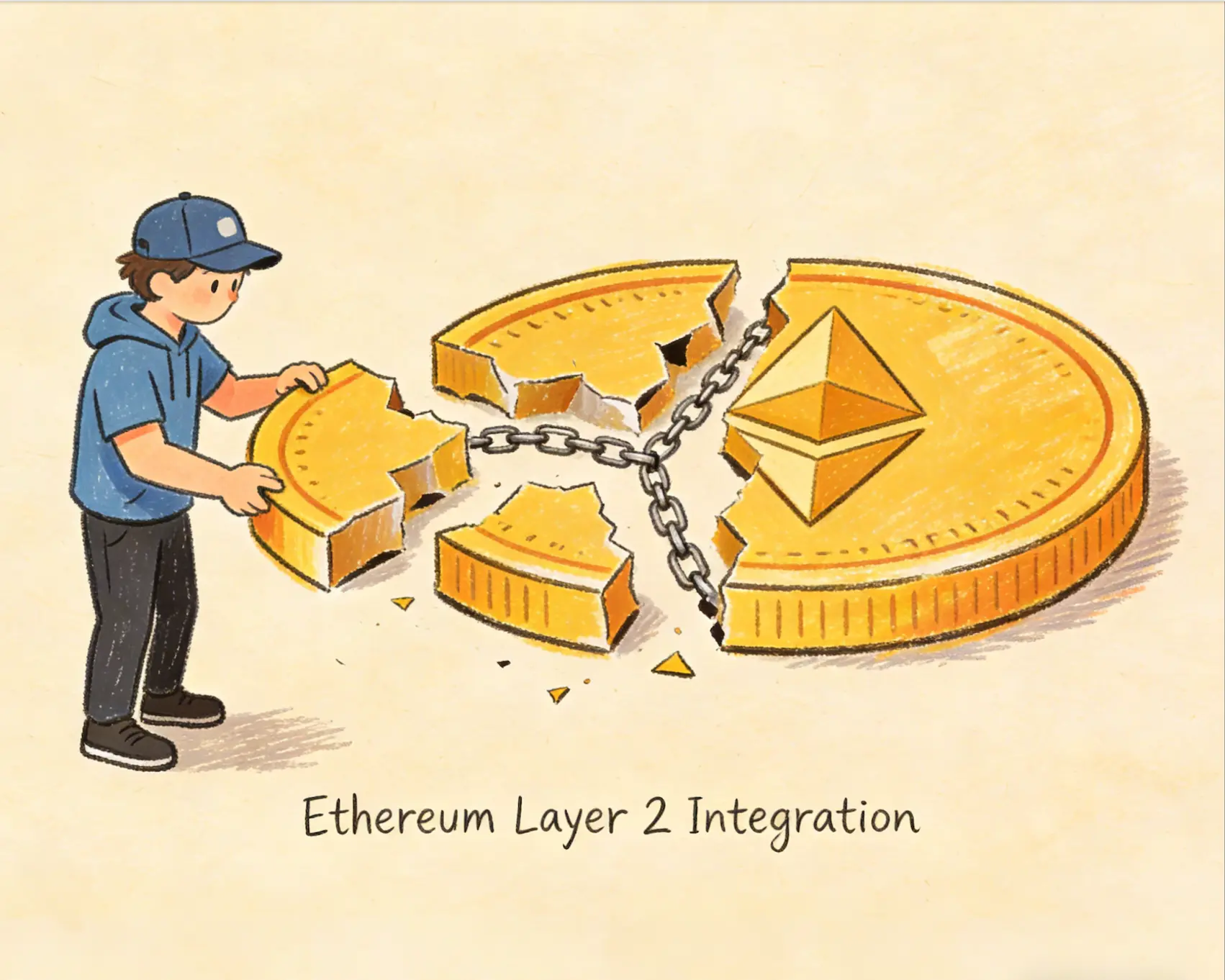
 Gnosis and Zisk developers proposed the Ethereum Economic Zone (EEZ) framework on March 30, 2026, a technical standard designed to enable rollups to interact synchronously with Ethereum mainnet and each other within a single transaction without relying on bridges.
The initiative, co-funded by the Ethereum Foundation, addresses fragmentation across Ethereum’s layer-2 ecosystem where dozens of rollups have split liquidity, infrastructure and user activity despite expanding overall network capacity.
EEZ Framework Proposes Synchronous Composability between Rollups and Ethereum Mainnet
The Ethereum Economic Zone framework allows smart contracts on connected rollups to call contracts on Ethereum mainnet or other EEZ-compliant rollups with the same guarantees as if deployed directly on Ethereum. The architecture uses ETH as its default gas token and requires no additional bridging infrastructure, eliminating the need for cross-chain transfers that currently fragment liquidity across separate environments.
Gnosis co-founder Friederike Ernst characterized Ethereum’s scaling challenge as a fragmentation problem rather than a capacity limitation, noting that each new layer-2 network launches with its own liquidity pool and bridge, creating isolated ecosystems. Zisk founder Jordi Baylina, who previously created the Circom programming language and co-founded Polygon zkEVM, stated that his proving stack enables real-time ZK proving of Ethereum blocks, making synchronous composability between rollups technically feasible.
The EEZ will be structured as a Swiss non-profit with all software released as free and open-source. The project aims for governance minimization and eventual non-upgradability. Technical specifications and performance benchmarks are expected in the coming weeks.
Ethereum Fragmentation Debate Intensifies as Layer-2 Networks Multiply
The EEZ proposal emerges amid ongoing debate within the Ethereum community over the trade-offs of the rollup-centric scaling roadmap. Data from L2BEAT shows more than 20 active layer-2 networks securing nearly $40 billion in total value, with liquidity distributed across networks including Arbitrum, Base and Optimism. Rather than consolidating activity, Ethereum’s scaling model has created parallel execution environments that split user experience and capital efficiency.
Ethereum co-founder Vitalik Buterin raised concerns in February 2026 about the design of certain layer-2 networks, pointing to centralized sequencers and trusted bridging mechanisms as potential weak points. Buterin stated that the original vision for layer-2 networks and their role in Ethereum no longer aligns with current realities, indicating the ecosystem may need to reconsider how rollups contribute to Ethereum’s scaling model.
Layer-2 builders responded with divergent views. Optimism co-founder Karl Floersch acknowledged that rollups must evolve beyond simple scaling, citing ongoing technical limitations. Offchain Labs co-founder Steven Goldfeder, whose firm develops Arbitrum, argued that scaling remains a core function as rollups continue to handle higher transaction throughput than Ethereum mainnet.
EEZ Alliance Forms with Aave, Block Builders and RWA Platforms as Founding Members
The EEZ initiative launched alongside an informal collective called the EEZ Alliance. Founding members include DeFi lending protocol Aave, block builders Titan and Beaver Build, real-world asset platform Centrifuge, and tokenized equities project xStocks. The alliance aims to coordinate standards and support adoption as Ethereum’s scaling architecture continues to evolve.
Analysis from 2024 indicated a new Ethereum layer-2 network was appearing approximately every 19 days, with each adding a new silo of fragmented liquidity. A 2026 outlook concluded that most new layer-2 launches became inactive shortly after incentive cycles, while meaningful activity concentrated around a small set of ecosystems.
GnosisDAO governance records from February 2026 showed the community had been debating a six-month research and development collaboration with Baylina to explore converting Gnosis Chain into a natively integrated Ethereum layer-2 with synchronous composability. The EEZ appears to be the product of that exploration.
Ethereum Foundation Co-Funding Signals Strategic Focus on Interoperability
The Ethereum Foundation’s decision to co-fund the EEZ initiative follows a shift to a leaner spending posture. The foundation paused its open grants program in mid-2025 as part of an effort to reduce its burn rate to approximately 5% annually. Co-executive directors Hsiao-Wei Wang and Tomasz K. Stańczak have stated that their priorities include scaling Ethereum mainnet and improving layer-2 interoperability, making the EEZ a natural fit for the foundation’s narrower focus.
The EEZ enters a field of existing interoperability efforts. The Ethereum Foundation’s Account Abstraction team unveiled an Interop Layer in November 2025 designed to make the layer-2 ecosystem function as a single unified chain. Optimism’s Superchain and Polygon’s AggLayer have pursued cross-chain coordination strategies, while the =nil; Foundation has developed a zkSharding-based approach to address the same underlying fragmentation problem.
FAQ
What is the Ethereum Economic Zone (EEZ) proposal?
The EEZ is a framework proposed by Gnosis and Zisk developers, co-funded by the Ethereum Foundation, that enables rollups to interact synchronously with Ethereum mainnet and with each other within a single transaction without relying on bridges. The framework uses ETH as its default gas token and requires no additional bridging infrastructure.
How does EEZ differ from other Ethereum interoperability solutions?
EEZ distinguishes itself through real-time ZK proving technology that can prove Ethereum blocks in real time, enabling synchronous composability between rollups. It joins existing interoperability efforts including the Ethereum Foundation’s Interop Layer, Optimism’s Superchain, and Polygon’s AggLayer, but proponents argue its proving stack makes synchronous composability technically achievable.
Which projects are involved in the EEZ Alliance?
Founding members of the EEZ Alliance include DeFi lending protocol Aave, block builders Titan and Beaver Build, real-world asset platform Centrifuge, and tokenized equities project xStocks. The alliance serves as an informal collective to coordinate standards and support adoption of the EEZ framework.
Disclaimer: The information on this page may come from third parties and does not represent the views or opinions of Gate. The content displayed on this page is for reference only and does not constitute any financial, investment, or legal advice. Gate does not guarantee the accuracy or completeness of the information and shall not be liable for any losses arising from the use of this information. Virtual asset investments carry high risks and are subject to significant price volatility. You may lose all of your invested principal. Please fully understand the relevant risks and make prudent decisions based on your own financial situation and risk tolerance. For details, please refer to
Disclaimer.


