À medida que os modelos de IA evoluem para multimodalidade, casos de uso verticais e agentes inteligentes (agentes), o consenso do setor migra de "mais dados é melhor" para "dados de alta fidelidade, rastreáveis e em conformidade com privacidade são o recurso escasso". Plataformas centralizadas tradicionais de rotulagem enfrentam gargalos de custo, resposta à demanda de cauda longa e distribuição justa dos colaboradores. Redes de dados de IA descentralizadas buscam remodelar as relações de produção de dados por meio de inteligência coletiva, coordenação por tokens e interfaces abertas. Compreender como a Alaya AI opera exige analisar suas camadas técnicas, pipeline de rotulagem automática, lógica de amostragem e mecanismos econômicos on-chain, em vez de descartá-la como mero "serviço terceirizado de rotulagem com blockchain".
Do ponto de vista da arquitetura industrial, a Alaya AI representa a convergência de Web3 e IA na camada de dados: as contribuições de dados podem ser incentivadas, as permissões de tarefas transformadas em NFTs e o desenvolvimento de modelos financiado pelo apoio da comunidade via pool de staking do AGT, enquanto a Plataforma de Dados Abertos (ODP) conecta oferta e demanda. As seções a seguir detalham a arquitetura central da rede, mecanismos de aumento de eficiência, integração Web3, sistemas de staking e contribuição, diferenças em relação às plataformas tradicionais, desafios reais e direções futuras, oferecendo uma estrutura organizada para avaliar sua viabilidade técnica e valor do ecossistema.
Detalhamento da Arquitetura Técnica Principal da Alaya AI
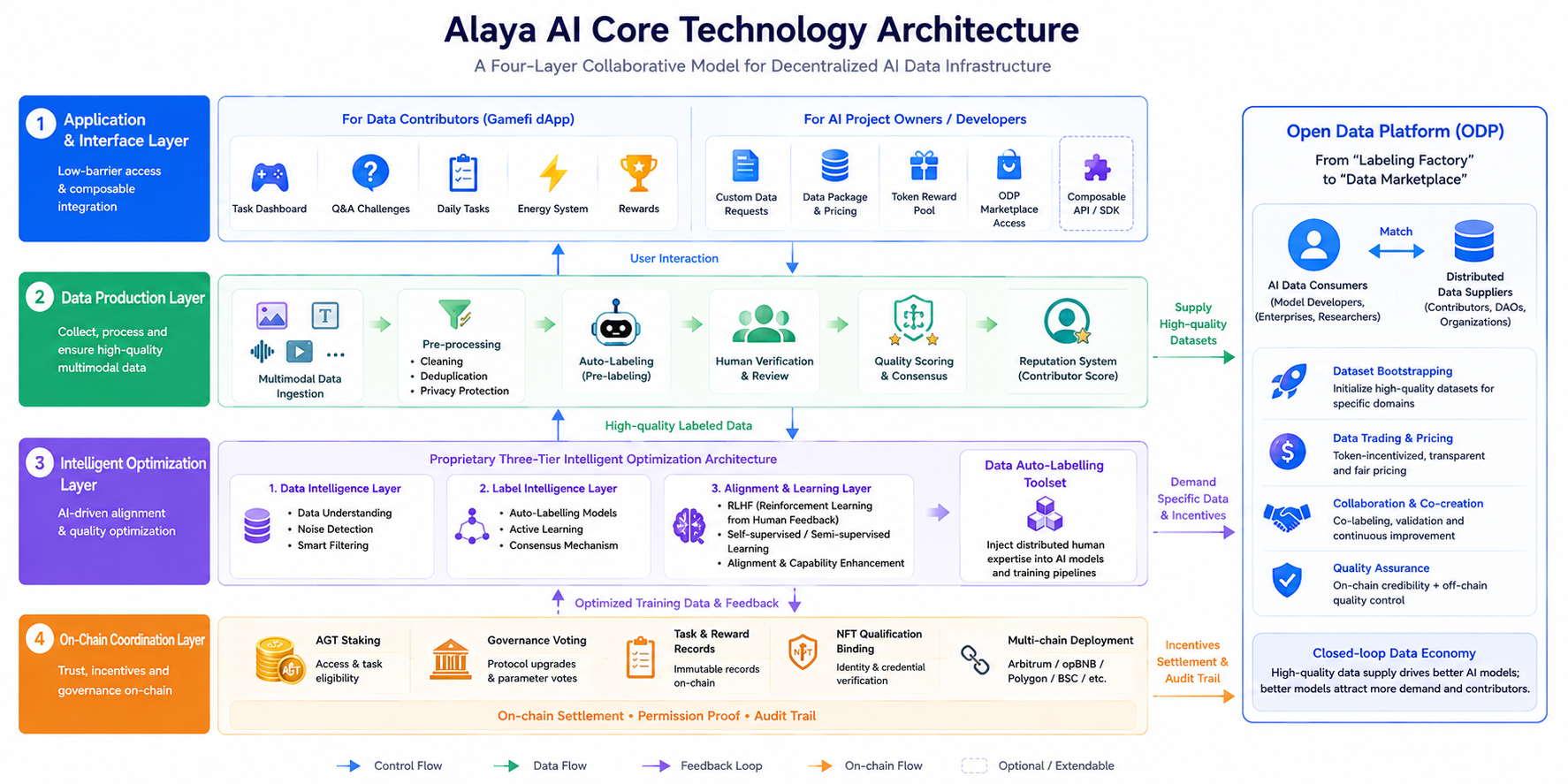
A arquitetura geral da Alaya AI pode ser descrita como um modelo colaborativo de quatro camadas, com responsabilidades claramente separadas e fluxos de dados e controle distintos, evitando a sobrecarga de desempenho de "colocar tudo on-chain".
-
Camada de Aplicação e Interface. Inclui um DApp gamificado para contribuidores de dados (com painéis de tarefas, desafios de quiz, tarefas diárias, etc.), além de solicitações personalizadas de dados, ofertas de pacotes de dados e entrada no marketplace ODP para equipes de projetos de IA. Esta camada enfatiza participação de baixa barreira e acesso componível, permitindo que desenvolvedores publiquem necessidades verticais de dados via pools de recompensa personalizados com tokens.
-
Camada de Produção de Dados. Responsável pela captação multimodal de dados (texto, imagens, vídeo, áudio), pré-processamento (limpeza, deduplicação, proteção de privacidade), rotulagem automática, verificação manual e pontuação de qualidade. A Alaya AI baseia-se em princípios de inteligência coletiva: a mesma tarefa pode ser rotulada de forma cruzada por vários contribuidores, usando mecanismos de consenso ou maioria para melhorar a consistência dos rótulos, enquanto a precisão histórica forma uma reputação que influencia a alocação futura de tarefas.
-
Camada de Otimização Inteligente. O componente principal é o Conjunto de Ferramentas de Rotulagem Automática de Dados, impulsionado por uma arquitetura proprietária de otimização inteligente em três camadas. Combinado com o ajuste fino por RLHF (Aprendizado por Reforço com Feedback Humano), injeta conhecimento humano distribuído em processos autossupervisionados e semissupervisionados, apoiando o alinhamento e a melhoria da capacidade do modelo.
-
Camada de Coordenação On-Chain. As principais informações de coordenação — como staking de AGT, votação de governança, registros de status de tarefas e recompensas e vinculação de qualificação de NFT — dependem da blockchain (as implantações do ecossistema abrangem várias redes, incluindo Arbitrum, opBNB, Polygon e BSC; consulte os anúncios oficiais para mais detalhes). A cadeia não armazena grandes volumes de dados brutos, mas lida com liquidação de incentivos, prova de permissão e ancoragem de trilha de auditoria, seguindo o paradigma comum de design de IA Web3 de "computação off-chain, confiança on-chain".
A Plataforma de Dados Abertos (ODP), lançada em novembro de 2024, expande a rede de uma "fábrica de rotulagem" para um "mercado de dados": consumidores de dados de IA e fornecedores distribuídos conectam-se diretamente por meio de incentivos personalizados com tokens, apoiando a inicialização, negociação e colaboração de conjuntos de dados para criar um ciclo fechado de oferta e demanda.
Como o Sistema de Rotulagem Automática Melhora a Eficiência dos Dados de IA
A rotulagem automática é um módulo central para a Alaya AI reduzir custos marginais e encurtar ciclos de entrega. O projeto a posiciona como a próxima fase da evolução da IA autossupervisionada: as máquinas geram rótulos candidatos, e os humanos concentram-se em amostras ambíguas e julgamentos específicos de domínio, em vez de rotular manualmente cada dado do zero.
O processo técnico normalmente inclui estas etapas:
-
Captação Multimodal: O conjunto de ferramentas aceita dados visuais estáticos e dinâmicos, texto e entradas de sensores, que entram em um pipeline de pré-processamento unificado.
-
Pré-processamento Algorítmico: Realiza limpeza automática e deduplicação. A criptografia de conhecimento zero (criptografia ZK) é aplicada a caminhos de dados sensíveis, permitindo computação enquanto minimiza a exposição de texto simples, atendendo aos requisitos de privacidade e conformidade dos clientes empresariais.
-
Pré-rotulagem do Modelo: Um modelo proprietário de rotulagem automática gera rótulos iniciais. Para categorias comuns de dados de IA, o projeto afirma uma taxa de verificação superior a 80%, com processamento em tempo real de fluxos visuais dinâmicos, essencial para cenários como rotulagem de quadros de direção autônoma e vídeos de inspeção de qualidade industrial.
-
Ciclo de Otimização RLHF: Os resultados da verificação dos contribuidores são realimentados no modelo, reduzindo continuamente a proporção de revisão manual. A prática do setor mostra que, dentro de um ciclo RLHF, a intervenção humana pode ser focada em aproximadamente 20% das amostras de alta dificuldade, reduzindo significativamente os custos e prazos gerais (as proporções exatas variam por tipo de tarefa).
-
Camada de Verdade de Especialistas: Para pedidos de alta fidelidade de nível empresarial, a plataforma pode implantar uma equipe interna de especialistas no domínio (engenheiros, linguistas, especialistas visuais, etc.) como a camada final de arbitragem, criando uma estrutura de dupla via de "rendimento automatizado + precisão de especialistas" junto com os resultados de crowdsourcing. Materiais de 2026 também enfatizam que grandes volumes de dados ruidosos tornam-se um gargalo operacional, e dados verticais de alta fidelidade são o combustível essencial para modelos e agentes de próxima geração.
O valor dessa arquitetura híbrida reside em: a rede pública fornece escala e velocidade, enquanto o pipeline fechado de especialistas mantém padrões de qualidade em setores sensíveis a riscos, evitando que a descentralização seja interpretada erroneamente como "crowdsourcing de baixa qualidade".
Como Funciona o Mecanismo de Amostragem Distribuída de Dados
Diferentemente da "raspagem aleatória total", a Alaya AI enfatiza a otimização inteligente e a amostragem direcionada: seleciona amostras com alta densidade de informação com base nos objetivos do modelo, aliviando o problema de "grande conjunto de dados, baixo sinal efetivo".
O mecanismo de amostragem pode ser entendido a partir de três dimensões:
-
Orientado pela Demanda: Clientes de IA enviam solicitações personalizadas (por exemplo, dialetos específicos, imagens médicas especializadas, condições de trânsito regionais). A plataforma roteia unidades de trabalho para pools de contribuidores que correspondam ao nível de NFT, idioma ou formação profissional exigidos, alcançando um alinhamento aproximado entre mão de obra e tarefas.
-
Amostragem de Redundância em Grupo: Múltiplas pessoas rotulam independentemente o mesmo lote de dados. A detecção de consistência identifica rótulos discrepantes; amostras com baixa consistência entram automaticamente em uma fila de revisão ou canal de especialistas. Isso substitui a supervisão total de um único inspetor de qualidade por redundância distribuída.
-
Desvio Dinâmico e Estático: Tarefas de imagem estática e tarefas de fluxo de vídeo dinâmico usam estratégias de taxa de transferência diferentes. A visão dinâmica pode integrar segmentação automática e rotulagem em nível de quadro para reduzir custos manuais por quadro.
-
Amostragem de Tempo e Cenário: Os cenários oficiais incluem o uso de tempo fragmentado (por exemplo, deslocamento) para participar de tarefas leves, convertendo mão de obra ociosa em capacidade de produção de dados. Uma interface de usuário gamificada (pontos de experiência, valores de energia) sustenta a retenção de longo prazo, tornando o pool de amostragem contínuo em vez de uma corrida de crowdsourcing única.
A limpeza e deduplicação no pré-processamento reduzem o viés de amostragem na fonte: se amostras duplicadas, arquivos corrompidos ou metadados incorretos entrarem no conjunto de treinamento, amplificam alucinações e vieses do modelo. Portanto, a amostragem não se resume a "quanto amostrar", mas envolve um esforço de engenharia sistemático sobre "o que amostrar, quem faz e como verificar".
Como se Combinam Web3 e Redes de IA
Os atributos Web3 da Alaya AI não se limitam a "pagar com tokens", mas envolvem tokenizar, transformar em NFTs e governar os principais elementos de coordenação da rede de dados.
-
Coordenação por Token: O token nativo AGT serve como limite de staking, votação de governança, desbloqueio de tarefas avançadas, upgrade de NFT e entrada de financiamento do pool de staking de modelos. O design de staking enfatiza custo irrecuperável e segurança. O projeto afirma explicitamente que o staking de AGT por si só não fornece rendimento passivo, evitando que capital especulativo prejudique os incentivos de qualidade da rotulagem.
-
Permissões de NFT: O Alaya NFT e o Medallion NFT formam um sistema de identidade de dupla via, determinando o tipo de tarefas acessíveis, limites de nível e sistemas de conquistas. Upgrades de alto nível consomem AGT em nós específicos, vinculando a identidade on-chain à produção de trabalho off-line.
-
Combinações Abertas de Incentivos: Projetos podem usar AGT ou seus próprios tokens para criar pools de dados personalizados, atendendo às preferências de liquidação de equipes de IA nativas da Web3. Desenvolvedores de pequeno e médio porte podem iniciar conjuntos de dados com custos de caixa mais baixos por meio da ODP.
-
Auditoria e Linhagem On-Chain: Para clientes empresariais, a plataforma enfatiza integridade criptográfica de ponta a ponta e trilhas de auditoria imutáveis, tornando a linhagem dos dados rastreável para apoiar revisões de conformidade.
-
Gamificação e Crescimento Social: Mecanismos como tarefas diárias, comissões de indicação e resgate mensal de AGT (usuários trocam créditos AIA ganhos em tarefas por AGT em um pool de resgate com prazo fixo) mapeiam periodicamente a atividade off-line para a distribuição de valor on-chain.
-
Implantação Multi-Cadeia: Reduz o atrito para usuários em diferentes ecossistemas. A mesma rede de dados pode alcançar grupos de usuários no Arbitrum, opBNB, etc. O roteiro também menciona a expansão para BNB Chain, Optimism, etc., para se adaptar a diferenças de taxa e velocidade.
A narrativa do ecossistema de 2026 posiciona ainda mais a Alaya AI como a espinha dorsal de dados para agentes de IA: os agentes exigem feedback humano contínuo e conhecimento de nicho, enquanto o crowdsourcing Web3 combinado com rotulagem automática fornece um pipeline de feedback escalável. A sinergia com estruturas de agente interativas em tempo real (como capacidades semelhantes ao OpenClaw discutidas externamente) aponta para um futuro de ciclo duplo de "aprendizado em tempo real + conjuntos de dados verificados em larga escala".
Análise dos Sistemas de Staking de Modelos de IA e Contribuição de Dados
A tokenização de modelos de IA é um mecanismo-chave que diferencia a Alaya AI das plataformas de rotulagem gerais: a comunidade pode financiar e fornecer mão de obra de dados para o desenvolvimento e ajuste fino de modelos específicos por meio do pool de staking de AGT, facilitando o alinhamento entre "aqueles que contribuem com dados se beneficiam das melhorias do modelo".
-
Caminho do Contribuidor: Registrar no DApp → Concluir tarefas básicas para construir reputação → Fazer staking de AGT para desbloquear tarefas de nível superior (verificação, calibração, colaboração em rotulagem automática) → Obter multiplicadores de recompensa mais altos; simultaneamente, ganhar créditos AIA para participar do resgate mensal por AGT.
-
Caminho do Projeto: Publicar solicitações personalizadas de dados na plataforma → Configurar pools de recompensa em AGT ou tokens de terceiros → A plataforma atribui tarefas a contribuidores correspondentes → Após rotulagem automática e controle de qualidade manual, entregar o conjunto de dados → Opcionalmente, listar ou negociar na ODP.
-
Lógica de Segurança do Staking: O AGT serve como ferramenta de coordenação de Prova de Participação, aumentando o custo econômico de rotulagem maliciosa e farming de volume. Combinado com o Medallion NFT, restringe ainda mais o acesso a tarefas de alto nível, protegendo pedidos de dados de alto valor.
-
Fluxo de Retorno de Valor: O plano oficial é usar a receita de serviços de dados da plataforma para recompra de AGT e injetá-lo no pool de recompensas de usuários, tentando fechar o ciclo de negócios de "demanda do cliente → receita → reincentivo → mais dados de alta qualidade". Seu efeito real depende do volume de pedidos empresariais e da transparência da recompra.
Esse sistema transforma a contribuição de dados de mão de obra única em uma colaboração em rede com participação: contribuidores, stakers e projetos competem e cooperam sob o mesmo conjunto de regras — uma estrutura Web3 que plataformas tradicionais de rotulagem SaaS não podem suportar nativamente.
| Dimensão |
Alaya AI |
Plataformas Tradicionais (ex.: Scale AI, Labelbox) |
| Forma Organizacional |
Comunidade distribuída + Plataforma aberta |
Operações centralizadas e contratos empresariais |
| Incentivo |
AGT, AIA, NFT, Gamificação |
Principalmente compensação em moeda fiduciária |
| Customização de Dados |
Pools de tokens personalizados, solicitações P2P |
SLAs padrão e processos de aquisição |
| Expressão de Propriedade |
NFT e registros on-chain enfatizam a equidade da contribuição |
Termos contratuais definem |
| Automação |
Rotulagem automática em três camadas + RLHF + Revisão de especialistas |
Pipelines maduros, muitos casos verticais profundos (ex.: automotivo) |
| Tipo de Cliente |
Nativos Web3 e equipes de IA de pequeno/médio porte, expansão empresarial em andamento |
Grandes empresas de tecnologia, projetos governamentais predominam |
As vantagens da Alaya AI residem em cauda longa, transfronteiriço, formação rápida de pools e incentivos transparentes. As plataformas tradicionais se destacam em certeza de entrega, maturidade jurídica, certificações do setor e experiência com projetos de megaprojetos. Redes descentralizadas não substituem fornecedores centralizados em todos os cenários, mas estabelecem diferenciação na interseção de "sensível ao orçamento, nicho vertical, nativo cripto".
Além disso, a Alaya enfatiza dados verticais de alta fidelidade em vez de acúmulo infinito de volume, diferindo da lógica tradicional de competição de "grande conjunto de dados". Isso favorece modelos pequenos eficientes em parâmetros e agentes, mas exige que os clientes aceitem o modelo de precificação e entrega de um pipeline híbrido (automático + especialista).
Desafios Enfrentados pelas Redes de Dados de IA Descentralizadas
Apesar da arquitetura completa, as redes de dados de IA descentralizadas enfrentam restrições do mundo real.
-
Equilíbrio entre Qualidade e Escala: Entre milhões de usuários registrados, a proporção de rotuladores consistentemente de alta qualidade é difícil de verificar externamente. Se os incentivos favorecerem o farming de volume, prejudicam a renovação de clientes de IA e a reputação da rede.
-
Barreiras de Adoção Empresarial: Jurídico, SOC2, gerentes de projeto dedicados, compensação de acidentes, etc., são requisitos padrão de aquisição empresarial. A transparência on-chain por si só não basta para assinar grandes contratos; é necessário acúmulo contínuo de casos auditáveis.
-
Complexidade da Experiência do Usuário: Carteiras, NFTs, tokens duplos (AGT/AIA), staking e regras de resgate aumentam o custo de aprendizado para novos usuários, potencialmente limitando o fluxo de contribuidores não Web3.
-
Incerteza Regulatória: Dados transfronteiriços, mão de obra incentivada por tokens e conformidade para dados sensíveis como saúde variam por país. Mudanças políticas podem afetar regiões operacionais e o design do token.
-
Sustentabilidade de Liquidez e Incentivos: A capitalização de mercado e o volume de negociação do AGT ainda são pequenos em relação ao mercado mais amplo. Se a receita da plataforma e as recompras não acompanharem a oferta de desbloqueio e resgate, os incentivos podem depender de novos usuários em vez de fluxo de caixa interno.
-
Riscos Técnicos: Vulnerabilidades de contratos inteligentes, erros de vinculação de carteira que impedem a coleta de resgate e amplificação de erros do modelo de rotulagem automática em categorias de cauda longa exigem investimento contínuo em engenharia.
-
Pressão Competitiva: Gigantes centralizados têm recursos profundos e alta fidelidade de clientes. Outros projetos de dados Web3 também competem pela mesma narrativa, e a diferenciação deve ser comprovada com dados entregues.
Direções Futuras de Desenvolvimento da Tecnologia Alaya AI
Combinando o roteiro oficial e as dinâmicas de 2025-2026, a evolução técnica provavelmente se concentrará nas seguintes direções.
-
Integração Profunda da Rotulagem Automática e RLHF: Melhorar as capacidades de processamento em tempo real para visão dinâmica, multilíngue e dados de feedback de agentes, encurtando o ciclo de "coletar → rotular → implantar de volta ao modelo".
-
ODP e Colaboração Socializada de Dados: Expandir da inicialização de conjuntos de dados para recursos mais ativos de negociação, compartilhamento e colaboração, aumentando os efeitos de rede.
-
DAO e Aprimoramento da Governança: Submeter mais decisões (ex.: prioridades de recursos de rotulagem automática, parâmetros econômicos) à votação dos stakers de AGT, aumentando a credibilidade das narrativas de soberania da comunidade.
-
Sinergia Multi-Cadeia e Ecossistema de Computação: Integrar com DePIN, computação descentralizada (ex.: Akash, Golem) e protocolos de mercado de modelos (ex.: Bittensor), explorando o stack aberto de "dados → treinamento → inferência" para reduzir o lock-in de plataforma única.
-
Posicionamento na era dos agentes: Fortalecer continuamente dados de alta fidelidade com intervenção humana como espinha dorsal de raciocínio para agentes; colaborar com estruturas de aprendizado de agentes em tempo real para formar ciclos duplos rápidos e lentos.
-
Aprimoramento de Conformidade Empresarial: Expandir criptografia ZK, auditoria de linhagem e cobertura de revisão de especialistas para ganhar pedidos em setores altamente regulamentados como saúde e finanças.
Mecanismos como o resgate mensal de AGT em 2026 indicam que o lado operacional usa uma cadência fixa para manter as expectativas dos contribuidores. Se o lado técnico corresponde à cadência operacional depende do investimento sustentado na precisão da rotulagem automática, algoritmos de roteamento de tarefas e na camada de especialistas.
Resumo
A rede de dados de IA descentralizada da Alaya AI é essencialmente um sistema colaborativo em camadas: a camada de aplicação reduz barreiras de participação, a camada de produção de dados melhora a eficiência com rotulagem automática e amostragem distribuída, a camada de otimização inteligente absorve conhecimento humano por meio de RLHF, e a camada de coordenação on-chain alinha incentivos e segurança com AGT, NFTs e regras de governança. A Plataforma de Dados Abertos eleva a rede de uma plataforma de tarefas a um mercado de dados componível, enquanto o pool de staking de modelos introduz capital comunitário e mão de obra no ciclo de ajuste fino de modelos.
O significado de sua lógica operacional para o setor de IA é: quando dados verticais de alta qualidade tornam-se um gargalo, a aquisição centralizada sozinha não pode cobrir mão de obra fragmentada de cauda longa e global; a arquitetura Web3 oferece uma curva de oferta alternativa. Ao mesmo tempo, os desafios são reais — verificação de qualidade, SLAs empresariais, regulação e sustentabilidade de incentivos determinarão se essa arquitetura técnica pode passar de "demonstrável" a "comercializável em escala".
Para observadores técnicos, avaliar a Alaya AI não deve olhar apenas para volumes de transações on-chain ou registros de usuários, mas acompanhar indicadores concretos como taxas de verificação de rotulagem automática, transações na ODP, renovações de clientes empresariais e execução de recompras. Esses indicadores respondem coletivamente a uma pergunta: uma rede de dados de IA descentralizada pode superar simultaneamente os principais pontos fortes das plataformas tradicionais em eficiência e confiabilidade?