Nos últimos anos, o setor de blockchain saiu de uma competição entre cadeias isoladas para uma coexistência multicadeia. Redes como Ethereum, BNB Chain, Avalanche, Arbitrum e Optimism desenvolveram seus próprios ecossistemas independentes. No entanto, esse crescimento espalhou ativos e aplicações por diferentes cadeias, tornando a interoperabilidade um desafio crítico para o avanço do setor.
Para alcançar a verdadeira interoperabilidade cross-chain, surgiram diversas soluções técnicas no mercado. Celer Network e Axelar são dois dos projetos mais representativos. Ambos buscam resolver o problema dos silos de informação entre blockchains, mas adotaram abordagens distintas em arquitetura de rede, design de segurança e posicionamento de produto.
O que é a Celer Network?
A Celer Network começou como uma solução de escalabilidade de Camada 2 antes de se transformar gradualmente em um protocolo cross-chain. Ela lançou produtos essenciais como cBridge, Inter-chain Messaging (IM) e a State Guardian Network (SGN).
O objetivo da Celer é criar uma camada de comunicação cross-chain unificada que permita transferências de ativos, passagem de mensagens e coordenação de contratos inteligentes em diferentes blockchains.
Hoje, seu ecossistema se concentra em pontes cross-chain, protocolos de mensagens cross-chain e infraestrutura para aplicações multicadeia.
O que é a Axelar?
Axelar é uma rede descentralizada projetada especificamente para comunicação cross-chain. Diferente de muitas pontes cross-chain, a Axelar é, por si só, uma blockchain PoS operada de forma independente, mantida por uma rede de validadores.
A Axelar conecta múltiplos blockchains por meio de contratos Gateway e protocolos de comunicação cross-chain, permitindo que desenvolvedores enviem mensagens, invoquem contratos inteligentes e transfiram ativos entre cadeias.
Sua visão central é construir uma rede de infraestrutura cross-chain análoga à camada de roteamento da Internet.
Quais são as principais diferenças no posicionamento central?
Embora ambos sejam protocolos de interoperabilidade cross-chain, suas prioridades de desenvolvimento divergem significativamente.
A Celer enfatiza a liquidez cross-chain e a interoperabilidade na camada de aplicação, com seu ecossistema construído em torno de cBridge e IM.
A Axelar, por outro lado, concentra-se em se tornar uma rede de comunicação universal entre blockchains, conectando diferentes cadeias por meio de uma camada de validação unificada.
Em essência, a Celer pode ser vista como uma combinação de ponte cross-chain e protocolo de mensagens, enquanto a Axelar se aproxima mais de uma camada de middleware de comunicação cross-chain.
Quais são as diferenças na arquitetura de rede?
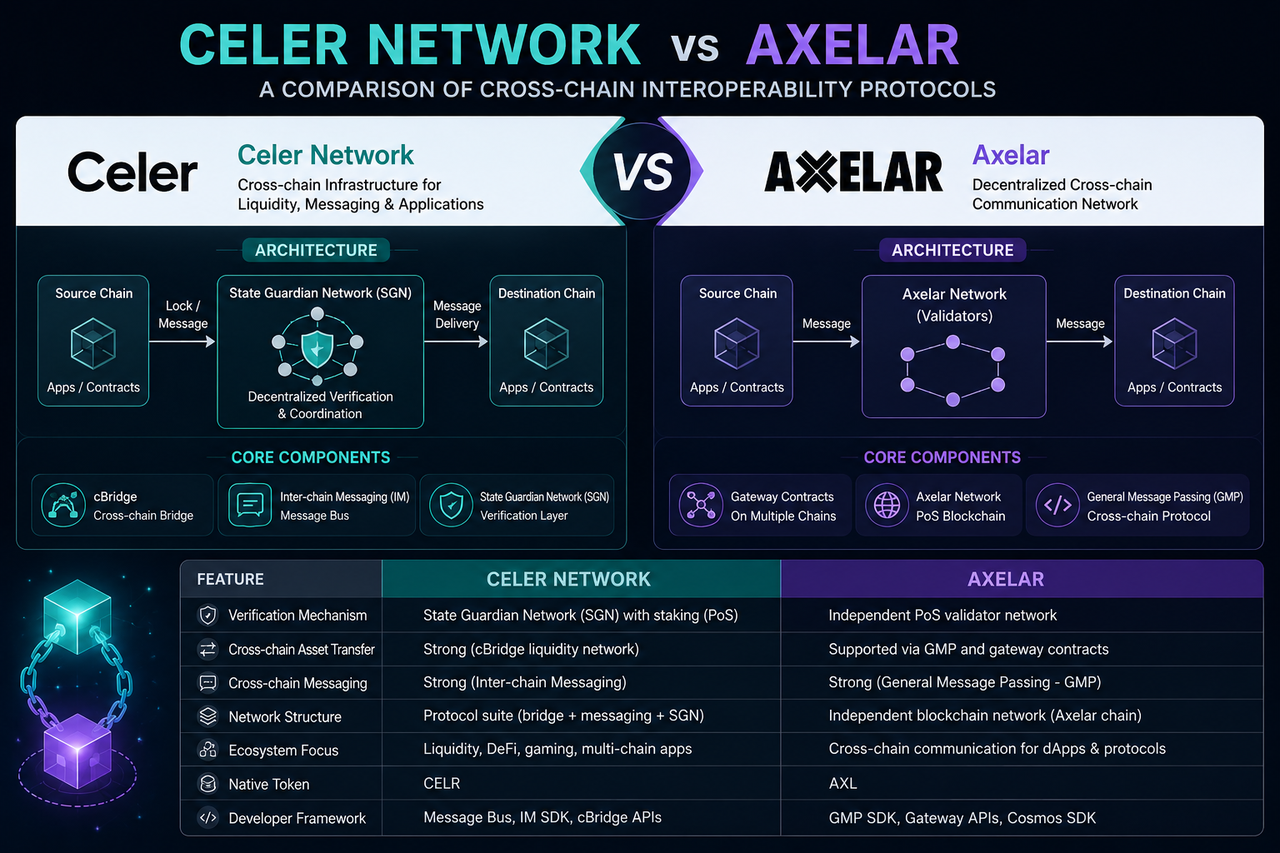
A arquitetura central da Celer inclui:
- cBridge (ponte cross-chain)
- Inter-chain Messaging (protocolo de mensagens cross-chain)
- State Guardian Network (SGN)
A SGN lida com a verificação de estado e a coordenação cross-chain.
A arquitetura da Axelar inclui:
Todas as solicitações cross-chain na Axelar são processadas por sua rede de validação independente.
Do ponto de vista arquitetural, a Axelar se assemelha mais a uma blockchain cross-chain independente, enquanto a Celer é mais uma coleção de protocolos de infraestrutura cross-chain.
Qual é a diferença entre a SGN e a rede de validadores da Axelar?
Esta é uma das distinções mais importantes entre os dois.
A SGN da Celer é uma camada de validação dedicada à verificação cross-chain e à coordenação de mensagens.
Os validadores fazem stake de CELR para participar da verificação de estado e da confirmação de mensagens.
A Axelar, por sua vez, opera uma rede completa de validadores e uma cadeia PoS independente.
Os validadores monitoram eventos de blockchains externos, verificam solicitações cross-chain e chegam a um consenso.
Em suma, a SGN é uma rede de validação a serviço do protocolo Celer, enquanto a rede de validadores da Axelar constitui, por si só, uma blockchain independente.
Como eles realizam a passagem de mensagens cross-chain?
A Celer utiliza o Inter-chain Messaging (IM) para a passagem de mensagens cross-chain.
As mensagens são iniciadas por meio do Message Bus, verificadas pela SGN e, em seguida, sincronizadas com a cadeia de destino para execução.
A Axelar usa o mecanismo General Message Passing (GMP).
Os desenvolvedores enviam mensagens por meio de contratos Gateway, e a rede de validadores as confirma antes de entregá-las à cadeia de destino.
Ambos suportam mensagens cross-chain arbitrárias, mas seus caminhos de execução subjacentes diferem.
Quais são as diferenças nos modelos de segurança?
A segurança é uma das métricas mais críticas para qualquer protocolo cross-chain.
A segurança da Celer é construída principalmente sobre o mecanismo de staking PoS da SGN.
Os validadores precisam fazer stake de CELR, e a segurança da rede é mantida por meio de incentivos econômicos e penalidades de slashing.
A segurança da Axelar depende de sua rede independente de validadores e do mecanismo de consenso PoS do Cosmos SDK.
Os validadores mantêm coletivamente a cadeia Axelar e são responsáveis pela verificação de estado cross-chain.
Assim, ambos adotam um modelo PoS, mas seus limites de segurança e designs de camada de consenso não são os mesmos.
Como eles se comparam em capacidades de transferência de ativos cross-chain?
O cBridge da Celer é um de seus produtos mais maduros.
Usando um modelo de rede de liquidez, os usuários podem mover ativos rapidamente por várias cadeias.
O gerenciamento de liquidez cross-chain sempre foi um ponto forte central da Celer.
A Axelar também suporta transferências de ativos cross-chain, mas seu foco de design tende mais para a camada de comunicação cross-chain.
Como resultado, na percepção do mercado, a Celer é mais frequentemente considerada uma solução de ponte cross-chain, enquanto a Axelar é vista como uma rede de comunicação cross-chain.
Quais são as diferenças na experiência do desenvolvedor?
A Celer fornece aos desenvolvedores:
- SDK do Inter-chain Messaging
- Interface do Message Bus
- Ferramentas de integração do cBridge
Os desenvolvedores podem construir rapidamente aplicações cross-chain e recursos de liquidez.
A Axelar fornece:
- SDK do GMP
- API do Gateway
- Ferramentas de desenvolvimento do ecossistema Cosmos
Os desenvolvedores podem usar uma interface unificada para alcançar comunicação multicadeia.
Ambos visam reduzir a complexidade do desenvolvimento cross-chain, mas suas pilhas tecnológicas diferem.
Quais são os principais casos de uso de cada um?
As aplicações típicas da Celer incluem:
- Pontes cross-chain
- DeFi multicadeia
- Governança cross-chain
- Redes de liquidez
- Jogos cross-chain
As principais aplicações da Axelar incluem:
- Comunicação de mensagens cross-chain
- Aplicações omnichain
- Governança multicadeia
- Serviços de automação cross-chain
- Conexão dos ecossistemas Cosmos e EVM
Do ponto de vista da aplicação, ambos suportam o desenvolvimento de aplicações cross-chain, mas seus focos de ecossistema diferem.
Celer vs. Axelar Core Comparison
| Dimensão |
Celer Network |
Axelar |
| Posicionamento central |
Ponte cross-chain e protocolo de interoperabilidade |
Rede de comunicação cross-chain |
| Mecanismo de validação |
Rede de validação SGN |
Rede de validadores Axelar |
| Modelo de consenso |
SGN PoS |
Cosmos PoS |
| Capacidade de ponte cross-chain |
Forte |
Média |
| Capacidade de mensagens cross-chain |
Forte |
Forte |
| Rede de liquidez |
cBridge |
Suportada, mas não central |
| Estrutura de desenvolvimento |
Message Bus |
GMP |
| Token nativo |
CELR |
AXL |
Resumo
A Celer Network e a Axelar são ambas protocolos de infraestrutura críticos no espaço de interoperabilidade cross-chain, mas seguem caminhos técnicos diferentes.
A Celer constrói seu sistema de liquidez e comunicação cross-chain em torno de cBridge, Inter-chain Messaging e SGN. A Axelar, por sua vez, alcança conectividade unificada entre blockchains por meio de uma rede PoS independente e do protocolo GMP.
Perguntas Frequentes
Qual é a maior diferença entre a Celer e a Axelar?
A maior diferença está na arquitetura de rede. A Celer usa a SGN como uma camada de validação, enquanto a Axelar é, por si só, uma blockchain PoS operada de forma independente.
Qual é a diferença entre a SGN e a rede de validadores da Axelar?
A SGN é a rede de validação cross-chain da Celer, enquanto a Rede de Validadores Axelar não apenas valida solicitações cross-chain, mas também mantém a operação da própria cadeia Axelar.
Qual protocolo é mais adequado para cenários de ponte cross-chain?
O cBridge da Celer é mais representativo em termos de liquidez cross-chain e transferência de ativos, por isso geralmente é considerado como tendo uma forte vantagem no domínio de pontes cross-chain.
O que é o GMP da Axelar?
GMP (General Message Passing) é o protocolo de mensagens cross-chain da Axelar que permite que desenvolvedores passem mensagens arbitrárias e invoquem contratos inteligentes em diferentes blockchains.