A indústria de energia vive uma transformação digital. Equipamentos energéticos já foram vistos como infraestrutura puramente física, com valor medido apenas pela capacidade de geração, armazenamento ou fornecimento. Porém, com a ascensão da IoT, das redes inteligentes e da tecnologia blockchain, os dispositivos de energia agora geram dados e trocam valor. Os sistemas energéticos evoluem de redes tradicionais de infraestrutura para redes digitais de energia.
Nesse cenário, a tokenização de ativos energéticos tornou-se uma direção estratégica para a internet da energia. Como um grande projeto no universo de energia DePIN, o OpenVPP tem como objetivo integrar recursos energéticos distribuídos, incluindo veículos elétricos (VEs), sistemas de armazenamento de baterias, equipamentos solares e medidores inteligentes, em uma rede blockchain unificada.
O que é a tokenização de ativos energéticos?
A tokenização de ativos energéticos é um processo digital que utiliza blockchain para mapear equipamentos de energia e o valor gerado por eles na chain.
Nos sistemas energéticos tradicionais, VEs, baterias e sistemas solares criam valor, mas esse valor geralmente fica isolado em plataformas fechadas ou bancos de dados corporativos.
O objetivo central da tokenização é criar uma representação digital unificada, tornando os ativos energéticos verificáveis, rastreáveis e programáveis.
Tecnicamente, a tokenização de ativos energéticos é uma forma especializada de tokenização de ativos do mundo real (RWA). Em vez de imóveis ou títulos, os ativos subjacentes são a infraestrutura energética e sua capacidade operacional.
Por que os dispositivos de energia precisam de uma identidade digital?
A identidade digital é o primeiro passo para trazer ativos energéticos para a chain.
O mundo real está repleto de dispositivos energéticos diversos — VEs, sistemas de armazenamento de baterias, painéis solares, medidores inteligentes e muito mais. Sem um sistema de identidade padronizado, as redes blockchain não conseguem verificar a procedência do dispositivo nem seu status operacional.
O OpenVPP atribui a cada dispositivo uma identidade digital que registra seus atributos principais.
Essas informações geralmente incluem:
Uma identidade digital permite que todo dispositivo se torne uma entidade on-chain independente e verificável dentro da rede.
Como o OpenVPP traz os ativos energéticos para a chain?
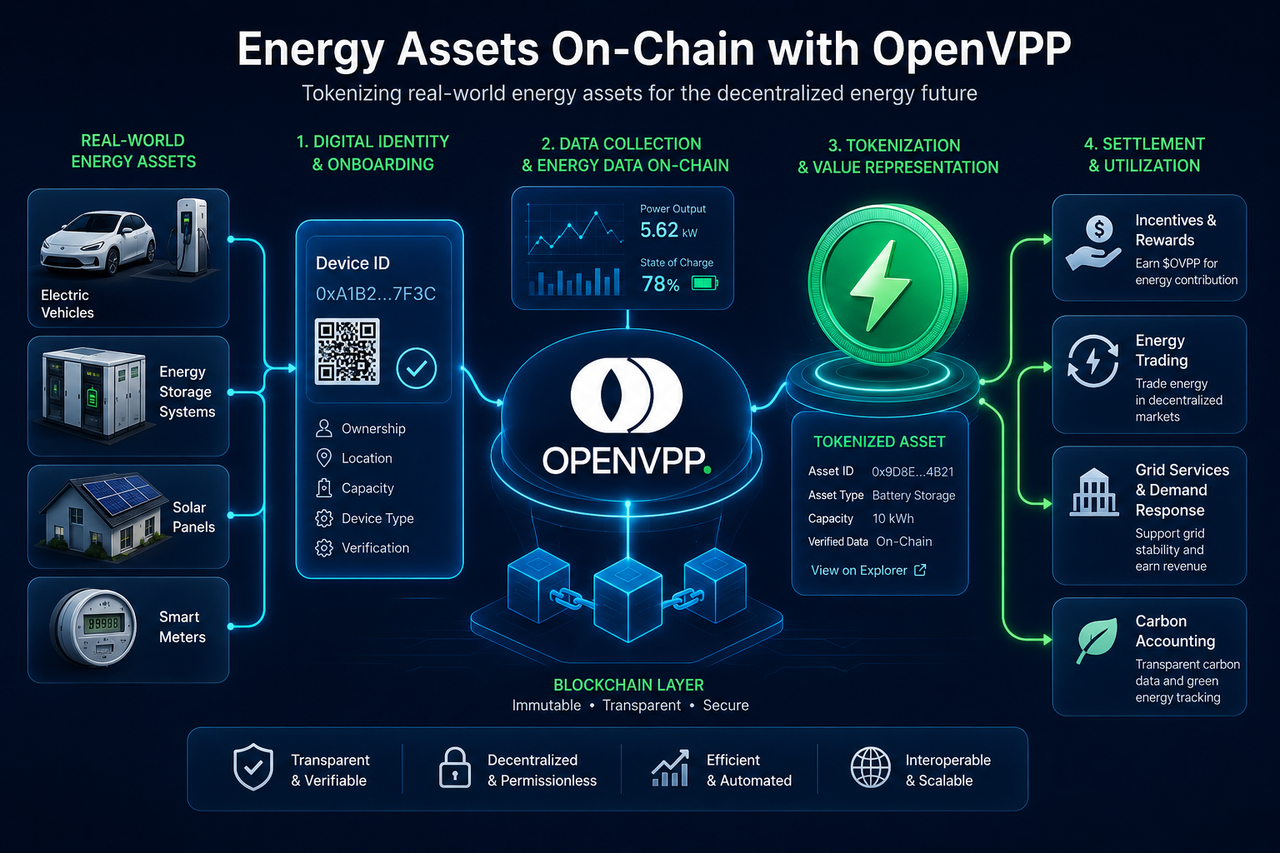
O processo de ativos energéticos on-chain do OpenVPP é composto por três camadas: identidade, dados e valor.
Assim que um dispositivo se conecta à rede, a verificação de identidade é concluída primeiro.
Em seguida, os dados operacionais — como geração de energia, consumo, capacidade de armazenamento e comportamento de resposta à rede — são carregados continuamente.
Por fim, o sistema gera registros de valor com base nas contribuições dos dispositivos e executa incentivos e liquidações via contratos inteligentes.
O processo completo pode ser resumido da seguinte forma:
Dispositivo Físico → Identidade Digital → Dados On-Chain → Mapeamento de Valor → Liquidação On-Chain
Essa estrutura confere aos ativos energéticos do mundo real um ciclo de vida digital completo.
Como um veículo elétrico pode se tornar um ativo energético on-chain?
Os VEs não são apenas meios de transporte — são unidades móveis de armazenamento de energia.
Com a tecnologia Vehicle-to-Grid (V2G), as baterias dos VEs podem alternar de forma flexível entre carga e descarga, ajudando a regular a rede.
Na rede OpenVPP, cada VE recebe uma identidade digital ao se conectar.
O sistema registra continuamente:
Esses dados formam o perfil de contribuição energética do VE.
Quando o veículo participa de serviços de resposta à demanda ou armazenamento, suas contribuições são registradas e consideradas no cálculo de incentivos on-chain.
Assim, dentro do OpenVPP, os VEs não são apenas consumidores de energia, são também provedores de serviços energéticos.
Como os dispositivos de armazenamento de energia são tokenizados?
Dispositivos de armazenamento representam um dos casos de uso mais típicos da tokenização de ativos energéticos.
Sistemas de armazenamento de baterias acumulam eletricidade quando a oferta supera a demanda e a liberam durante os horários de pico.
Nos mercados de energia tradicionais, o valor dos equipamentos de armazenamento geralmente é gerenciado de forma centralizada pelos operadores.
O OpenVPP registra o comportamento de armazenamento on-chain, permitindo que as contribuições sejam quantificadas de forma independente.
Por exemplo:
-
Quantidade de eletricidade armazenada
-
Número de ciclos de descarga
-
Velocidade de resposta
-
Capacidade de regulação da rede
Essas métricas constroem um histórico de crédito e contribuição do dispositivo.
Com o tempo, o dispositivo de armazenamento desenvolve um perfil de ativo digital completo.
Como o OpenVPP registra o valor dos dados energéticos?
Os dados energéticos são um componente essencial da digitalização de ativos energéticos.
Sistemas tradicionais tendem a focar apenas nos resultados das transações de energia, ignorando o valor intrínseco dos dados.
O OpenVPP trata os dados operacionais dos dispositivos como um recurso estratégico da rede.
O sistema registra continuamente:
Esses dados apoiam a previsão de demanda, o despacho da rede e as operações do mercado de energia.
Em um ambiente de internet da energia, o valor dos dados e o valor da energia juntos formam o sistema de valor dos ativos.
Quais são os casos de uso da tokenização de ativos energéticos?
Trazer ativos energéticos para a chain não é apenas uma inovação técnica — também pode viabilizar novos modelos de colaboração energética.
Redes de energia descentralizadas
Os dispositivos podem participar diretamente das operações da rede sem depender inteiramente de um coordenador centralizado.
Coordenação de usinas virtuais
Dispositivos tokenizados podem formar um pool de recursos essencial para usinas virtuais.
Liquidação no mercado de energia
As contribuições podem ser registradas e liquidadas em tempo real, aumentando a transparência do mercado.
Rastreamento de emissões de carbono
Dados on-chain fornecem uma prova mais transparente de fontes de energia verde.
Financiamento de infraestrutura energética
Registros de ativos digitais aumentam a verificabilidade e a transparência da infraestrutura energética.
Quais desafios a tokenização de ativos energéticos enfrenta?
A tokenização de ativos energéticos ainda está em estágio inicial.
Primeiro, é necessário um mecanismo confiável de verificação de dados entre os dispositivos físicos e os dados on-chain. Se a autenticidade dos dados não puder ser garantida, os registros on-chain perdem o valor.
Segundo, diferentes países e regiões possuem estruturas regulatórias variadas para mercados de energia e ativos digitais.
Além disso, a falta de padronização dos dispositivos dificulta a compatibilidade da rede.
Daqui em diante, uma direção estratégica é estabelecer padrões unificados de dados energéticos e protocolos de identidade de dispositivos.
Como o OpenVPP difere do gerenciamento tradicional de ativos energéticos?
| Dimensão de Comparação |
Modelo OpenVPP |
Modelo Tradicional |
| Identidade do Dispositivo |
Identidade digital on-chain |
Banco de dados empresarial |
| Armazenamento de Dados |
Registros distribuídos |
Armazenamento centralizado |
| Confirmação de Valor |
Cálculo via contrato inteligente |
Contabilidade manual ou em plataforma |
| Transparência do Ativo |
Alta |
Relativamente limitada |
| Participação na Rede |
Rede aberta |
Gerenciada por plataforma |
| Mecanismo de Incentivo |
Recompensas em ativos digitais |
Subsídios fixos |
O OpenVPP enfatiza a digitalização de ativos energéticos e a construção de uma rede de valor aberta, enquanto os modelos tradicionais focam na gestão e operação centralizadas.
Resumo
A tokenização de ativos energéticos é uma direção estratégica tanto para a internet da energia quanto para a tokenização de ativos do mundo real. Ao estabelecer identidades digitais, registros de dados on-chain e mecanismos de liquidação via contratos inteligentes, VEs, dispositivos de armazenamento, sistemas solares e outras infraestruturas energéticas podem obter representações digitais verificáveis.
O OpenVPP conecta dispositivos energéticos do mundo real por meio de uma rede de usina virtual descentralizada, mapeando contribuições energéticas, capacidades de dispositivos e dados operacionais no ambiente blockchain.
Perguntas Frequentes
Como o OpenVPP traz ativos energéticos para a chain?
O OpenVPP conecta dispositivos energéticos do mundo real à blockchain por meio de verificação de identidade do dispositivo, coleta de dados em tempo real e liquidação via contratos inteligentes, estabelecendo sistemas correspondentes de identidade digital e registro de valor.
Por que um veículo elétrico pode ser considerado um ativo energético?
As baterias dos VEs têm capacidade de armazenamento e podem participar da regulação da rede e da resposta à demanda em cenários V2G. Portanto, os VEs não são apenas transporte — eles também fornecem serviços energéticos.
Os NFTs podem ser usados para o gerenciamento de dispositivos energéticos?
Os NFTs podem servir como portadores de identidades digitais de dispositivos energéticos, registrando propriedade, histórico operacional e dados de contribuição para formar credenciais digitais verificáveis.
A tokenização de ativos energéticos pertence ao RWA?
Sim, é uma forma de tokenização de ativos do mundo real (RWA). Diferentemente dos RWAs tradicionais como imóveis ou títulos, os ativos subjacentes aqui são a infraestrutura energética e os dados e serviços que ela gera.
Qual é a maior diferença entre o OpenVPP e as plataformas tradicionais de gerenciamento de energia?
O OpenVPP usa blockchain para registrar a identidade do dispositivo e os dados energéticos, e depende de contratos inteligentes para a liquidação de valor. As plataformas tradicionais usam bancos de dados centralizados e modelos operacionais, resultando em diferenças claras em transparência e abertura.