Sob uma ótica de mercado, os pagamentos com stablecoins e as transações cross-chain ganharam ritmo entre 2025 e 2026, com empresas demonstrando demanda nitidamente maior por infraestrutura de pagamento de baixo custo, auditável e programável. Conforme dados oficiais da Request Network, o volume processado acumulado da rede ultrapassou US$ 2 bilhões, e desde março de 2026 vêm sendo lançadas atualizações contínuas sobre migração de comerciantes e novos produtos, recolocando o modelo de token do REQ no centro das atenções do mercado.
Do ponto de vista do valor do setor, o REQ não importa apenas pelo "pague uma vez, use uma vez", mas por conectar fluxo de pagamento, dados financeiros on-chain, governança do protocolo e ecossistema de desenvolvedores. Somente se o modelo tokenômico aliar eficiência de uso e retenção de valor é que a Request Network poderá evoluir de uma ferramenta de pagamento para uma camada central da infraestrutura financeira Web3.
Funções principais e casos de uso do token REQ
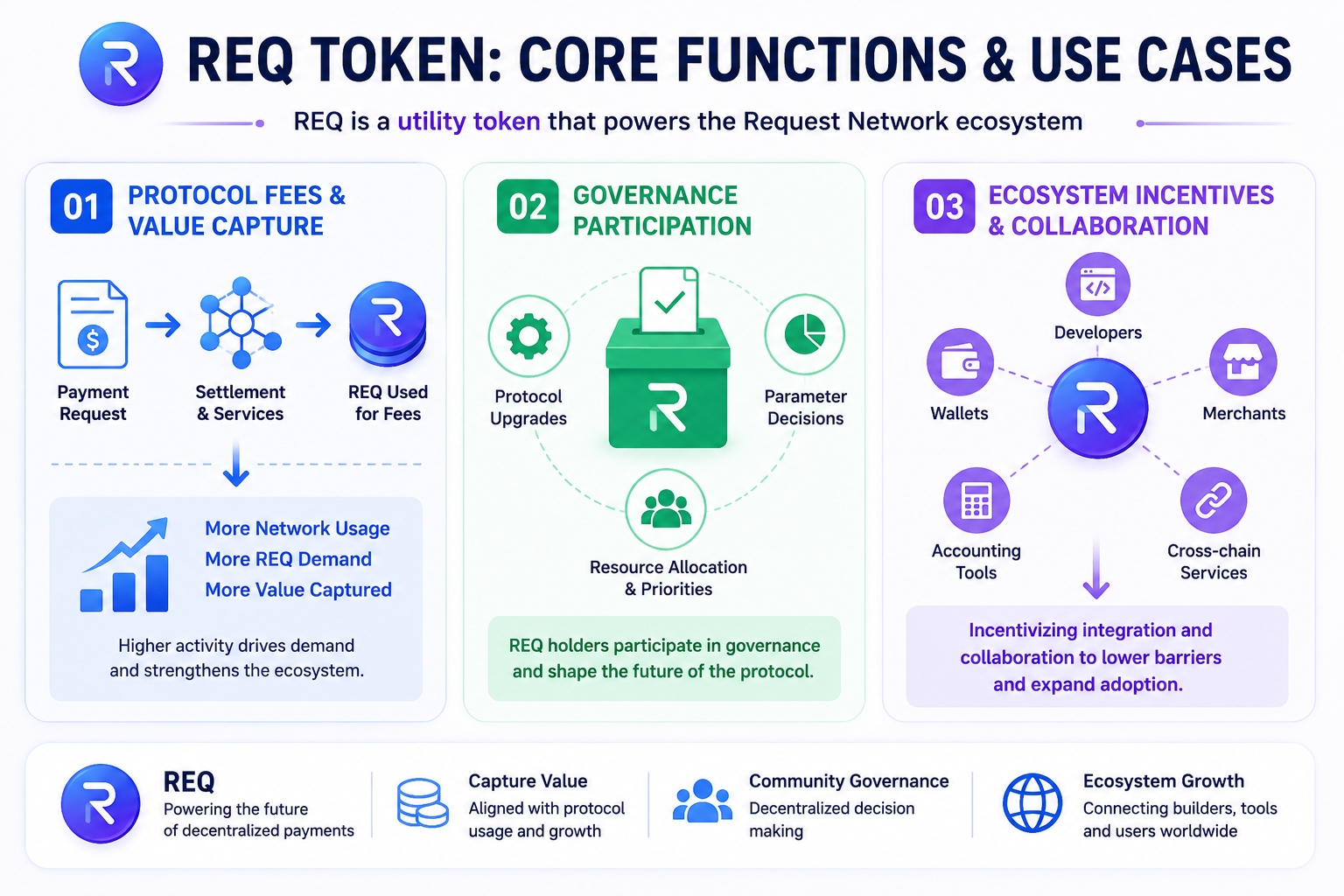
O REQ foi concebido como token de utilidade, e não como token de segurança puro. Com base na documentação pública do protocolo e nas práticas do ecossistema, o REQ atende a três casos de uso principais.
Primeiro, taxas do protocolo e captura de valor. Quando a Request Network processa solicitações de pagamento e serviços relacionados, entram em cena as taxas do protocolo e as rotas de liquidação. O REQ desempenha papel crítico nesse mecanismo de taxas. Com o aumento do uso, a correlação entre demanda pelo token e atividade da rede se torna mais estreita.
Segundo, participação na governança. À medida que o protocolo se expande para pagamentos multi-cadeia, ferramentas para comerciantes e serviços de API, as decisões sobre parâmetros e roteiro exigem governança da comunidade. O REQ atua como veículo de governança, capacitando holders do token a influenciar direções de atualização do protocolo, prioridades de alocação de recursos e muito mais.
Terceiro, incentivos e coordenação do ecossistema. O REQ também serve como mecanismo de incentivo que conecta desenvolvedores, integradores e participantes do ecossistema. Para um protocolo de pagamento escalar, ele precisa não só de usuários finais, mas também de carteiras, ferramentas de contabilidade, sistemas para comerciantes e serviços cross-chain. Os incentivos em tokens reduzem o atrito para integrações iniciais.
Distribuição do token REQ e mecanismo de incentivo
Avaliar um token de protocolo de pagamento exige mais que a oferta total; é preciso também examinar se a estrutura de distribuição apoia o crescimento de longo prazo da rede. Para o REQ, a lógica de distribuição deve focar em três aspectos: alocação inicial, ritmo de circulação e direção dos incentivos.
No nível da alocação inicial, o mercado normalmente analisa as participações detidas pela equipe, fundação, investidores iniciais e comunidade. Uma estrutura razoável equilibra o "compromisso de longo prazo dos construtores" com a "liquidez da comunidade", evitando concentração excessiva que prejudique a governança ou dispersão excessiva que reduza a eficiência de execução.
No nível do ritmo de circulação, os cronogramas de desbloqueio e os caminhos de liberação impactam diretamente a pressão no mercado secundário. Se as liberações forem muito rápidas antes de surgir demanda real de pagamento, o preço do token é suprimido pela oferta. Se as liberações estiverem alinhadas com marcos de produto, conquistas de parcerias e crescimento do volume de transações, o mercado forma expectativas mais estáveis.
No nível da direção dos incentivos, o ponto-chave para o REQ não é "quantas recompensas são dadas", mas "se as recompensas se traduzem em comportamento real de pagamento e retenção de desenvolvedores". Incentivos de qualidade geralmente se atrelam a métricas verificáveis, como atividade do comerciante, taxa de sucesso de pagamento, profundidade de integração e retenção de longo prazo, e não a farming de volume de curto prazo.
Papel do REQ em protocolos de pagamento e sistemas de governança
Na Request Network, o REQ funciona como o "coordenador da rede de pagamento". Protocolos de pagamento envolvem naturalmente múltiplas partes: pagadores, recebedores, sistemas de comerciantes, roteadores cross-chain, ferramentas de contabilidade e ferramentas fiscais. Sem um mecanismo unificado de coordenação econômica, a expansão sustentada da rede é difícil.
Na camada do protocolo de pagamento, o REQ faz a ponte entre taxas programáveis e lógica de liquidação. Quanto mais pagamentos reais e cenários de contabilidade empresarial a rede processar, mais clara se torna a demanda funcional do protocolo pelo token. Em outras palavras, a base de valor do REQ inclina-se mais para um "amplificador de efeito de rede" do que para um impulsionador narrativo único.
Na camada de governança, a importância do REQ está em vincular participantes de longo prazo às decisões do protocolo. Atualizações oficiais de 2026 mostram a Request Network avançando na migração de comerciantes e na expansão de produtos de pagamento, ao mesmo tempo que fortalece a direção descentralizada do produto. Essas fases exigem governança para equilibrar eficiência e descentralização. A qualidade da participação dos holders de REQ influencia diretamente a estabilidade do roteiro do protocolo.
Como o REQ impulsiona o crescimento do ecossistema financeiro Web3
A questão central para o ecossistema financeiro Web3 não é "conseguimos transferir?", mas "conseguimos construir processos financeiros escaláveis?". O caminho de crescimento da Request Network se estende de solicitações de pagamento à automação financeira.
Primeiro, padronização de pagamentos. Pagamentos on-chain sem campos padronizados e registros verificáveis dificultam a conciliação empresarial, auditoria e processamento fiscal. O design da camada de solicitação da Request transforma pagamentos de simples transferências de endereços em fluxos de dados com contexto de negócios, essencial para a adoção empresarial.
Segundo, maior disponibilidade cross-chain. Segundo documentos oficiais de migração, a Request vem expandindo a cobertura de pagamentos multi-cadeia nos últimos anos, com ênfase na acessibilidade para os principais usuários de stablecoins. Com melhores capacidades cross-chain, as barreiras de integração para comerciantes diminuem, facilitando que a rede de pagamento alcance escala.
Terceiro, migração de comerciantes e iteração de produtos. Em março de 2026, a equipe lançou alternativas voltadas para comerciantes após o encerramento da Coinbase Commerce, além de atualizações sobre produtos descentralizados e parcerias de infraestrutura. Essas "migrações reais de negócios" validam a capacidade comercial do protocolo de forma mais eficaz que puro marketing e têm maior probabilidade de impulsionar a demanda de longo prazo pelo REQ.
Principais fatores que influenciam o valor do token REQ
O preço de curto prazo do REQ é influenciado pelo sentimento do mercado, mas o desempenho de médio a longo prazo depende dos fundamentos. Os principais fatores podem ser agrupados em seis.
- Uso real do protocolo – número de pagamentos, volume liquidado, retenção de comerciantes, endereços ativos etc. formam a base de valor mais direta.
- Mecanismo de taxas e eficiência de captura do token – se as taxas do protocolo fluem de volta efetivamente para o modelo tokenômico determina se o "crescimento dos negócios" se mapeia para "crescimento do valor do token".
- Amplitude de integração do ecossistema – mais integrações com carteiras, exchanges, SaaS de contabilidade, plugins de pagamento e APIs empresariais fortalecem o efeito de rede.
- Eficiência da governança – participação persistentemente baixa ou alta fragmentação desacelera a iteração do produto; alta qualidade da governança dá aos direitos de governança do token valor real.
- Ambiente macro e regulatório – mudanças na regulamentação de stablecoins, conformidade de pagamentos transfronteiriços e requisitos de auditoria financeira on-chain afetam o espaço de crescimento de protocolos como o Request.
- Liquidez de mercado e estrutura de negociação – profundidade da liquidez, concentração de holdings, cronograma de desbloqueio e ciclos de mercado afetam as faixas de valuation.
Modelos de incentivo à comunidade e desenvolvedores da Request Network
A competitividade de longo prazo de um protocolo de pagamento depende, em última análise, da permanência de desenvolvedores e comerciantes. O modelo de incentivo da Request Network pode ser observado de dois ângulos.
Do ângulo da comunidade, o foco está na barreira de participação e no feedback de contribuição. Se as propostas de governança, conteúdo educacional e atividades do ecossistema envolvem usuários não técnicos na criação de valor, a qualidade da comunidade se torna mais estável e menos dependente de flutuações de preço de curto prazo.
Do ângulo do desenvolvedor, o foco está na documentação, SDK, experiência da API e transparência dos incentivos. Em atualizações públicas durante 2025-2026, a Request avançou consistentemente documentação, lançamentos de produtos e colaborações de infraestrutura, sinalizando foco não apenas na narrativa do token, mas também na usabilidade para desenvolvedores. Para o REQ, tais investimentos expandem a área "integrável", impulsionando assim a demanda real de pagamento, e não apenas a demanda de negociação.
Principais riscos a considerar ao investir em REQ
Primeiro, risco de adoção empresarial. A valuation de um protocolo de pagamento depende do volume real de transações. Se o crescimento e a retenção de comerciantes ficarem aquém, a captura de valor do token enfraquece.
Segundo, risco competitivo. O espaço de pagamentos cripto inclui pagamentos construídos por exchanges, gateways independentes, camadas de pagamento nativas de stablecoins e mais. O Request precisa provar diferenciação continuamente.
Terceiro, risco regulatório e de conformidade. Pagamentos transfronteiriços, liquidações com stablecoins e processamento de dados financeiros empresariais estão sob flutuações regulatórias. Mudanças de políticas podem impactar a velocidade de expansão.
Quarto, risco de execução tokenômica. Se os parâmetros de alocação, desbloqueio e incentivo não estiverem alinhados com a fase do negócio, podem surgir pressão de venda e expectativas comunitárias desalinhadas.
Quinto, risco técnico e de segurança. Protocolos de pagamento envolvem dependências multi-cadeia, roteamento e infraestrutura. Bugs em contratos inteligentes, interrupções de serviço ou problemas com componentes terceiros podem prejudicar a confiança no ecossistema.
Potencial de desenvolvimento de longo prazo do ecossistema REQ
No longo prazo, o potencial do REQ não está em "se tornar o próximo token popular", mas sim se a Request Network consegue manter sua posição como infraestrutura financeira Web3. Se o protocolo expandir consistentemente os cenários para comerciantes, melhorar a experiência de pagamento cross-chain, fortalecer as ferramentas para desenvolvedores e fechar o ciclo entre o modelo tokenômico e o uso real, a base de valor de longo prazo do REQ será mais sólida.
Atualizações oficiais em 2026 enviam dois sinais positivos: primeiro, a capacidade de resolver pontos problemáticos reais de comerciantes por meio de suporte à migração; segundo, a continuidade da construção em torno de produtos de pagamento descentralizados e parcerias de infraestrutura. Para observadores de médio a longo prazo, esses sinais merecem mais atenção que flutuações de preço de curto prazo, pois estão diretamente ligados à profundidade do uso da rede e à eficiência de captura do token.
Resumo
O modelo tokenômico do REQ responde essencialmente a uma pergunta: como o crescimento de um protocolo de pagamento se traduz em valor sustentável do token? Em torno das funções principais, incentivos de distribuição, participação na governança e expansão do ecossistema, o REQ construiu uma estrutura relativamente completa. Seu desempenho futuro ainda depende do equilíbrio entre demanda real de pagamento, adoção por desenvolvedores, ambiente regulatório e eficiência de execução. Avaliar o REQ a partir de uma lente de "infraestrutura financeira Web3" aproxima você mais de sua lógica de valor de longo prazo do que focar em movimentos de mercado de curto prazo.