# CryptoStocksRally

12.21K
✨ JAPAN GOES ONCHAIN
Japan advances plans to tokenize government bonds using blockchain infrastructure, marking a major step toward digitized sovereign debt.
✨ WHAT IS HAPPENING
Japan's JSCC, Mizuho, and Nomura launched a pilot to test on-chain JGB collateral, targeting 24/7 cross-border settlement, with results guiding regulatory updates and commercial rollout. The trial runs through September 2026. Separately, Japan plans to issue blockchain-based local government bonds in 2026, aiming to boost liquidity, enable fractional ownership, and increase transparency.
✨ WHY IT MATTERS
Tokenized JGBs
User_any
✨ JAPAN GOES ONCHAIN
Japan advances plans to tokenize government bonds using blockchain infrastructure, marking a major step toward digitized sovereign debt.
✨ WHAT IS HAPPENING
Japan's JSCC, Mizuho, and Nomura launched a pilot to test on-chain JGB collateral, targeting 24/7 cross-border settlement, with results guiding regulatory updates and commercial rollout. The trial runs through September 2026. Separately, Japan plans to issue blockchain-based local government bonds in 2026, aiming to boost liquidity, enable fractional ownership, and increase transparency.
✨ WHY IT MATTERS
Tokenized JGBs allow real-time collateral transfers, reduce settlement friction, and open access to global investors. Local bond tokenization in cities like Osaka and Shizuoka offers direct citizen participation and flexible funding for municipalities.
✨ TIMELINE
Pilot phase launched April 20 and continues into late 2026. Full local government bond tokenization framework targets 2026 rollout, supported by the Financial Services Agency's Payment Innovation Project and top-level policy backing.
✨ Sovereign bond tokenization by the world's third-largest bond market signals accelerating institutional adoption. Watch for increased demand for blockchain infrastructure tokens, custody solutions, and yen-pegged stablecoins as Japan builds rails for 24/7 government securities. This development strengthens the long-term thesis for real-world asset tokenization and supports continued institutional flows into crypto.
#CryptoStocksRally
#GateSquareMayTradingShare
repost-content-media
  • Reward
  • 4
  • Repost
  • Share
AylaShinex:
2026 GOGOGO 👊
View More
#CryptoStocksRally
Crypto-related stocks are once again becoming one of the strongest-performing sectors in financial markets as investors return to digital asset exposure through public companies rather than direct cryptocurrency ownership alone. The latest rally across crypto-linked equities reflects growing optimism surrounding Bitcoin stabilization, improving institutional sentiment, and expectations that blockchain-related businesses may enter a new expansion cycle despite broader macroeconomic uncertainty. Companies connected to cryptocurrency trading, Bitcoin mining, digital payments,
MrFlower_XingChen
#CryptoStocksRally
Crypto-related stocks are once again becoming one of the strongest-performing sectors in financial markets as investors return to digital asset exposure through public companies rather than direct cryptocurrency ownership alone. The latest rally across crypto-linked equities reflects growing optimism surrounding Bitcoin stabilization, improving institutional sentiment, and expectations that blockchain-related businesses may enter a new expansion cycle despite broader macroeconomic uncertainty. Companies connected to cryptocurrency trading, Bitcoin mining, digital payments, and blockchain infrastructure have all experienced renewed investor attention as capital flows back into high-risk growth sectors. Recent market momentum has been driven not only by rising crypto prices, but also by changing narratives around regulation, artificial intelligence integration, and the long-term role of digital assets in traditional finance.
One of the primary drivers behind the rally has been Bitcoin’s ability to maintain strength above key support levels after months of volatility. Historically, crypto-related equities tend to amplify Bitcoin’s movements because investors view these companies as leveraged exposure to digital asset adoption. When Bitcoin stabilizes or begins recovering, publicly traded firms connected to crypto markets often outperform due to expectations of rising trading activity, stronger balance sheets, and improving investor sentiment. Companies such as Coinbase, Robinhood, and Bitcoin mining firms have all benefited from this dynamic during recent market rebounds.
Another major catalyst fueling crypto stock momentum is growing anticipation surrounding regulatory clarity in the United States. Discussions around the proposed CLARITY Act and broader digital asset legislation have created optimism that the industry may finally receive clearer operational frameworks after years of uncertainty. Investors generally prefer markets with predictable regulation because it reduces legal risk and encourages institutional participation. Progress on crypto legislation has directly contributed to rallies in crypto-linked stocks, especially firms expected to benefit from institutional adoption and regulated stablecoin infrastructure.
Coinbase remains one of the most closely watched companies in the sector because it functions as a major gateway between traditional finance and cryptocurrency markets. The company’s stock performance often acts as a proxy for broader sentiment toward the digital asset industry. Despite recent earnings pressure caused by lower trading volumes and weaker retail participation, investors continue focusing on Coinbase’s long-term strategic positioning in custody services, institutional infrastructure, derivatives markets, and stablecoin ecosystems. The company’s inclusion in the S&P 500 previously strengthened its legitimacy among traditional investors, while its push toward AI integration and operational restructuring reflects broader technology-sector trends.
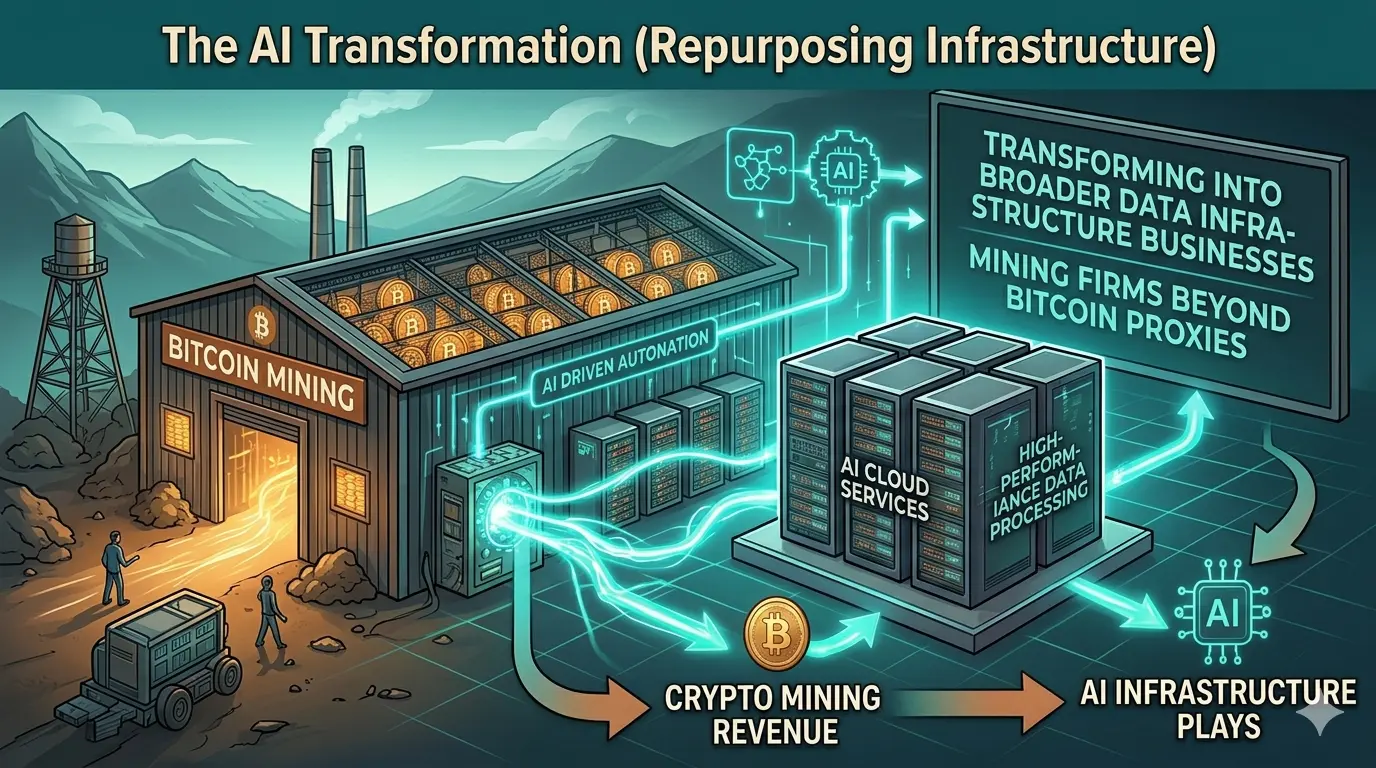
Bitcoin mining companies are also experiencing renewed momentum, although the reasons behind their rally are becoming increasingly complex. In earlier cycles, mining stocks moved almost entirely in correlation with Bitcoin prices and mining profitability. Today, many mining firms are transforming into broader data infrastructure businesses, using their energy capacity and computing infrastructure to support artificial intelligence and high-performance computing operations. This transition has created a new narrative where mining companies are no longer viewed solely as Bitcoin proxies, but also as potential AI infrastructure plays. Firms connected to this trend have significantly outperformed Bitcoin itself in some periods during 2026.
The integration of artificial intelligence into crypto-related businesses is becoming one of the most important themes shaping investor expectations. Technology investors increasingly favor companies capable of combining blockchain infrastructure with AI-driven automation, cloud computing, and predictive systems. Coinbase’s restructuring toward becoming a more AI-native organization reflects how rapidly the industry is adapting to this trend. Mining companies are also repurposing facilities for AI cloud services and high-performance data processing, creating additional revenue streams beyond cryptocurrency mining alone. This convergence between AI and crypto infrastructure has expanded the investor base interested in the sector.
Institutional participation is another critical factor supporting the rally. Unlike earlier crypto cycles dominated primarily by retail speculation, the current environment includes stronger involvement from hedge funds, asset managers, ETFs, and publicly traded corporations holding Bitcoin reserves. Strategy, formerly known as MicroStrategy, continues to be viewed as one of the most aggressive corporate Bitcoin accumulation vehicles in financial markets. Investors often use such companies as indirect methods of gaining exposure to Bitcoin without directly managing crypto assets themselves. This institutionalization of crypto exposure has increased correlations between digital assets and broader equity market behavior.
Prediction markets and blockchain-based financial products are also contributing to bullish sentiment surrounding certain crypto-linked stocks. Analysts have suggested that companies positioned within trading infrastructure and digital financial ecosystems may benefit substantially if decentralized prediction and tokenized markets continue expanding. Firms with strong retail trading platforms and crypto integration capabilities are increasingly viewed as potential long-term winners if blockchain-based financial applications achieve mainstream adoption.
However, despite the strong rally, risks across crypto equities remain extremely high. Many of these companies still operate in industries heavily dependent on market sentiment, liquidity conditions, and regulatory developments. Crypto stocks are historically more volatile than traditional technology or financial stocks because they combine both equity risk and digital asset exposure simultaneously. Even minor corrections in Bitcoin prices can produce disproportionately large declines in mining stocks, exchanges, and blockchain-related companies. Investors therefore continue balancing optimism about long-term adoption against concerns regarding earnings stability and macroeconomic conditions.
Recent earnings reports from major crypto companies also highlight the ongoing challenges facing the industry. Coinbase, for example, recently reported declining revenues, lower transaction activity, and workforce reductions despite broader optimism surrounding crypto markets. This illustrates an important reality within the current rally: stock performance is increasingly being driven by future expectations rather than present profitability. Investors appear willing to tolerate short-term weakness if they believe regulatory clarity, institutional adoption, and technological expansion could significantly strengthen the sector over the coming years.
Retail investor behavior is also changing compared to previous crypto-driven stock rallies. Earlier cycles were often fueled by extreme speculative mania and social media hype, resulting in rapid price spikes followed by severe crashes. Today’s market environment appears somewhat more selective, with investors focusing more carefully on revenue models, infrastructure development, AI integration, and long-term positioning. While speculative enthusiasm still exists, there is growing recognition that only companies capable of adapting to evolving market conditions may survive long term.
Another important trend is the increasing overlap between traditional financial markets and blockchain ecosystems. Large financial institutions are gradually expanding services related to custody, tokenization, stablecoins, and digital settlement systems. As a result, publicly traded crypto firms are no longer operating entirely outside mainstream finance. Instead, they are becoming integrated into broader discussions about the future of digital payments, tokenized assets, and financial infrastructure modernization. This structural shift is one reason many analysts believe crypto-related stocks could remain relevant even during periods of weaker cryptocurrency prices.
At the same time, macroeconomic conditions continue influencing the sustainability of the rally. Interest rate expectations, inflation data, liquidity conditions, and geopolitical uncertainty all affect investor appetite for high-growth sectors like crypto equities. If central banks maintain tighter financial conditions for longer than expected, speculative assets could once again face pressure. Conversely, improving liquidity and stronger economic confidence may further support capital inflows into digital asset-related companies.
Ultimately, the current crypto stock rally reflects far more than simple Bitcoin price appreciation. It represents a broader transformation of how investors perceive blockchain-related businesses within global financial markets. Companies connected to digital assets are increasingly being evaluated not only as speculative vehicles, but also as infrastructure providers operating at the intersection of finance, technology, artificial intelligence, and decentralized systems. Whether the rally develops into a sustained long-term trend or faces another major correction will depend on institutional adoption, regulatory outcomes, market liquidity, and the industry’s ability to generate sustainable real-world utility beyond speculative trading alone.
#Gate13thAnniversaryLive
#GateSquareMayTradingShare
#TopCopyTradingScout
repost-content-media
  • Reward
  • Comment
  • Repost
  • Share
#CryptoStocksRally
Crypto-related stocks are once again becoming one of the strongest-performing sectors in financial markets as investors return to digital asset exposure through public companies rather than direct cryptocurrency ownership alone. The latest rally across crypto-linked equities reflects growing optimism surrounding Bitcoin stabilization, improving institutional sentiment, and expectations that blockchain-related businesses may enter a new expansion cycle despite broader macroeconomic uncertainty. Companies connected to cryptocurrency trading, Bitcoin mining, digital payments,
MrFlower_XingChen
#CryptoStocksRally
Crypto-related stocks are once again becoming one of the strongest-performing sectors in financial markets as investors return to digital asset exposure through public companies rather than direct cryptocurrency ownership alone. The latest rally across crypto-linked equities reflects growing optimism surrounding Bitcoin stabilization, improving institutional sentiment, and expectations that blockchain-related businesses may enter a new expansion cycle despite broader macroeconomic uncertainty. Companies connected to cryptocurrency trading, Bitcoin mining, digital payments, and blockchain infrastructure have all experienced renewed investor attention as capital flows back into high-risk growth sectors. Recent market momentum has been driven not only by rising crypto prices, but also by changing narratives around regulation, artificial intelligence integration, and the long-term role of digital assets in traditional finance.
One of the primary drivers behind the rally has been Bitcoin’s ability to maintain strength above key support levels after months of volatility. Historically, crypto-related equities tend to amplify Bitcoin’s movements because investors view these companies as leveraged exposure to digital asset adoption. When Bitcoin stabilizes or begins recovering, publicly traded firms connected to crypto markets often outperform due to expectations of rising trading activity, stronger balance sheets, and improving investor sentiment. Companies such as Coinbase, Robinhood, and Bitcoin mining firms have all benefited from this dynamic during recent market rebounds.
Another major catalyst fueling crypto stock momentum is growing anticipation surrounding regulatory clarity in the United States. Discussions around the proposed CLARITY Act and broader digital asset legislation have created optimism that the industry may finally receive clearer operational frameworks after years of uncertainty. Investors generally prefer markets with predictable regulation because it reduces legal risk and encourages institutional participation. Progress on crypto legislation has directly contributed to rallies in crypto-linked stocks, especially firms expected to benefit from institutional adoption and regulated stablecoin infrastructure.
Coinbase remains one of the most closely watched companies in the sector because it functions as a major gateway between traditional finance and cryptocurrency markets. The company’s stock performance often acts as a proxy for broader sentiment toward the digital asset industry. Despite recent earnings pressure caused by lower trading volumes and weaker retail participation, investors continue focusing on Coinbase’s long-term strategic positioning in custody services, institutional infrastructure, derivatives markets, and stablecoin ecosystems. The company’s inclusion in the S&P 500 previously strengthened its legitimacy among traditional investors, while its push toward AI integration and operational restructuring reflects broader technology-sector trends.
Bitcoin mining companies are also experiencing renewed momentum, although the reasons behind their rally are becoming increasingly complex. In earlier cycles, mining stocks moved almost entirely in correlation with Bitcoin prices and mining profitability. Today, many mining firms are transforming into broader data infrastructure businesses, using their energy capacity and computing infrastructure to support artificial intelligence and high-performance computing operations. This transition has created a new narrative where mining companies are no longer viewed solely as Bitcoin proxies, but also as potential AI infrastructure plays. Firms connected to this trend have significantly outperformed Bitcoin itself in some periods during 2026.
The integration of artificial intelligence into crypto-related businesses is becoming one of the most important themes shaping investor expectations. Technology investors increasingly favor companies capable of combining blockchain infrastructure with AI-driven automation, cloud computing, and predictive systems. Coinbase’s restructuring toward becoming a more AI-native organization reflects how rapidly the industry is adapting to this trend. Mining companies are also repurposing facilities for AI cloud services and high-performance data processing, creating additional revenue streams beyond cryptocurrency mining alone. This convergence between AI and crypto infrastructure has expanded the investor base interested in the sector.
Institutional participation is another critical factor supporting the rally. Unlike earlier crypto cycles dominated primarily by retail speculation, the current environment includes stronger involvement from hedge funds, asset managers, ETFs, and publicly traded corporations holding Bitcoin reserves. Strategy, formerly known as MicroStrategy, continues to be viewed as one of the most aggressive corporate Bitcoin accumulation vehicles in financial markets. Investors often use such companies as indirect methods of gaining exposure to Bitcoin without directly managing crypto assets themselves. This institutionalization of crypto exposure has increased correlations between digital assets and broader equity market behavior.
Prediction markets and blockchain-based financial products are also contributing to bullish sentiment surrounding certain crypto-linked stocks. Analysts have suggested that companies positioned within trading infrastructure and digital financial ecosystems may benefit substantially if decentralized prediction and tokenized markets continue expanding. Firms with strong retail trading platforms and crypto integration capabilities are increasingly viewed as potential long-term winners if blockchain-based financial applications achieve mainstream adoption.
However, despite the strong rally, risks across crypto equities remain extremely high. Many of these companies still operate in industries heavily dependent on market sentiment, liquidity conditions, and regulatory developments. Crypto stocks are historically more volatile than traditional technology or financial stocks because they combine both equity risk and digital asset exposure simultaneously. Even minor corrections in Bitcoin prices can produce disproportionately large declines in mining stocks, exchanges, and blockchain-related companies. Investors therefore continue balancing optimism about long-term adoption against concerns regarding earnings stability and macroeconomic conditions.
Recent earnings reports from major crypto companies also highlight the ongoing challenges facing the industry. Coinbase, for example, recently reported declining revenues, lower transaction activity, and workforce reductions despite broader optimism surrounding crypto markets. This illustrates an important reality within the current rally: stock performance is increasingly being driven by future expectations rather than present profitability. Investors appear willing to tolerate short-term weakness if they believe regulatory clarity, institutional adoption, and technological expansion could significantly strengthen the sector over the coming years.
Retail investor behavior is also changing compared to previous crypto-driven stock rallies. Earlier cycles were often fueled by extreme speculative mania and social media hype, resulting in rapid price spikes followed by severe crashes. Today’s market environment appears somewhat more selective, with investors focusing more carefully on revenue models, infrastructure development, AI integration, and long-term positioning. While speculative enthusiasm still exists, there is growing recognition that only companies capable of adapting to evolving market conditions may survive long term.
Another important trend is the increasing overlap between traditional financial markets and blockchain ecosystems. Large financial institutions are gradually expanding services related to custody, tokenization, stablecoins, and digital settlement systems. As a result, publicly traded crypto firms are no longer operating entirely outside mainstream finance. Instead, they are becoming integrated into broader discussions about the future of digital payments, tokenized assets, and financial infrastructure modernization. This structural shift is one reason many analysts believe crypto-related stocks could remain relevant even during periods of weaker cryptocurrency prices.
At the same time, macroeconomic conditions continue influencing the sustainability of the rally. Interest rate expectations, inflation data, liquidity conditions, and geopolitical uncertainty all affect investor appetite for high-growth sectors like crypto equities. If central banks maintain tighter financial conditions for longer than expected, speculative assets could once again face pressure. Conversely, improving liquidity and stronger economic confidence may further support capital inflows into digital asset-related companies.
Ultimately, the current crypto stock rally reflects far more than simple Bitcoin price appreciation. It represents a broader transformation of how investors perceive blockchain-related businesses within global financial markets. Companies connected to digital assets are increasingly being evaluated not only as speculative vehicles, but also as infrastructure providers operating at the intersection of finance, technology, artificial intelligence, and decentralized systems. Whether the rally develops into a sustained long-term trend or faces another major correction will depend on institutional adoption, regulatory outcomes, market liquidity, and the industry’s ability to generate sustainable real-world utility beyond speculative trading alone.
#Gate13thAnniversaryLive
#GateSquareMayTradingShare
#TopCopyTradingScout
repost-content-media
  • Reward
  • Comment
  • Repost
  • Share
Wall Street hiring in crypto is accelerating.
✨ WALL STREET GOES CRYPTO
Institutions including BlackRock, JPMorgan, and Morgan Stanley are expanding digital asset teams in 2026, signaling a clear shift toward institutional adoption.
✨ BLACKROCK
Seven new global openings focused on scaling digital asset ETFs, tokenization, and first-mover opportunities in Asia
Eight current Web3 roles in the US with salaries ranging from $81,000 to $180,000
High-paying leadership positions, including Managing Director in New York at $270,000 to $350,000 annually
Overall digital assets pipeline shows around 80
BTC1.02%
ETH1.5%
DOGE4.41%
  • Reward
  • Comment
  • Repost
  • Share
✨ MORGAN STANLEY GOES BIG ON CRYPTO
Morgan Stanley launched crypto trading on its Trade platform, extending access toward 8.6 million users with fees designed to compete directly with major exchanges.
✨ The firm's Global Investment Committee recommends allocations reaching 4% toward cryptocurrencies, a move potentially unlocking around $2 trillion in institutional capital. Additional initiatives include filing for spot Bitcoin and Solana ETFs in January 2026, with projections channeling $40 to $80 billion toward institutional flows.
✨ Leadership describes this expansion as part of years of inf
BTC1.02%
DOGE4.41%
  • Reward
  • Comment
  • Repost
  • Share
✨ MORGAN STANLEY GOES BIG ON CRYPTO
Morgan Stanley launched crypto trading on its Trade platform, extending access toward 8.6 million users with fees designed to compete directly with major exchanges.
✨ The firm's Global Investment Committee recommends allocations reaching 4% toward cryptocurrencies, a move potentially unlocking around $2 trillion in institutional capital. Additional initiatives include filing for spot Bitcoin and Solana ETFs in January 2026, with projections channeling $40 to $80 billion toward institutional flows.
✨ Leadership describes this expansion as part of years of inf
BTC1.02%
SOL6.13%
  • Reward
  • Comment
  • Repost
  • Share
#CryptoStocksRally
Wall Street just delivered one of the clearest signals yet that crypto is no longer operating on the outside of the financial system. The latest rally across crypto-related equities was not simply another green trading session — it was a powerful confirmation that institutional capital continues moving deeper into the digital asset sector.
While the S&P 500 and Nasdaq closed higher overall, the strongest momentum came from crypto-linked stocks. Companies directly tied to Bitcoin infrastructure, trading activity, and stablecoin growth dramatically outperformed traditional se
BTC1.02%
TRX1.13%
CryptoChampion
#CryptoStocksRally
Wall Street just delivered one of the clearest signals yet that crypto is no longer operating on the outside of the financial system. The latest rally across crypto-related equities was not simply another green trading session — it was a powerful confirmation that institutional capital continues moving deeper into the digital asset sector.
While the S&P 500 and Nasdaq closed higher overall, the strongest momentum came from crypto-linked stocks. Companies directly tied to Bitcoin infrastructure, trading activity, and stablecoin growth dramatically outperformed traditional sectors. That kind of leadership matters because markets usually reward sectors where future growth expectations are strongest.
MicroStrategy once again acted as the market’s preferred Bitcoin proxy. Every major rally in MSTR reflects one simple reality: institutions still want Bitcoin exposure. Many large funds remain restricted from directly holding BTC, so they use regulated equity vehicles instead. When MSTR gains aggressively, it often signals rising institutional confidence toward Bitcoin’s long-term direction.
Coinbase also delivered a strong breakout session, and that move may be even more important structurally. COIN’s strength reflects growing optimism that U.S. regulators are slowly moving toward clearer digital asset frameworks. Investors understand that if regulatory pressure stabilizes, exchanges like Coinbase could benefit from massive increases in trading activity, institutional onboarding, and global crypto adoption.
At the same time, Circle’s rally highlighted how important stablecoins have become within modern finance. Markets are beginning to recognize that regulated stablecoin infrastructure could become one of the most profitable areas of the digital economy. If lawmakers continue pushing forward stablecoin legislation, companies connected to compliant digital payments may enter an entirely new growth phase.
The biggest surprise of the day came from TRON, which exploded more than 25% in a single session. Moves of this size rarely happen without aggressive speculative demand entering the market. Whether fueled by momentum traders, ecosystem developments, or liquidity rotation, such rallies usually indicate that risk appetite is returning across the broader crypto environment.
The larger takeaway is far bigger than one trading day.
Crypto equities are increasingly behaving like legitimate institutional sector plays instead of isolated speculative bets. Portfolio managers are now treating digital asset exposure similarly to technology or growth allocations. This shift changes everything because institutional participation brings deeper liquidity, longer investment horizons, and stronger market stability over time.
For Bitcoin, this environment creates powerful momentum conditions. Rising crypto stocks improve overall market sentiment, attract mainstream financial attention, and reduce fear among sidelined investors. Every strong equity rally linked to digital assets increases confidence that Bitcoin remains part of the future global financial system.
BTC consolidating near the $80,000 region while crypto equities outperform may not be a coincidence. Historically, periods where institutional crypto stocks lead broader markets often become early indicators of stronger Bitcoin expansion phases ahead.
The market is no longer asking whether crypto survives.
The market is now deciding how large the sector can become.
#CryptoStocksRally
#GateSquareMayTradingShare
repost-content-media
  • Reward
  • Comment
  • Repost
  • Share
Wall Street hiring in crypto is accelerating.
✨ WALL STREET GOES CRYPTO
Institutions including BlackRock, JPMorgan, and Morgan Stanley are expanding digital asset teams in 2026, signaling a clear shift toward institutional adoption.
✨ BLACKROCK
Seven new global openings focused on scaling digital asset ETFs, tokenization, and first-mover opportunities in Asia
Eight current Web3 roles in the US with salaries ranging from $81,000 to $180,000
High-paying leadership positions, including Managing Director in New York at $270,000 to $350,000 annually
Overall digital assets pipeline shows around 80
BTC1.02%
ETH1.5%
DOGE4.41%
User_any
Wall Street hiring in crypto is accelerating.
✨ WALL STREET GOES CRYPTO
Institutions including BlackRock, JPMorgan, and Morgan Stanley are expanding digital asset teams in 2026, signaling a clear shift toward institutional adoption.
✨ BLACKROCK
Seven new global openings focused on scaling digital asset ETFs, tokenization, and first-mover opportunities in Asia
Eight current Web3 roles in the US with salaries ranging from $81,000 to $180,000
High-paying leadership positions, including Managing Director in New York at $270,000 to $350,000 annually
Overall digital assets pipeline shows around 80 openings across operations, cybersecurity, and sales
✨ JPMORGAN
Part of the broader institutional hiring wave for 2026, with aggressive recruitment across crypto, custody, compliance, and product leadership roles alongside its 2,000+ technology and finance openings.
✨ MORGAN STANLEY
Actively hiring a Crypto & Digital Assets Advisory Compliance Officer, Vice President in New York, with compensation of $108,000 to $184,500, focused on shaping US digital asset business strategy and regulatory policy.
✨ WHY IT MATTERS
This hiring wave centers on custody, compliance, ETF scaling, and tokenization — the infrastructure layer for mainstream adoption. When the world's largest asset managers allocate headcount and high salaries to crypto, capital flows typically follow.
✨ Wall Street building crypto teams at scale supports the long-term thesis for institutional inflows. Watch BlackRock ETF expansion, Morgan Stanley wealth integration, and JPMorgan custody developments as leading indicators for the next leg of adoption.
#CryptoStocksRally
#BTCPullback
#StablecoinReserveDrops
#GateSquareMayTradingShare
$BTC $ETH $DOGE
repost-content-media
  • Reward
  • 47
  • Repost
  • Share
discovery:
To The Moon 🌕
View More
#CryptoStocksRally Wall Street hiring in crypto is accelerating.
✨ WALL STREET GOES CRYPTO
Institutions including BlackRock, JPMorgan, and Morgan Stanley are expanding digital asset teams in 2026, signaling a clear shift toward institutional adoption.
✨ BLACKROCK
Seven new global openings focused on scaling digital asset ETFs, tokenization, and first-mover opportunities in Asia
Eight current Web3 roles in the US with salaries ranging from $81,000 to $180,000
High-paying leadership positions, including Managing Director in New York at $270,000 to $350,000 annually
Overall digital assets pipeli
BTC1.02%
ETH1.5%
DOGE4.41%
User_any
Wall Street hiring in crypto is accelerating.
✨ WALL STREET GOES CRYPTO
Institutions including BlackRock, JPMorgan, and Morgan Stanley are expanding digital asset teams in 2026, signaling a clear shift toward institutional adoption.
✨ BLACKROCK
Seven new global openings focused on scaling digital asset ETFs, tokenization, and first-mover opportunities in Asia
Eight current Web3 roles in the US with salaries ranging from $81,000 to $180,000
High-paying leadership positions, including Managing Director in New York at $270,000 to $350,000 annually
Overall digital assets pipeline shows around 80 openings across operations, cybersecurity, and sales
✨ JPMORGAN
Part of the broader institutional hiring wave for 2026, with aggressive recruitment across crypto, custody, compliance, and product leadership roles alongside its 2,000+ technology and finance openings.
✨ MORGAN STANLEY
Actively hiring a Crypto & Digital Assets Advisory Compliance Officer, Vice President in New York, with compensation of $108,000 to $184,500, focused on shaping US digital asset business strategy and regulatory policy.
✨ WHY IT MATTERS
This hiring wave centers on custody, compliance, ETF scaling, and tokenization — the infrastructure layer for mainstream adoption. When the world's largest asset managers allocate headcount and high salaries to crypto, capital flows typically follow.
✨ Wall Street building crypto teams at scale supports the long-term thesis for institutional inflows. Watch BlackRock ETF expansion, Morgan Stanley wealth integration, and JPMorgan custody developments as leading indicators for the next leg of adoption.
#CryptoStocksRally
#BTCPullback
#StablecoinReserveDrops
#GateSquareMayTradingShare
$BTC $ETH $DOGE
repost-content-media
  • Reward
  • Comment
  • Repost
  • Share
#CryptoStocksRally
Wall Street just delivered one of the clearest signals yet that crypto is no longer operating on the outside of the financial system. The latest rally across crypto-related equities was not simply another green trading session — it was a powerful confirmation that institutional capital continues moving deeper into the digital asset sector.
While the S&P 500 and Nasdaq closed higher overall, the strongest momentum came from crypto-linked stocks. Companies directly tied to Bitcoin infrastructure, trading activity, and stablecoin growth dramatically outperformed traditional se
BTC1.02%
TRX1.13%
post-image
post-image
  • Reward
  • Comment
  • Repost
  • Share
Load More