
The February employment report released by the U.S. Bureau of Labor Statistics (BLS) shows that the United States unexpectedly lost 92,000 jobs this month, significantly below market expectations. Meanwhile, data from the Federal Reserve Bank of St. Louis indicates that by the end of 2025, job openings in the finance and insurance sectors have fallen to their lowest level in 13 years, a 75% reduction since the peak in 2022.
Collapse of Job Openings in the Financial Sector: Multiple Historical Comparisons Indicate Structural Contraction
(Source: CNN)
According to the latest data from the Federal Reserve Bank of St. Louis, hiring vacancies in the finance and insurance industries are experiencing structural decline. Coindesk highlights several notable historical comparison points: since reaching a peak in 2022, job openings in finance and insurance have decreased by 410,000, a 75% drop; last month’s vacancies fell to 134,000, an 117,000 decrease from December of the previous year; the current level of vacancies is not only below 2012 but has also fallen below the recession lows of 2001, and is the lowest since February 2010.
In terms of vacancy rate, the vacancy rate in finance and insurance has dropped to 1.9%, meaning fewer than 2 out of every 100 positions are vacant. By comparison, during the 2008 financial crisis, the largest monthly decline was 125,000. The ongoing contraction in vacancies reflects a significant slowdown in hiring activity, often seen as a leading indicator of layoffs.
February Employment Report: Industry Layoff Details and Bright Spot in the Financial Sector
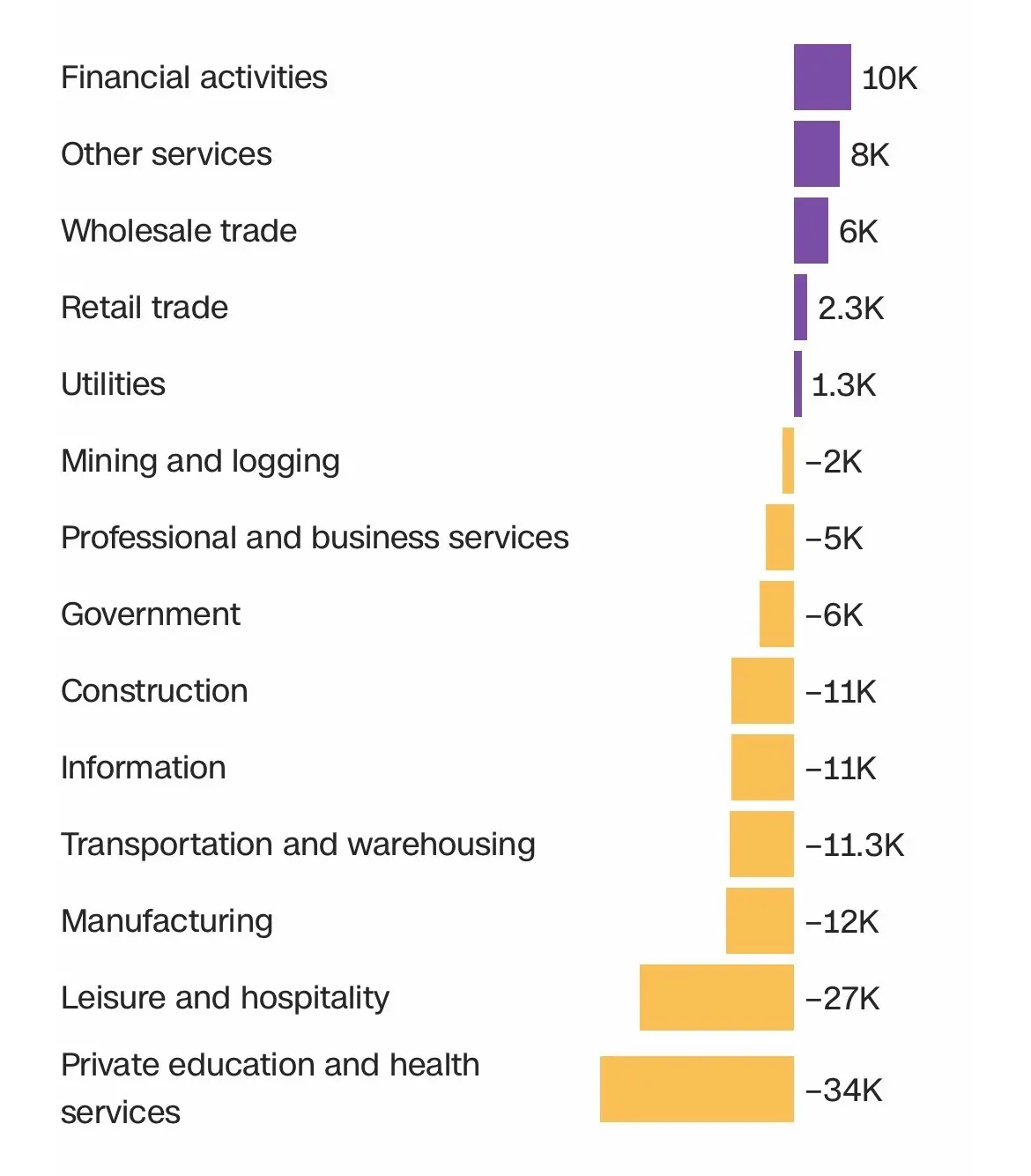
Despite the long-term decline in hiring within the financial industry, the February non-farm payroll report shows that the “Financial Activities” sector added 10,000 jobs this month, making it one of the few bright spots in the overall unemployment report.
The net employment changes across industries for February are as follows:
- Healthcare: -28,000, accounting for about 30% of total unemployment that month, mainly due to Kaiser Permanente’s four-week strike ending at the end of the month
- Information Industry: -11,000
- Transportation and Warehousing: -11,000
- Federal Government: -10,000
- Financial Activities: +10,000, a countertrend positive growth
CNN notes that extreme weather may have had some impact on the February employment data, but the BLS states that weather-related effects are difficult to quantify precisely.
Market Implications of Employment Data: Fed Policy Expectations and Dual Effects on Crypto Markets
Weak employment data is often seen as a signal to increase the likelihood of the Federal Reserve (Fed) cutting interest rates, as a cooling labor market is interpreted as a need for monetary policy to balance inflation pressures with supporting employment. In theory, a rate cut environment is favorable for risk assets, including cryptocurrencies.
However, Coindesk also points out an alternative perspective: overall weakness in the employment market may reflect economic fragility, prompting investors to adopt risk-averse strategies and reduce allocations to high-risk assets. If the contraction in financial sector hiring leads to widespread layoffs, it could further dampen overall market sentiment.
Frequently Asked Questions
Why is the number of financial sector job openings considered a leading indicator of layoffs?
A continuous decline in job openings suggests that companies are halting active recruitment over a period, which typically precedes actual layoffs. Currently, the job opening rate in finance and insurance is only 1.9%, below the levels seen during the 2001 and 2008 recessions. Historically, such contraction in vacancies often occurs months before companies begin significant layoffs.
What are the main reasons behind the unexpected loss of 92,000 jobs in the U.S. February employment market?
According to the BLS report, the healthcare industry was the largest drag, losing 28,000 jobs mainly due to Kaiser Permanente’s four-week strike. The information industry and transportation & warehousing each lost 11,000 jobs, and the federal government lost 10,000. CNN adds that extreme weather may have had some impact on the data but is difficult to quantify.
How does the financial sector employment data affect the crypto market?
Weakness in the financial employment sector could increase the chances of the Fed cutting interest rates, which is generally seen as positive for risk assets like cryptocurrencies. However, overall employment weakness may also trigger risk-averse sentiment among investors, leading to reduced allocations to volatile assets, creating a dual effect on the crypto market.
Disclaimer: The information on this page may come from third parties and does not represent the views or opinions of Gate. The content displayed on this page is for reference only and does not constitute any financial, investment, or legal advice. Gate does not guarantee the accuracy or completeness of the information and shall not be liable for any losses arising from the use of this information. Virtual asset investments carry high risks and are subject to significant price volatility. You may lose all of your invested principal. Please fully understand the relevant risks and make prudent decisions based on your own financial situation and risk tolerance. For details, please refer to
Disclaimer.
Related Articles
Bloomberg strategist: Silver, gold, crude oil, and other commodities may face pullback risks by the end of 2026
Bloomberg strategist Mike McGlone says that after a big surge in 2025, Bitcoin could face a sharp pullback, while similar risks exist for silver, gold, copper, natural gas, and crude oil—especially if crude oil prices spike, which could trigger even larger market ripple effects.
GateNews16m ago
CoinShares: Net inflows of $1.1 billion into digital asset investment products last week, the highest single-week level this year
According to CoinShares’ research report, digital asset investment products recorded a net inflow of $1.1 billion last week, the highest in the year to date. Bitcoin saw inflows of $871 million, Ethereum inflows of $196.5 million, and XRP inflows of $19.3 million, with the U.S. driving the dominant inflows. Overall market risk appetite rebounded, reflecting investor demand.
GateNews2h ago
European stocks opened lower across the board; the STOXX Europe 50 index fell 1.02%.
Gate News message: On April 13, European stocks opened broadly lower. The EURO STOXX 50 Index (the benchmark for European blue-chip stocks) fell 1.02%, the German DAX Index (the benchmark for the German stock market) fell 1.42%, the UK FTSE 100 Index fell 0.5%, the Spain IBEX35 Index fell 1.06%, and the France CAC40 Index fell 0.89%.
GateNews5h ago
Exodus CEO: Retail investors at a nine-year low, institutions quietly enjoy the crypto bull market
Exodus CEO JP Richardson said that in 2026 the crypto market will see an unprecedented structural shift, with institutional investors moving in rapidly, while retail investors are absent at scale due to a cost-of-living crisis. Data shows retail activity has fallen to a nine-year low, and some funds are flowing to traditional markets. While sentiment is fragile in the short term, the outlook for the mid term is still viewed positively.
MarketWhisper5h ago
Hormuz Strait is interrupted again: U.S. forces’ formal blockade goes into effect, with crude oil surging nearly 10% intraday
The U.S. Navy began blockading the Strait of Hormuz starting April 13, U.S. Eastern Time, with all passage halted. Crude oil prices jumped nearly 10% in a single day, while Bitcoin fell 1.2% over the past 24 hours.
GateInstantTrends6h ago
U.S. Central Command blocks Iranian ports: oil prices surge to $105, while Bitcoin slips to $71,000
U.S. Central Command confirms that, starting April 13, it will impose a maritime blockade on Iranian ports, while international shipping through the Strait of Hormuz is not affected. WTI crude oil prices break above $105, and Bitcoin falls back to around $71,000, with global energy and crypto asset markets responding in sync.
GateInstantTrends8h ago


