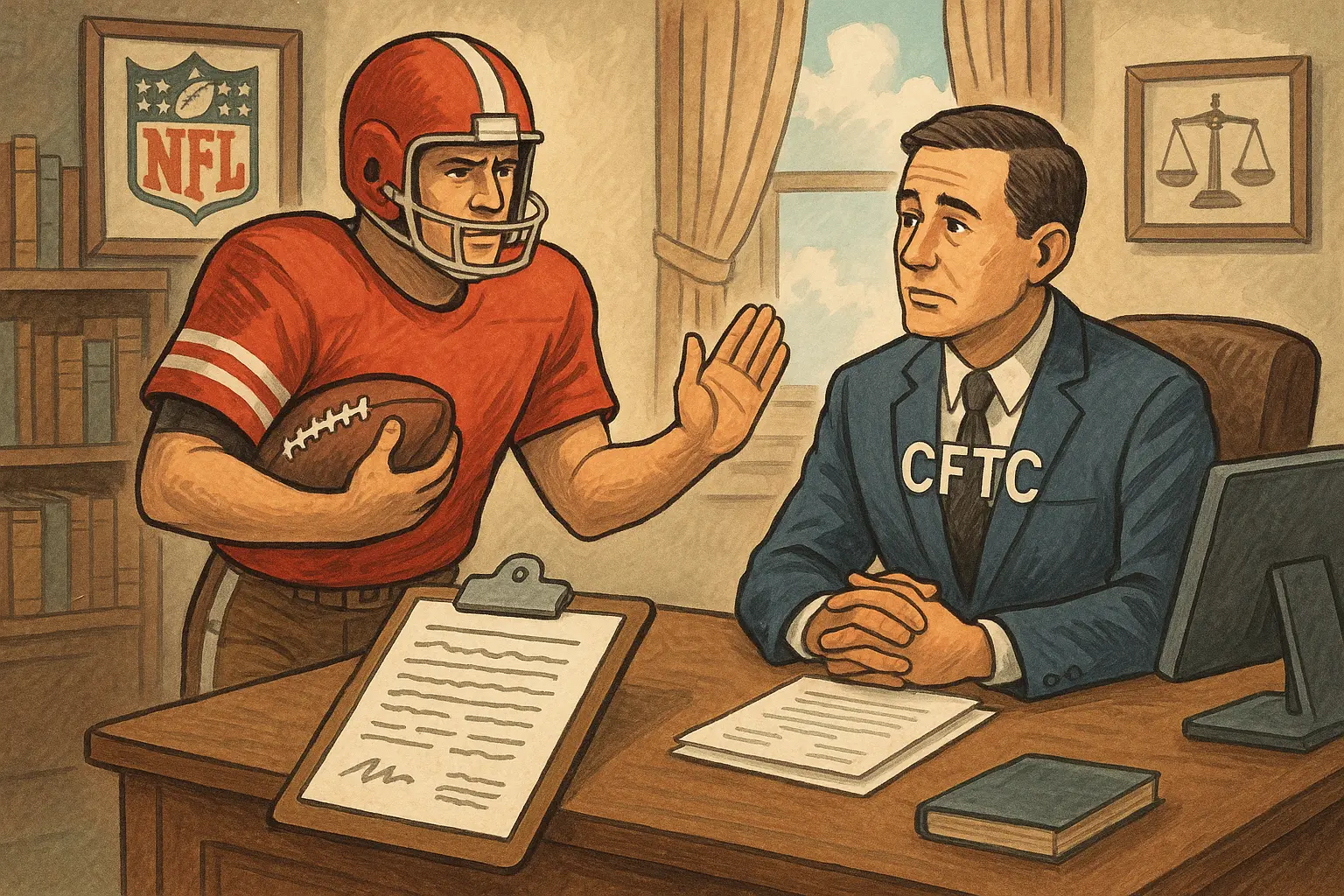
The National Football League (NFL) has sent formal letters to prediction market platforms such as Kalshi and Polymarket, urging them to stop offering contracts related to football games whose outcomes can be easily manipulated or determined in advance. This move was initiated after consultations with the U.S. Commodity Futures Trading Commission (CFTC). CFTC Chairman Michael Selig said that when assessing which contracts are vulnerable to manipulation, he will respect the views of each sports league.
NFL’s Opposition List: Which Contracts Are Deemed to Carry Manipulation Risk
In the letter, Jeff Miller, the NFL’s executive vice president, said the league opposes contract types where people who can access information from within the organizations can learn about outcomes in advance, or where outcomes can even be directly influenced by individuals’ actions. According to ESPN, the relevant contracts cover the following categories:
Commentator Speech Contracts: Announcers stating specific words or phrases during a game
Player Signing Contracts: Decisions to transfer or sign specific players
Coach Firing Contracts: The timing and conditions under which a specific coach is dismissed
On-Field Injury Contracts: Players’ injury status and severity during the event
The common feature of the above contracts is the lack of the kind of randomness that final game scores provide. Their outcomes can be known in advance—and even proactively engineered—by players, coaching staff, or team management, forming the basic set of conditions for “insider trading” as defined in traditional financial markets.
CFTC’s Delegation of Review Authority: A Structural Shift in the Regulatory Landscape
 (Source: X)
Selig’s remarks carry regulatory significance that goes beyond this case itself. He said, “Each league is fully capable of making these decisions,” meaning that professional sports organizations such as the NFL have effectively gained an informal veto influence over the listing of the relevant contracts.
Under Selig’s leadership, the CFTC is actively working to establish its “exclusive jurisdiction” over prediction markets, seeking to unify the currently fragmented interstate regulatory landscape at the federal level. However, regulators in multiple U.S. states are still bringing lawsuits against Kalshi and Polymarket under the banner of “gambling platforms.” The tension between federal regulatory claims and interstate jurisdiction has not been resolved.
Legislative Developments and Industry Split: Two Paths of Confrontation vs. Cooperation
On the legislative front, U.S. lawmakers are proposing multiple bills to address regulatory gaps in prediction markets. One bill would create an anti-insider-trading mechanism for “highly unusual bets” that appear in contracts related to Iran. Another bill would seek to prohibit any trading by the U.S. president and members of Congress on prediction markets.
What’s worth noting is that there is a clear divergence in how various professional sports leagues approach prediction markets. The NFL has chosen a confrontational stance, directly demanding that the relevant contracts be taken down. Meanwhile, Major League Baseball (MLB) has chosen a cooperation route: it has signed an information-sharing agreement with Polymarket and a memorandum of understanding with the CFTC to uphold a “integrity” framework.
This split reflects two distinctly different regulatory logics for professional sports organizations as prediction markets rise: using administrative pressure to prevent unfavorable contracts from being listed, or building real-time monitoring capabilities for suspicious trades through agreement-based mechanisms.
Frequently Asked Questions
Why does the NFL think injury and player signing contracts are easy to manipulate?
The results of events such as injury conditions, player transfers, and coach firings can be known in advance—even actively influenced—by parties who possess inside information, and they lack the randomness protection provided by the final game score. People with insider information can take positions in advance on these contracts to profit, which constitutes “insider trading” under the definition of traditional financial markets. This is the core argument behind the NFL’s demand that prediction market platforms stop offering the related contracts.
What does the CFTC’s statement following the leagues’ opinions mean for the prediction market industry?
The CFTC’s remarks effectively grant professional sports leagues an informal veto influence over specific prediction market contract listings. This regulatory stance may push more leagues to follow the NFL by making similar demands, forming an informal regulatory pre-screening mechanism led by professional sports organizations. This could have a systematic impact on the lineup of sports-related contract products offered by prediction markets.
What possible responses could Kalshi and Polymarket have to the NFL letter?
As of the time the report was published, neither platform had publicly responded. Given that MLB and Polymarket have already established an information-sharing cooperation relationship, prediction market platforms may face a choice: voluntarily take down the relevant contracts to comply with the leagues’ demands, or follow the MLB model—using cooperation through agreements to win the leagues’ trust rather than engaging in confrontation. The CFTC’s clear position makes regulatory pressure for the first option more direct.
Disclaimer: The information on this page may come from third parties and does not represent the views or opinions of Gate. The content displayed on this page is for reference only and does not constitute any financial, investment, or legal advice. Gate does not guarantee the accuracy or completeness of the information and shall not be liable for any losses arising from the use of this information. Virtual asset investments carry high risks and are subject to significant price volatility. You may lose all of your invested principal. Please fully understand the relevant risks and make prudent decisions based on your own financial situation and risk tolerance. For details, please refer to
Disclaimer.
Related Articles
Prediction Market Trading Volume Expected to Exceed $1 Trillion by 2030, Bernstein Report Highlights
Bernstein's report forecasts prediction market trading volume will surge from $51 billion in 2025 to $1 trillion by 2030, driven by regulatory clarity, blockchain support, and mainstream integration. Industry revenue is expected to rise from $400 million to $10.8 billion, with retail brokerages gaining a competitive edge.
GateNews9h ago
Trader with 100% Win Rate Bets $12.3K That MicroStrategy Will Hold Over 1M BTC by Year-End
A trader known as epsteinfiles has placed a $12,300 bet with Lookonchain, predicting that MicroStrategy will hold over 1 million BTC by December 31, 2026, with a flawless track record in past bets.
GateNews18h ago
Encourage innovation! U.S. judges ban Arizona from regulating prediction markets, pausing the prosecution of Kalshi
A U.S. federal district court ruled that Arizona is barred from bringing charges against prediction market platform Kalshi under gambling laws, finding that the Federal Commodity Futures Trading Commission has exclusive jurisdiction. The ruling affects the boundary between state and federal authority in regulating financial markets. Kalshi, meanwhile, insists that its business falls under financial products rather than traditional gambling. Rulings by different states on prediction markets have varied, and the Trump family has also voiced support for prediction markets.
CryptoCity19h ago
21Shares 更新 Hyperliquid ETF 申請,揭露 THYP 代碼
21Shares updates its Hyperliquid ETF filing, confirming the stock ticker THYP, which is seen as an adjustment in response to SEC comments. This move increases the likelihood of the ETF being listed. Compared with Bitwise’s HYPE ETF, the latter has already announced a 0.67% management fee, one of the highest in the market. The Hyperliquid platform’s strong fundamentals attract attention, but given the uncertainty around inflows of meme-coin ETF funds, market demand still needs to be watched.
MarketWhisper19h ago
Major CEX Partners with High Roller Technologies to Enter Prediction Market Space
A major centralized exchange has partnered with High Roller Technologies to provide prediction market services in the U.S. Analysts project significant growth in this sector, although it faces regulatory challenges.
GateNews21h ago
Encourage innovation! A U.S. judge bans Arizona’s regulation of prediction markets and suspends the prosecution of Kalshi
A U.S. federal district court ruled that Arizona may not rely on its gambling law to prosecute the prediction market platform Kalshi, finding that the U.S. Commodity Futures Trading Commission has exclusive jurisdiction. The ruling affects the line between state and federal authority in financial market regulation, while Kalshi maintains that its business is a financial product rather than traditional gambling. Decisions by states on prediction markets have differed, and the Trump family has also expressed support for prediction markets.
CryptoCity22h ago


