
Futures
Access hundreds of perpetual contracts
TradFi
Gold
One platform for global traditional assets
Options
Hot
Trade European-style vanilla options
Unified Account
Maximize your capital efficiency
Demo Trading
Introduction to Futures Trading
Learn the basics of futures trading
Futures Events
Join events to earn rewards
Demo Trading
Use virtual funds to practice risk-free trading
Launch
CandyDrop
Collect candies to earn airdrops
Launchpool
Quick staking, earn potential new tokens
HODLer Airdrop
Hold GT and get massive airdrops for free
Pre-IPOs
Unlock full access to global stock IPOs
Alpha Points
Trade on-chain assets and earn airdrops
Futures Points
Earn futures points and claim airdrop rewards


The decisive moment of the "CLARITY Act" has arrived! U.S. Senators: Missing this week could mean waiting another 4 years
Author: Fenrir, Crypto City
The final legislative sprint from April 13 to April 20 has become a critical watershed. Typically regarded as “crypto-friendly,” U.S. Republican Senator Cynthia Lummis recently issued a stern warning on social platform X, directly stating that this is the last chance to pass the CLARITY Act. She explicitly stated that if Congress fails to complete legislation before the 2026 midterm election cycle, the regulatory framework for the U.S. digital finance industry will face a prolonged stagnation of up to four years, potentially extending to 2030.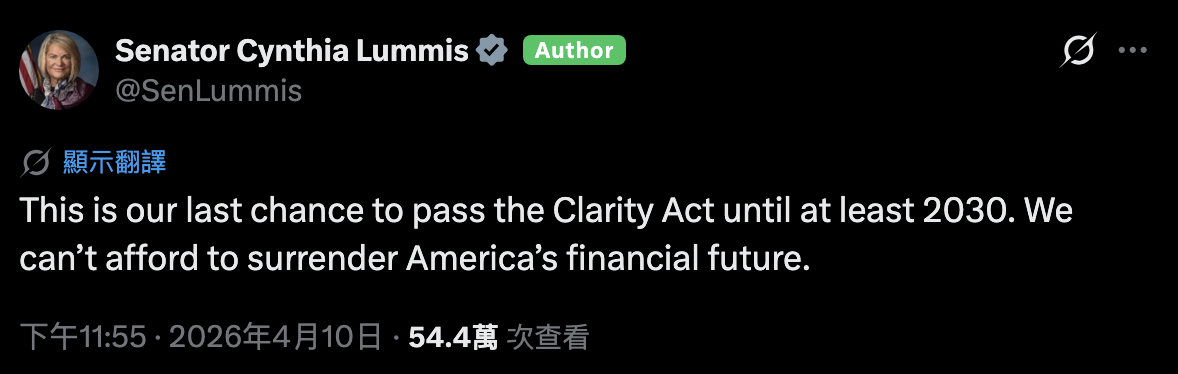
Image source: X/@SenLummis | Cynthia Lummis states that if Congress cannot complete legislation before the 2026 midterm election cycle, the regulatory framework for the U.S. digital finance industry will fall into a stagnation period of up to four years.
This statement has caused a strong ripple in the cryptocurrency community and political circles. The Senate Banking Committee hearings from April 13 to 20 have become the focus of widespread attention. The urgency stems from a tight legislative schedule, with the Senate expected to go into recess around May 21, after which the political focus for the second half of the year will shift entirely to the midterm elections. Lummis emphasized that if the bill cannot make substantial progress before the recess, election considerations will overshadow policy priorities, turning the bill into a casualty of political deadlock. To safeguard America’s financial future, she calls on her colleagues to act immediately, believing that the current administration is ready and only needs to reach a consensus in Congress to advance.
Support from Finance to Industry Giants, Unified Voice Despite the legislative timeline pressure, the backing forces behind the bill have reached new heights. U.S. Treasury Secretary Scott Bessent recently publicly urged the Senate Banking Committee to expedite submitting the bill to the President’s desk. Bessent pointed out that discussions on the relevant framework have been ongoing for over five years, and Senate proceedings are extremely precious and should not be wasted. He warned that the lack of clear regulation has already led to talent and companies moving to friendly regions like Singapore or Abu Dhabi, damaging U.S. competitiveness.
In the industry sector, Coinbase CEO Brian Armstrong has made a significant stance shift, publicly supporting Bessent’s call and praising the Senate team for their efforts to improve the bill. Additionally, industry leaders such as former White House advisor David Sacks, a16z Crypto partner Chris Dixon, and Immutable founder Robbie Ferguson believe that clear rules will unleash enormous innovation potential. Ferguson predicts that the implementation of the CLARITY Act will make the industry growth of the past decade look insignificant.
Battle over Stablecoin Yields? Traditional Banks vs. Crypto Industry The bill’s progress still faces resistance, mainly over the regulation of stablecoin yields and conflicts of interest with traditional banks. Some traditional financial institutions and lobbying groups argue that allowing stablecoins to offer yields will lead to deposit outflows from banks and weaken lending capacity. However, a report from the White House Council of Economic Advisers (CEA) offers a different data perspective. The report shows that removing stablecoin yields would contribute minimally to increasing bank loans, estimated at about $2.1 billion, only 0.02% of total U.S. loans. Analysis indicates that if yields are forcibly banned, community banks’ loans might slightly increase by $129 billion, but the overall financial system would suffer a net loss of $800 million, with costs ultimately passed on to consumers.
Coinbase policy chief Faryar Shirzad believes stablecoins should be viewed as a technological upgrade, enabling banks of all sizes to optimize payment processing and services. Currently, the Senate is trying to balance various interests and is finalizing revisions to the yield definitions.
Global Financial Restructuring: The Chain Reaction of Bill Passage or Not Beyond domestic industry impacts, the CLARITY Act is also crucial for the U.S. to maintain its leading position in the global digital asset race. SEC Chairman Paul Atkins stated that Congress needs to establish market structure legislation with future adaptability to prevent regulatory agencies from taking aggressive or inconsistent enforcement actions. If the bill passes committee review and subsequent votes this month, the likelihood of signing into law is very high. According to market forecasts, investors estimate about a 56% chance that the bill will be enacted within the year. Market analysts point out that $XRP assets are on the verge of a technological breakthrough, and regulatory authority distribution will directly impact investor confidence. If legislation fails, the U.S. may relinquish its proactive control over digital finance. This game involving midterm elections, financial system transformation, and setting global regulatory standards is now counting down, and the Senate’s move will determine whether the U.S. can maintain its global financial hegemony.