# IntelandTexasInstrumentsSurge

420.2K
🚀 #IntelandTexasInstrumentsSurge | AI Infrastructure Boom Meets Crypto Markets
The latest surge in Intel and Texas Instruments is not just another earnings-driven rally —
👉 it marks a structural shift in how global markets are pricing the future of technology
---
📊 A Defining Market Moment
This rally stands out for its scale and significance:
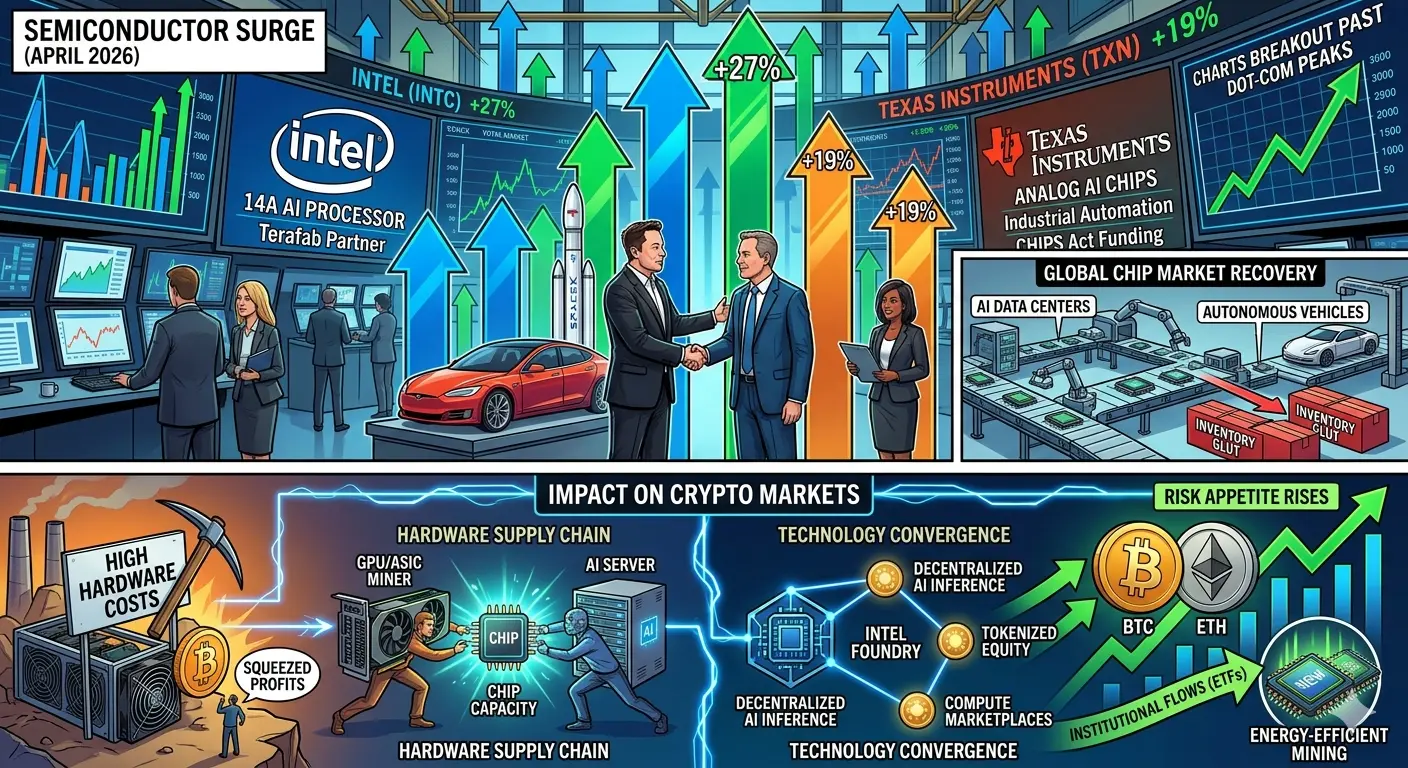
• Intel delivered a historic breakout, gaining over 20%+ and reclaiming long-term resistance
• Texas Instruments surged nearly 19%, backed by strong revenue and forward guidance
• Semiconductor indices pushed into record territory, confirming a sector-
BTC-0,77%
post-image
  • Reward
  • 4
  • Repost
  • Share
ShainingMoon:
To The Moon 🌕
View More
#IntelandTexasInstrumentsSurge
🚨 Intel & Texas Instruments Surge – A Historic Semiconductor Rally and What It Means for Crypto Markets 🚨
The global semiconductor sector has entered a powerful new phase of growth, as industry giants like Intel and Texas Instruments delivered exceptional performances following their Q1 2026 earnings, triggering one of the most aggressive rallies the chip industry has seen in decades, and creating ripple effects across technology markets, institutional capital flows, and the broader cryptocurrency ecosystem.
📊 The Scale of the Surge – A Turning Point Moment
T
BTC-0,77%
HighAmbition
#IntelandTexasInstrumentsSurge
🚨 Intel & Texas Instruments Surge – A Historic Semiconductor Rally and What It Means for Crypto Markets 🚨
The global semiconductor sector has entered a powerful new phase of growth, as industry giants like Intel and Texas Instruments delivered exceptional performances following their Q1 2026 earnings, triggering one of the most aggressive rallies the chip industry has seen in decades, and creating ripple effects across technology markets, institutional capital flows, and the broader cryptocurrency ecosystem.
📊 The Scale of the Surge – A Turning Point Moment
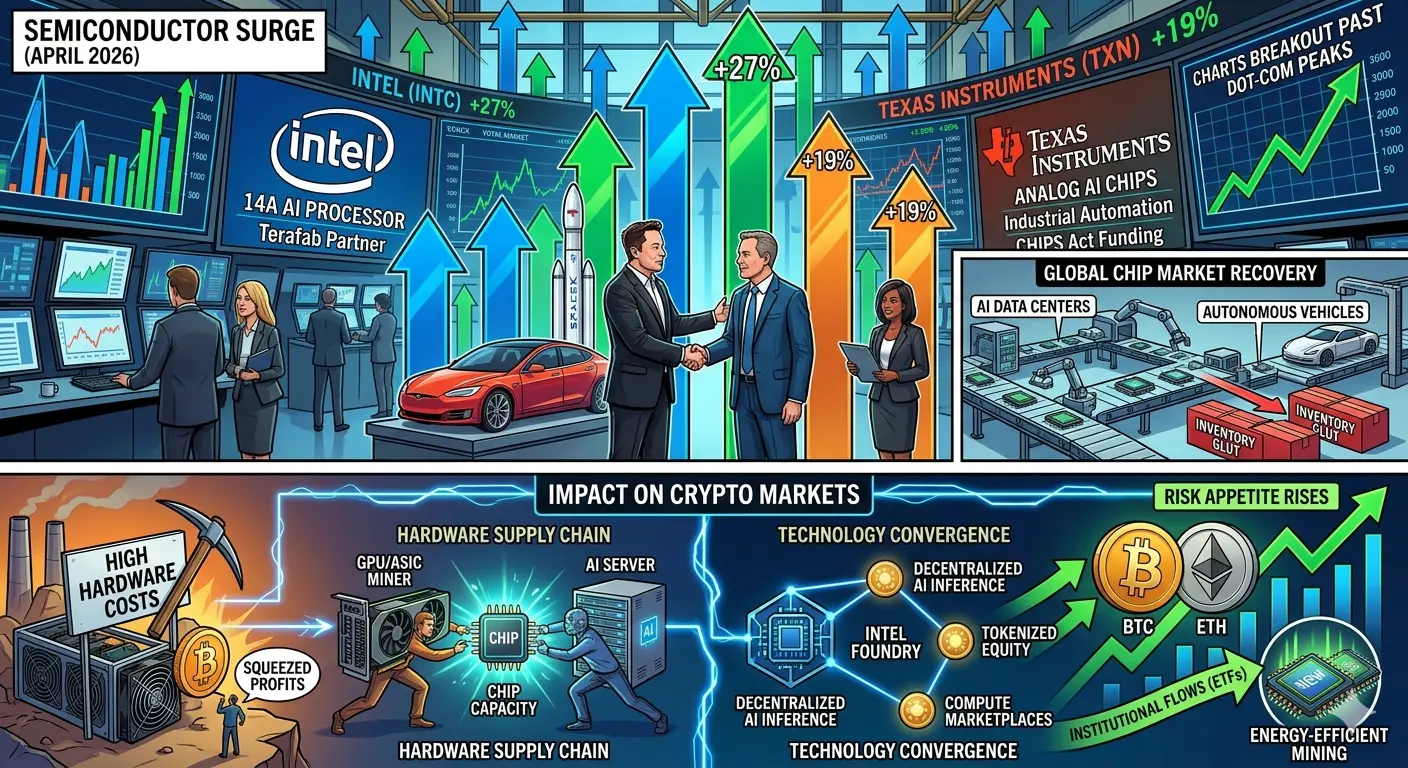
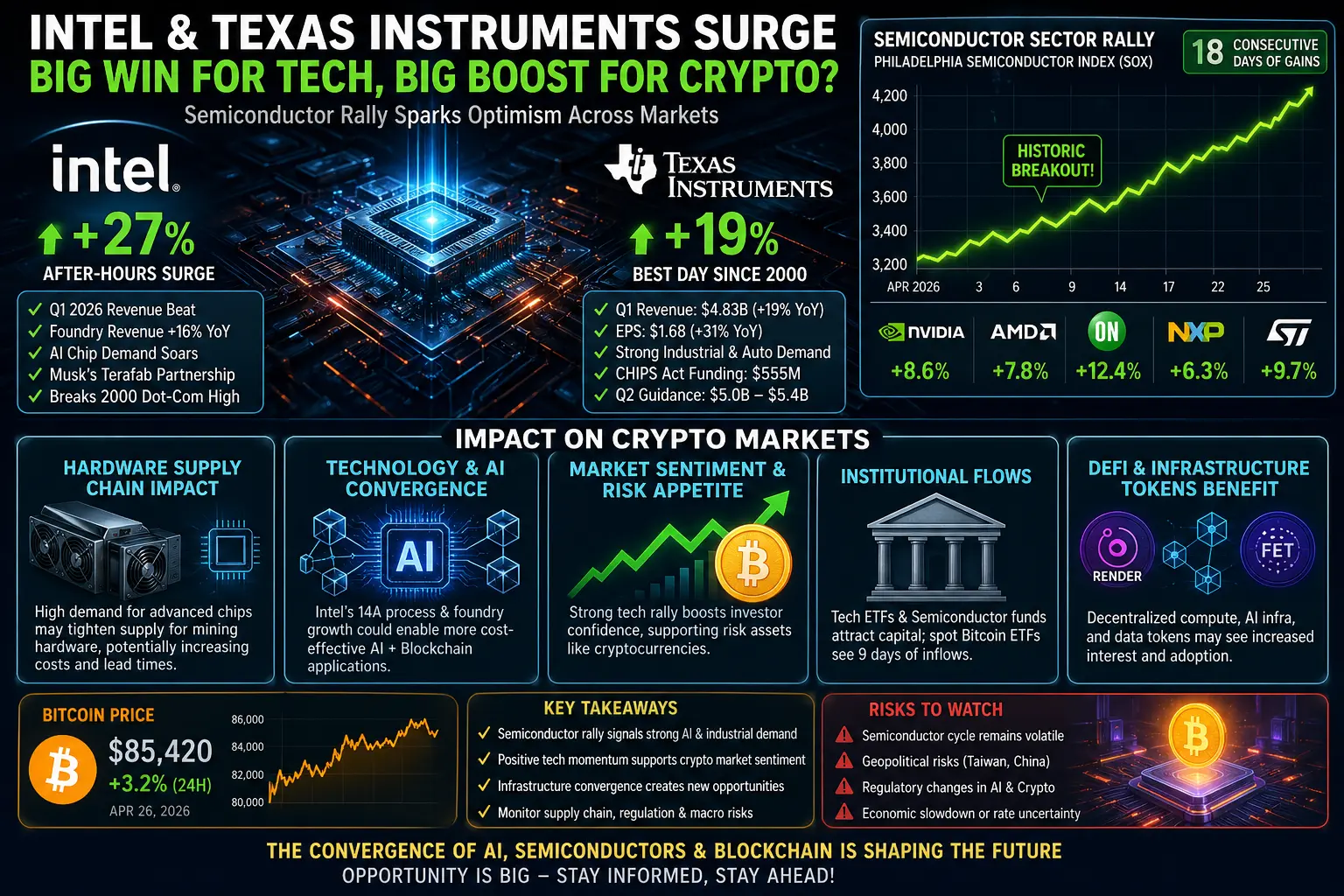
The magnitude of this rally cannot be underestimated, as Intel witnessed a massive price expansion of nearly 20% to 27% in extended trading, marking its strongest move in decades while also breaking past long-standing resistance levels dating back to the dot-com era, signaling not just short-term momentum but a deeper structural shift in investor confidence toward its business model and execution strategy.
At the same time, Texas Instruments delivered equally strong results, with its stock jumping close to 19%, supported by impressive financial performance that included $4.83 billion in revenue and strong year-over-year growth, along with forward guidance that exceeded expectations and reinforced the narrative that semiconductor demand is accelerating rather than slowing down.
⚙️ What’s Driving This Semiconductor Explosion?
This rally is not happening in isolation, but rather is being driven by multiple powerful forces working together, creating a strong foundation for sustained growth across the chip industry.
First, the global buildout of artificial intelligence infrastructure is creating unprecedented demand for chips, including processors, analog components, and data center hardware, as companies race to develop and deploy AI systems at scale, making semiconductors the backbone of this technological revolution.
Second, the recovery in industrial and automotive demand is adding another layer of growth, as businesses resume capital expenditure cycles and supply chains normalize after years of disruption, leading to increased orders and stronger revenue visibility for companies like Texas Instruments.
Third, government support through initiatives like the CHIPS Act is injecting significant funding into domestic semiconductor manufacturing, allowing companies to expand capacity, improve technology, and reduce reliance on foreign supply chains, which strengthens long-term industry stability.
Fourth, partnerships and strategic collaborations, including high-profile projects involving advanced manufacturing technologies, are further validating the future growth potential of companies like Intel, especially in the AI and high-performance computing space.
🔗 Sector-Wide Impact – A Full Industry Rally
The momentum generated by Intel and Texas Instruments has spread across the entire semiconductor sector, pushing major indices like the Philadelphia Semiconductor Index to record-breaking streaks, while companies such as AMD, Nvidia, and others have also benefited from increased investor interest and capital rotation into chip stocks.
This broad-based rally reflects a shift in market perception, where semiconductors are no longer seen as cyclical commodities but as critical infrastructure powering the future of AI, cloud computing, and digital economies.
🌐 Impact on Cryptocurrency Markets – The Hidden Connection
While the relationship between semiconductors and crypto may not seem obvious at first glance, the connection is deep and increasingly important, especially as both sectors become more intertwined through technology and infrastructure.
🖥️ 1. Hardware Supply & Mining Economics
The surge in semiconductor demand directly impacts the availability and pricing of mining hardware, as competition for advanced chips increases, potentially raising costs for crypto miners and affecting profitability, especially in networks that rely on high-performance computing resources.
🤖 2. AI + Blockchain Convergence
As companies like Intel push forward in AI chip development, the cost and accessibility of computational power may improve over time, enabling more advanced AI-driven blockchain applications, including smart contracts, automated trading systems, and decentralized AI networks.
💰 3. Institutional Sentiment & Capital Flow
Perhaps the most immediate impact comes through market sentiment, as strong performance in the technology sector increases investor confidence in innovation-driven assets, which often includes cryptocurrencies, leading to stronger inflows and renewed interest in digital assets.
📈 4. Risk Appetite Expansion
When traditional markets, especially tech stocks, are performing strongly, investors are more willing to take on risk, which benefits high-volatility assets like cryptocurrencies, creating a supportive environment for price growth and market expansion.
🏦 Institutional Momentum & Bitcoin Positioning
The ongoing semiconductor rally is also influencing institutional behavior, as capital flows into technology ETFs and innovation sectors, indirectly supporting crypto markets, particularly through increased exposure to Bitcoin and digital asset funds.
Bitcoin (BTC) is currently holding strong around the $78,000 – $80,000 range (Gate.io reference)
Institutional inflows remain steady
Market structure is supported by strong macro and tech-driven sentiment
This indicates that Bitcoin is acting as a stability anchor while broader narratives like AI and semiconductors drive market optimism.
⚡ Mining, DeFi & Infrastructure Tokens Outlook
Crypto sectors that could benefit the most from this development include:
Decentralized compute networks
AI-focused blockchain projects
Data storage and processing protocols
Infrastructure tokens supporting GPU and cloud systems
As demand for computational power rises globally, these sectors may attract increased attention and capital.
⚠️ Risk Factors to Watch
Despite the bullish momentum, several risks remain:
Semiconductor industry is still cyclical in nature
AI demand could slow if economic conditions tighten
Geopolitical tensions (especially involving Taiwan and China) may disrupt supply chains
Regulatory pressures on AI and crypto could impact growth
These factors highlight the importance of staying cautious despite strong market signals.
🔮 Final Outlook – A New Tech-Crypto Cycle Emerging
The surge in Intel and Texas Instruments represents more than just a stock market rally — it signals the beginning of a new phase where AI infrastructure, semiconductor power, and blockchain ecosystems are converging into a unified growth narrative.
In the short term, this creates a favorable environment for crypto markets through improved sentiment and capital flows, while in the long term, it lays the foundation for deeper integration between AI systems and decentralized technologies.
💡 The future market will not be driven by a single sector, but by the fusion of semiconductors, artificial intelligence, and blockchain, and those who understand this connection early may be better positioned to navigate the next wave of digital innovation.
repost-content-media
  • Reward
  • Comment
  • Repost
  • Share
#IntelandTexasInstrumentsSurge
🚨 Intel & Texas Instruments Surge – A Historic Semiconductor Rally and What It Means for Crypto Markets 🚨
The global semiconductor sector has entered a powerful new phase of growth, as industry giants like Intel and Texas Instruments delivered exceptional performances following their Q1 2026 earnings, triggering one of the most aggressive rallies the chip industry has seen in decades, and creating ripple effects across technology markets, institutional capital flows, and the broader cryptocurrency ecosystem.
📊 The Scale of the Surge – A Turning Point Moment
T
BTC-0,77%
HighAmbition
#IntelandTexasInstrumentsSurge
🚨 Intel & Texas Instruments Surge – A Historic Semiconductor Rally and What It Means for Crypto Markets 🚨
The global semiconductor sector has entered a powerful new phase of growth, as industry giants like Intel and Texas Instruments delivered exceptional performances following their Q1 2026 earnings, triggering one of the most aggressive rallies the chip industry has seen in decades, and creating ripple effects across technology markets, institutional capital flows, and the broader cryptocurrency ecosystem.
📊 The Scale of the Surge – A Turning Point Moment
The magnitude of this rally cannot be underestimated, as Intel witnessed a massive price expansion of nearly 20% to 27% in extended trading, marking its strongest move in decades while also breaking past long-standing resistance levels dating back to the dot-com era, signaling not just short-term momentum but a deeper structural shift in investor confidence toward its business model and execution strategy.
At the same time, Texas Instruments delivered equally strong results, with its stock jumping close to 19%, supported by impressive financial performance that included $4.83 billion in revenue and strong year-over-year growth, along with forward guidance that exceeded expectations and reinforced the narrative that semiconductor demand is accelerating rather than slowing down.
⚙️ What’s Driving This Semiconductor Explosion?
This rally is not happening in isolation, but rather is being driven by multiple powerful forces working together, creating a strong foundation for sustained growth across the chip industry.
First, the global buildout of artificial intelligence infrastructure is creating unprecedented demand for chips, including processors, analog components, and data center hardware, as companies race to develop and deploy AI systems at scale, making semiconductors the backbone of this technological revolution.
Second, the recovery in industrial and automotive demand is adding another layer of growth, as businesses resume capital expenditure cycles and supply chains normalize after years of disruption, leading to increased orders and stronger revenue visibility for companies like Texas Instruments.
Third, government support through initiatives like the CHIPS Act is injecting significant funding into domestic semiconductor manufacturing, allowing companies to expand capacity, improve technology, and reduce reliance on foreign supply chains, which strengthens long-term industry stability.
Fourth, partnerships and strategic collaborations, including high-profile projects involving advanced manufacturing technologies, are further validating the future growth potential of companies like Intel, especially in the AI and high-performance computing space.
🔗 Sector-Wide Impact – A Full Industry Rally
The momentum generated by Intel and Texas Instruments has spread across the entire semiconductor sector, pushing major indices like the Philadelphia Semiconductor Index to record-breaking streaks, while companies such as AMD, Nvidia, and others have also benefited from increased investor interest and capital rotation into chip stocks.
This broad-based rally reflects a shift in market perception, where semiconductors are no longer seen as cyclical commodities but as critical infrastructure powering the future of AI, cloud computing, and digital economies.
🌐 Impact on Cryptocurrency Markets – The Hidden Connection
While the relationship between semiconductors and crypto may not seem obvious at first glance, the connection is deep and increasingly important, especially as both sectors become more intertwined through technology and infrastructure.
🖥️ 1. Hardware Supply & Mining Economics
The surge in semiconductor demand directly impacts the availability and pricing of mining hardware, as competition for advanced chips increases, potentially raising costs for crypto miners and affecting profitability, especially in networks that rely on high-performance computing resources.
🤖 2. AI + Blockchain Convergence
As companies like Intel push forward in AI chip development, the cost and accessibility of computational power may improve over time, enabling more advanced AI-driven blockchain applications, including smart contracts, automated trading systems, and decentralized AI networks.
💰 3. Institutional Sentiment & Capital Flow
Perhaps the most immediate impact comes through market sentiment, as strong performance in the technology sector increases investor confidence in innovation-driven assets, which often includes cryptocurrencies, leading to stronger inflows and renewed interest in digital assets.
📈 4. Risk Appetite Expansion
When traditional markets, especially tech stocks, are performing strongly, investors are more willing to take on risk, which benefits high-volatility assets like cryptocurrencies, creating a supportive environment for price growth and market expansion.
🏦 Institutional Momentum & Bitcoin Positioning
The ongoing semiconductor rally is also influencing institutional behavior, as capital flows into technology ETFs and innovation sectors, indirectly supporting crypto markets, particularly through increased exposure to Bitcoin and digital asset funds.
Bitcoin (BTC) is currently holding strong around the $78,000 – $80,000 range (Gate.io reference)
Institutional inflows remain steady
Market structure is supported by strong macro and tech-driven sentiment
This indicates that Bitcoin is acting as a stability anchor while broader narratives like AI and semiconductors drive market optimism.
⚡ Mining, DeFi & Infrastructure Tokens Outlook
Crypto sectors that could benefit the most from this development include:
Decentralized compute networks
AI-focused blockchain projects
Data storage and processing protocols
Infrastructure tokens supporting GPU and cloud systems
As demand for computational power rises globally, these sectors may attract increased attention and capital.
⚠️ Risk Factors to Watch
Despite the bullish momentum, several risks remain:
Semiconductor industry is still cyclical in nature
AI demand could slow if economic conditions tighten
Geopolitical tensions (especially involving Taiwan and China) may disrupt supply chains
Regulatory pressures on AI and crypto could impact growth
These factors highlight the importance of staying cautious despite strong market signals.
🔮 Final Outlook – A New Tech-Crypto Cycle Emerging
The surge in Intel and Texas Instruments represents more than just a stock market rally — it signals the beginning of a new phase where AI infrastructure, semiconductor power, and blockchain ecosystems are converging into a unified growth narrative.
In the short term, this creates a favorable environment for crypto markets through improved sentiment and capital flows, while in the long term, it lays the foundation for deeper integration between AI systems and decentralized technologies.
💡 The future market will not be driven by a single sector, but by the fusion of semiconductors, artificial intelligence, and blockchain, and those who understand this connection early may be better positioned to navigate the next wave of digital innovation.
repost-content-media
  • Reward
  • 1
  • Repost
  • Share
Ryakpanda:
Just charge forward 👊
#IntelandTexasInstrumentsSurge
Intel and Texas Instruments Surge: Comprehensive Analysis and Crypto Market Impact
The semiconductor sector witnessed a historic rally in late April 2026, with both Intel and Texas Instruments posting their most significant single-day gains in over two decades. This surge represents a pivotal moment in the chip industry, signaling a fundamental shift from narrow AI-driven growth to a broader semiconductor upcycle that has far-reaching implications for the technology ecosystem, including the cryptocurrency market.
The Magnitude of the Surge
Texas Instruments expe
HighAmbition
#IntelandTexasInstrumentsSurge
Intel and Texas Instruments Surge: Comprehensive Analysis and Crypto Market Impact
The semiconductor sector witnessed a historic rally in late April 2026, with both Intel and Texas Instruments posting their most significant single-day gains in over two decades. This surge represents a pivotal moment in the chip industry, signaling a fundamental shift from narrow AI-driven growth to a broader semiconductor upcycle that has far-reaching implications for the technology ecosystem, including the cryptocurrency market.
The Magnitude of the Surge
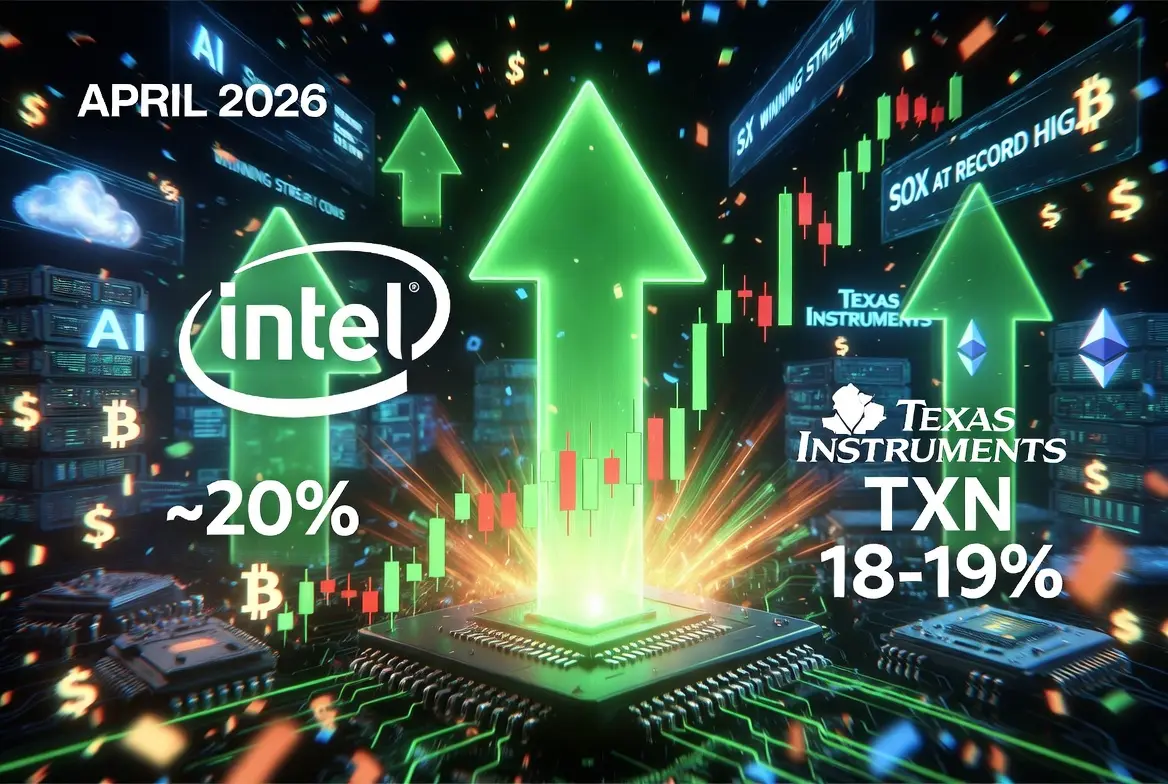
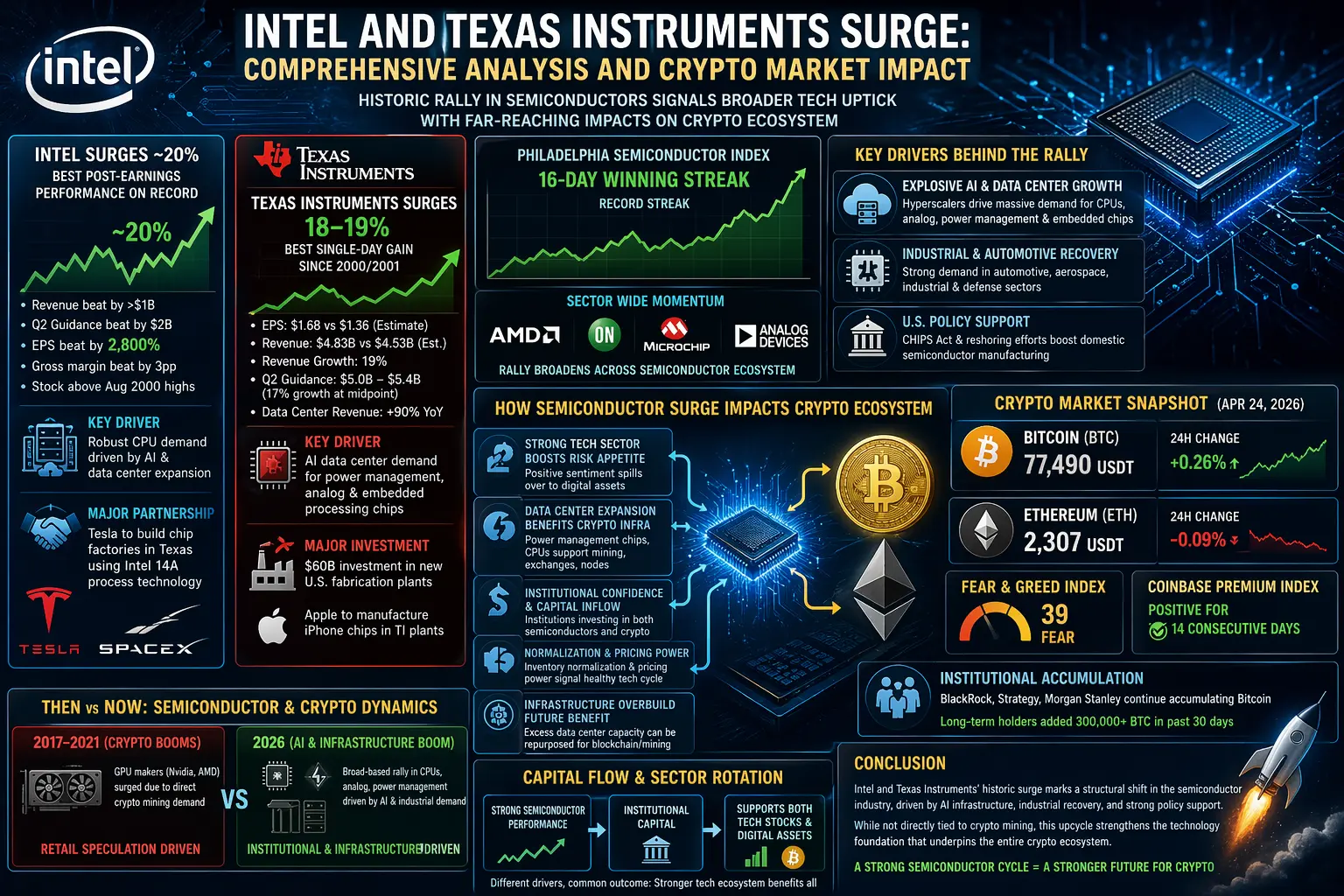
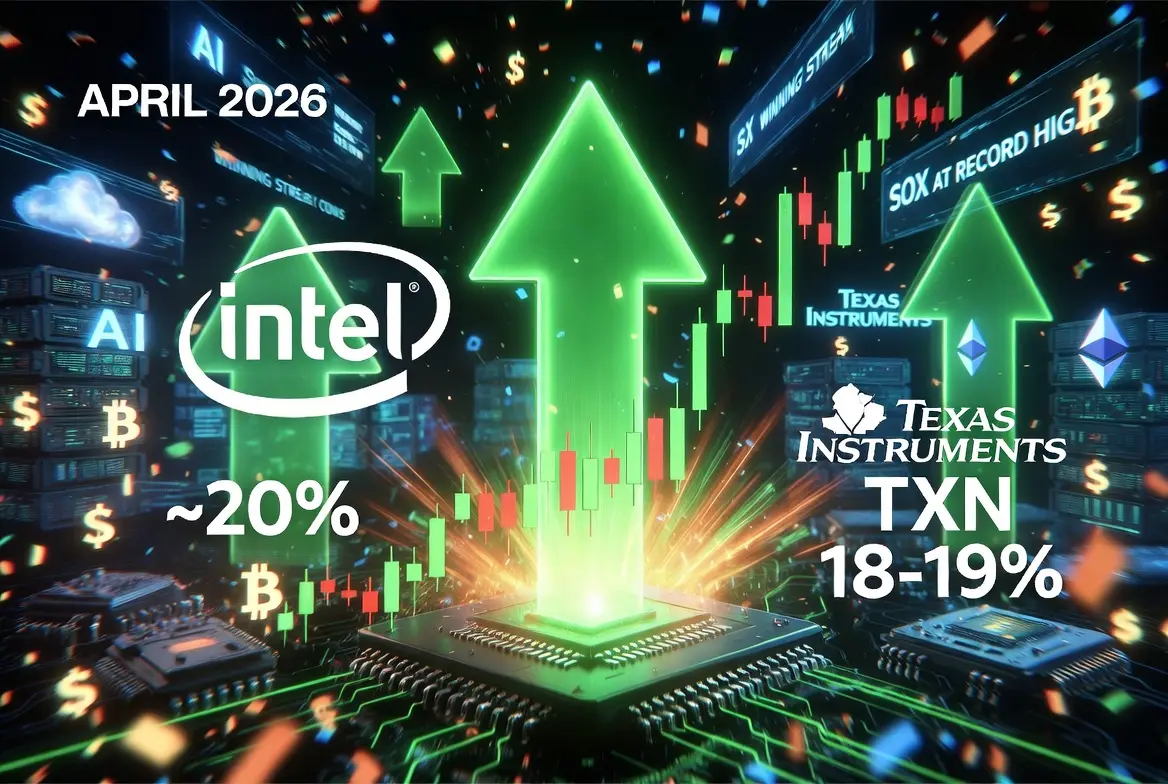
Texas Instruments experienced an extraordinary 18 to 19 percent surge on April 23, 2026, marking its best single-day performance since the year 2000 or 2001. This remarkable rally was triggered by the company's first-quarter earnings report, which delivered results that significantly exceeded Wall Street expectations. The company reported earnings per share of 1.68 dollars, crushing the consensus estimate of 1.36 dollars. Revenue growth reached 19 percent, totaling 4.83 billion dollars compared to the analyst estimate of 4.53 billion dollars. Looking ahead, Texas Instruments provided upbeat second-quarter guidance, projecting revenue between 5 billion and 5.4 billion dollars, representing 17 percent growth at the midpoint.
Intel's performance was equally impressive, with the stock surging approximately 20 percent in extended trading following its earnings announcement. This gain positioned Intel to potentially achieve its best post-earnings performance on record. The stock surpassed its August 2000 highs, approaching levels last seen during the dot-com era. Intel's earnings beat was substantial, with revenue exceeding estimates by over 1 billion dollars, second-quarter guidance beating by 2 billion dollars, and earnings per share crushing expectations by an astounding 2800 percent. Gross margins also exceeded forecasts by 3 percentage points.
Key Drivers Behind the Rally
The primary catalyst for both companies' surge was the explosive growth in artificial intelligence infrastructure and data center demand. Texas Instruments benefited from a 90 percent year-over-year increase in data center revenue, driven by hyperscalers requiring power management, analog signal chain, and embedded processing chips for their AI operations. The company's analog chips are crucial components in the AI data center buildout, providing essential power management and signal processing capabilities.
Intel's rally reflected robust CPU demand amid the AI and data center expansion. The company announced significant partnerships, including Tesla's commitment to build chip factories in Texas using Intel's advanced 14A process technology. This partnership with Tesla and potential collaboration with SpaceX has bolstered investor confidence in Intel's manufacturing capabilities and future revenue streams.
The broader semiconductor ecosystem also benefited from this momentum. The Philadelphia Semiconductor Index achieved a record 16-day winning streak, with peer companies like AMD experiencing positive spillover effects. Analog and mixed-signal semiconductor companies including ON Semiconductor, Microchip Technology, and Analog Devices also saw their stocks bloom as the rally broadened across the sector.
Crypto Market Interconnection and Impact
While the Intel and Texas Instruments surge was primarily driven by AI and data center demand rather than cryptocurrency mining, the relationship between semiconductor performance and the crypto market operates through multiple interconnected channels.
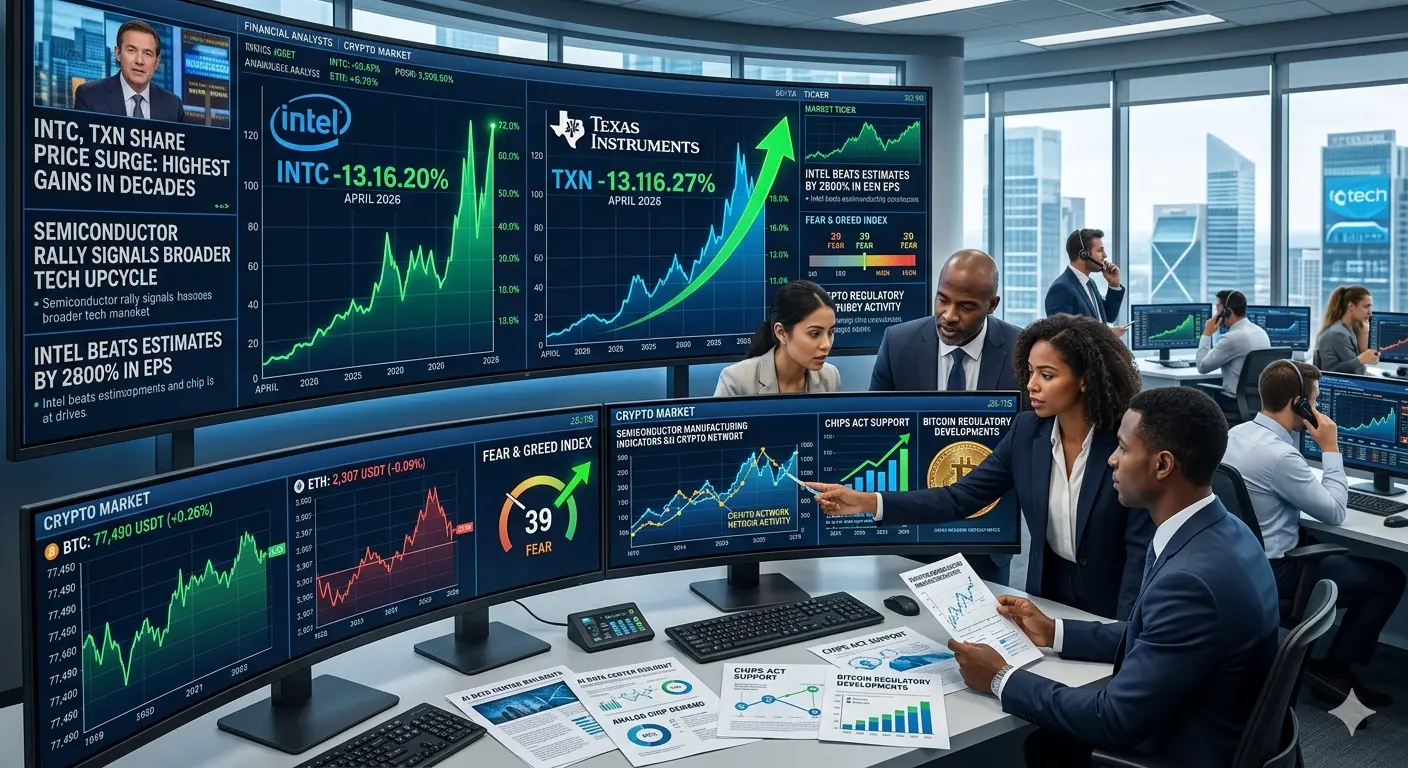
The most direct connection lies in the mining infrastructure that underpins proof-of-work cryptocurrencies like Bitcoin. Although modern Bitcoin mining relies predominantly on specialized ASICs rather than general-purpose CPUs or analog chips, the semiconductor rally signals broader technology sector health that often correlates with risk asset performance, including cryptocurrencies. The current crypto market context shows Bitcoin trading around 77,490 USDT with a modest 0.26 percent gain over 24 hours, while Ethereum hovers near 2,307 USDT with a slight decline of 0.09 percent. The fear and greed index stands at 39, indicating a fearful market sentiment that contrasts with the exuberance in semiconductor stocks.
The divergence between semiconductor stocks and crypto prices suggests that the current chip rally is driven by fundamentally different factors than previous crypto-mining booms. During the 2017 and 2021 crypto bull runs, GPU manufacturers like Nvidia and AMD saw their stocks surge due to direct demand from cryptocurrency miners. The current Intel and Texas Instruments rally, however, stems from AI data center buildouts and industrial resurgence rather than crypto mining demand.
Indirect Effects on the Crypto Ecosystem
The semiconductor surge impacts the crypto market through several indirect mechanisms. First, the rally reflects strong institutional confidence in technology infrastructure, which often translates to increased risk appetite across digital assets. BlackRock, Strategy, and Morgan Stanley continue accumulating Bitcoin, with long-term holders adding over 300,000 BTC in the past 30 days. This institutional accumulation parallels the institutional investment driving semiconductor stocks higher.
Second, the data center expansion fueled by AI demand creates infrastructure that indirectly benefits cryptocurrency operations. Modern crypto mining facilities, exchanges, and blockchain nodes rely on robust data center infrastructure. Texas Instruments' power management chips and Intel's CPUs play supporting roles in the broader technology ecosystem that enables cryptocurrency operations, even if they are not the primary mining hardware.
Third, the semiconductor rally signals a normalization of inventory levels and the return of pricing power in the technology sector. Goldman Sachs highlighted an impending analog chip recovery, aligning with broader United States manufacturing reshoring efforts under the CHIPS Act. This policy support for domestic semiconductor manufacturing creates a more resilient supply chain for technology hardware, indirectly benefiting crypto infrastructure providers.
Sector Rotation and Capital Flow Implications
The historic surge in Intel and Texas Instruments may trigger sector rotation dynamics that affect cryptocurrency markets. When traditional technology stocks deliver exceptional returns, some capital may rotate from speculative assets like cryptocurrencies into established semiconductor names. However, the current market structure shows that crypto and semiconductor stocks can rise simultaneously, driven by different underlying factors.
The crypto market's current state reflects institutional accumulation and regulatory developments rather than retail speculation. United States Senator Lummis indicated that Bitcoin market structure legislation has gained bipartisan support, while Bitcoin Core privacy optimizations and application ecosystem expansion create new growth vectors. The Coinbase premium index has remained positive for 14 consecutive days, reflecting ample dollar liquidity and improving institutional sentiment.
Long-term Structural Implications
The Intel and Texas Instruments surge represents a structural shift from narrow AI growth concentrated in GPU manufacturers like Nvidia to a full-stack semiconductor upcycle. This broadening of the rally across analog, mixed-signal, and CPU segments suggests sustained industry strength that could extend through 2026 and beyond.
For the cryptocurrency market, this structural shift implies several developments. The expansion of data center capacity driven by AI demand creates excess infrastructure that could eventually be repurposed for blockchain operations or crypto mining during periods of high profitability. Texas Instruments' 60 billion dollar investment in new United States fabrication plants, where Apple will manufacture iPhone chips, represents a significant expansion of domestic semiconductor capacity that could indirectly support crypto hardware needs.
The industrial resurgence highlighted by Texas Instruments' aerospace and defense business, which generates over 1 billion dollars annually, alongside data center power strength, indicates broad-based economic recovery that typically supports risk assets including cryptocurrencies. As inventories normalize and pricing power returns to semiconductor manufacturers, the technology sector enters a more sustainable growth phase that benefits the entire digital asset ecosystem.
Conclusion
The Intel and Texas Instruments surge represents a watershed moment for the semiconductor industry, delivering the strongest performance in over two decades driven by AI infrastructure demand and industrial recovery. While the rally is not directly tied to cryptocurrency mining, the interconnected nature of technology markets creates multiple channels through which semiconductor strength influences the crypto ecosystem.
The current crypto market, with Bitcoin near 77,500 USDT and Ethereum around 2,300 USDT, operates in a different dynamic than the semiconductor rally, driven by institutional accumulation and regulatory developments rather than mining hardware demand. However, the broader technology sector health signaled by the chip surge, combined with supportive policy frameworks like the CHIPS Act and expanding data center infrastructure, creates a favorable environment for digital asset adoption and infrastructure development.
Investors should recognize that while Intel and Texas Instruments are not directly exposed to crypto mining demand, their performance reflects the same macroeconomic forces of technology adoption, infrastructure investment, and institutional risk appetite that drive cryptocurrency markets. The semiconductor upcycle's broadening from GPUs to analog chips and CPUs suggests a maturing technology market that ultimately supports the long-term viability of blockchain and cryptocurrency ecosystems.
repost-content-media
  • Reward
  • 1
  • Repost
  • Share
GateUser-17482050:
2026 GOGOGO 👊
#IntelandTexasInstrumentsSurge
🚨 Intel & Texas Instruments Surge – A Historic Semiconductor Rally and What It Means for Crypto Markets 🚨
The global semiconductor sector has entered a powerful new phase of growth, as industry giants like Intel and Texas Instruments delivered exceptional performances following their Q1 2026 earnings, triggering one of the most aggressive rallies the chip industry has seen in decades, and creating ripple effects across technology markets, institutional capital flows, and the broader cryptocurrency ecosystem.
📊 The Scale of the Surge – A Turning Point Moment
T
BTC-0,77%
post-image
post-image
post-image
post-image
  • Reward
  • 10
  • Repost
  • Share
SoominStar:
Ape In 🚀
View More
#IntelandTexasInstrumentsSurge
Intel and Texas Instruments Surge: Comprehensive Analysis and Crypto Market Impact
The semiconductor sector witnessed a historic rally in late April 2026, with both Intel and Texas Instruments posting their most significant single-day gains in over two decades. This surge represents a pivotal moment in the chip industry, signaling a fundamental shift from narrow AI-driven growth to a broader semiconductor upcycle that has far-reaching implications for the technology ecosystem, including the cryptocurrency market.
The Magnitude of the Surge
Texas Instruments expe
HighAmbition
#IntelandTexasInstrumentsSurge
Intel and Texas Instruments Surge: Comprehensive Analysis and Crypto Market Impact
The semiconductor sector witnessed a historic rally in late April 2026, with both Intel and Texas Instruments posting their most significant single-day gains in over two decades. This surge represents a pivotal moment in the chip industry, signaling a fundamental shift from narrow AI-driven growth to a broader semiconductor upcycle that has far-reaching implications for the technology ecosystem, including the cryptocurrency market.
The Magnitude of the Surge
Texas Instruments experienced an extraordinary 18 to 19 percent surge on April 23, 2026, marking its best single-day performance since the year 2000 or 2001. This remarkable rally was triggered by the company's first-quarter earnings report, which delivered results that significantly exceeded Wall Street expectations. The company reported earnings per share of 1.68 dollars, crushing the consensus estimate of 1.36 dollars. Revenue growth reached 19 percent, totaling 4.83 billion dollars compared to the analyst estimate of 4.53 billion dollars. Looking ahead, Texas Instruments provided upbeat second-quarter guidance, projecting revenue between 5 billion and 5.4 billion dollars, representing 17 percent growth at the midpoint.
Intel's performance was equally impressive, with the stock surging approximately 20 percent in extended trading following its earnings announcement. This gain positioned Intel to potentially achieve its best post-earnings performance on record. The stock surpassed its August 2000 highs, approaching levels last seen during the dot-com era. Intel's earnings beat was substantial, with revenue exceeding estimates by over 1 billion dollars, second-quarter guidance beating by 2 billion dollars, and earnings per share crushing expectations by an astounding 2800 percent. Gross margins also exceeded forecasts by 3 percentage points.
Key Drivers Behind the Rally
The primary catalyst for both companies' surge was the explosive growth in artificial intelligence infrastructure and data center demand. Texas Instruments benefited from a 90 percent year-over-year increase in data center revenue, driven by hyperscalers requiring power management, analog signal chain, and embedded processing chips for their AI operations. The company's analog chips are crucial components in the AI data center buildout, providing essential power management and signal processing capabilities.
Intel's rally reflected robust CPU demand amid the AI and data center expansion. The company announced significant partnerships, including Tesla's commitment to build chip factories in Texas using Intel's advanced 14A process technology. This partnership with Tesla and potential collaboration with SpaceX has bolstered investor confidence in Intel's manufacturing capabilities and future revenue streams.
The broader semiconductor ecosystem also benefited from this momentum. The Philadelphia Semiconductor Index achieved a record 16-day winning streak, with peer companies like AMD experiencing positive spillover effects. Analog and mixed-signal semiconductor companies including ON Semiconductor, Microchip Technology, and Analog Devices also saw their stocks bloom as the rally broadened across the sector.
Crypto Market Interconnection and Impact
While the Intel and Texas Instruments surge was primarily driven by AI and data center demand rather than cryptocurrency mining, the relationship between semiconductor performance and the crypto market operates through multiple interconnected channels.
The most direct connection lies in the mining infrastructure that underpins proof-of-work cryptocurrencies like Bitcoin. Although modern Bitcoin mining relies predominantly on specialized ASICs rather than general-purpose CPUs or analog chips, the semiconductor rally signals broader technology sector health that often correlates with risk asset performance, including cryptocurrencies. The current crypto market context shows Bitcoin trading around 77,490 USDT with a modest 0.26 percent gain over 24 hours, while Ethereum hovers near 2,307 USDT with a slight decline of 0.09 percent. The fear and greed index stands at 39, indicating a fearful market sentiment that contrasts with the exuberance in semiconductor stocks.
The divergence between semiconductor stocks and crypto prices suggests that the current chip rally is driven by fundamentally different factors than previous crypto-mining booms. During the 2017 and 2021 crypto bull runs, GPU manufacturers like Nvidia and AMD saw their stocks surge due to direct demand from cryptocurrency miners. The current Intel and Texas Instruments rally, however, stems from AI data center buildouts and industrial resurgence rather than crypto mining demand.
Indirect Effects on the Crypto Ecosystem
The semiconductor surge impacts the crypto market through several indirect mechanisms. First, the rally reflects strong institutional confidence in technology infrastructure, which often translates to increased risk appetite across digital assets. BlackRock, Strategy, and Morgan Stanley continue accumulating Bitcoin, with long-term holders adding over 300,000 BTC in the past 30 days. This institutional accumulation parallels the institutional investment driving semiconductor stocks higher.
Second, the data center expansion fueled by AI demand creates infrastructure that indirectly benefits cryptocurrency operations. Modern crypto mining facilities, exchanges, and blockchain nodes rely on robust data center infrastructure. Texas Instruments' power management chips and Intel's CPUs play supporting roles in the broader technology ecosystem that enables cryptocurrency operations, even if they are not the primary mining hardware.
Third, the semiconductor rally signals a normalization of inventory levels and the return of pricing power in the technology sector. Goldman Sachs highlighted an impending analog chip recovery, aligning with broader United States manufacturing reshoring efforts under the CHIPS Act. This policy support for domestic semiconductor manufacturing creates a more resilient supply chain for technology hardware, indirectly benefiting crypto infrastructure providers.
Sector Rotation and Capital Flow Implications
The historic surge in Intel and Texas Instruments may trigger sector rotation dynamics that affect cryptocurrency markets. When traditional technology stocks deliver exceptional returns, some capital may rotate from speculative assets like cryptocurrencies into established semiconductor names. However, the current market structure shows that crypto and semiconductor stocks can rise simultaneously, driven by different underlying factors.
The crypto market's current state reflects institutional accumulation and regulatory developments rather than retail speculation. United States Senator Lummis indicated that Bitcoin market structure legislation has gained bipartisan support, while Bitcoin Core privacy optimizations and application ecosystem expansion create new growth vectors. The Coinbase premium index has remained positive for 14 consecutive days, reflecting ample dollar liquidity and improving institutional sentiment.
Long-term Structural Implications
The Intel and Texas Instruments surge represents a structural shift from narrow AI growth concentrated in GPU manufacturers like Nvidia to a full-stack semiconductor upcycle. This broadening of the rally across analog, mixed-signal, and CPU segments suggests sustained industry strength that could extend through 2026 and beyond.
For the cryptocurrency market, this structural shift implies several developments. The expansion of data center capacity driven by AI demand creates excess infrastructure that could eventually be repurposed for blockchain operations or crypto mining during periods of high profitability. Texas Instruments' 60 billion dollar investment in new United States fabrication plants, where Apple will manufacture iPhone chips, represents a significant expansion of domestic semiconductor capacity that could indirectly support crypto hardware needs.
The industrial resurgence highlighted by Texas Instruments' aerospace and defense business, which generates over 1 billion dollars annually, alongside data center power strength, indicates broad-based economic recovery that typically supports risk assets including cryptocurrencies. As inventories normalize and pricing power returns to semiconductor manufacturers, the technology sector enters a more sustainable growth phase that benefits the entire digital asset ecosystem.
Conclusion
The Intel and Texas Instruments surge represents a watershed moment for the semiconductor industry, delivering the strongest performance in over two decades driven by AI infrastructure demand and industrial recovery. While the rally is not directly tied to cryptocurrency mining, the interconnected nature of technology markets creates multiple channels through which semiconductor strength influences the crypto ecosystem.
The current crypto market, with Bitcoin near 77,500 USDT and Ethereum around 2,300 USDT, operates in a different dynamic than the semiconductor rally, driven by institutional accumulation and regulatory developments rather than mining hardware demand. However, the broader technology sector health signaled by the chip surge, combined with supportive policy frameworks like the CHIPS Act and expanding data center infrastructure, creates a favorable environment for digital asset adoption and infrastructure development.
Investors should recognize that while Intel and Texas Instruments are not directly exposed to crypto mining demand, their performance reflects the same macroeconomic forces of technology adoption, infrastructure investment, and institutional risk appetite that drive cryptocurrency markets. The semiconductor upcycle's broadening from GPUs to analog chips and CPUs suggests a maturing technology market that ultimately supports the long-term viability of blockchain and cryptocurrency ecosystems.
repost-content-media
  • Reward
  • Comment
  • Repost
  • Share
#IntelandTexasInstrumentsSurge
Intel and Texas Instruments Surge: Comprehensive Analysis and Crypto Market Impact
The semiconductor sector witnessed a historic rally in late April 2026, with both Intel and Texas Instruments posting their most significant single-day gains in over two decades. This surge represents a pivotal moment in the chip industry, signaling a fundamental shift from narrow AI-driven growth to a broader semiconductor upcycle that has far-reaching implications for the technology ecosystem, including the cryptocurrency market.
The Magnitude of the Surge
Texas Instruments expe
post-image
post-image
post-image
  • Reward
  • 1
  • Repost
  • Share
Yusfirah:
To The Moon 🌕
#IntelandTexasInstrumentsSurge
Intel and Texas Instruments Surge: Comprehensive Analysis and Crypto Market Impact
The semiconductor sector witnessed a historic rally in late April 2026, with both Intel and Texas Instruments posting their most significant single-day gains in over two decades. This surge represents a pivotal moment in the chip industry, signaling a fundamental shift from narrow AI-driven growth to a broader semiconductor upcycle that has far-reaching implications for the technology ecosystem, including the cryptocurrency market.
The Magnitude of the Surge
Texas Instruments expe
HighAmbition
#IntelandTexasInstrumentsSurge
Intel and Texas Instruments Surge: Comprehensive Analysis and Crypto Market Impact
The semiconductor sector witnessed a historic rally in late April 2026, with both Intel and Texas Instruments posting their most significant single-day gains in over two decades. This surge represents a pivotal moment in the chip industry, signaling a fundamental shift from narrow AI-driven growth to a broader semiconductor upcycle that has far-reaching implications for the technology ecosystem, including the cryptocurrency market.
The Magnitude of the Surge
Texas Instruments experienced an extraordinary 18 to 19 percent surge on April 23, 2026, marking its best single-day performance since the year 2000 or 2001. This remarkable rally was triggered by the company's first-quarter earnings report, which delivered results that significantly exceeded Wall Street expectations. The company reported earnings per share of 1.68 dollars, crushing the consensus estimate of 1.36 dollars. Revenue growth reached 19 percent, totaling 4.83 billion dollars compared to the analyst estimate of 4.53 billion dollars. Looking ahead, Texas Instruments provided upbeat second-quarter guidance, projecting revenue between 5 billion and 5.4 billion dollars, representing 17 percent growth at the midpoint.
Intel's performance was equally impressive, with the stock surging approximately 20 percent in extended trading following its earnings announcement. This gain positioned Intel to potentially achieve its best post-earnings performance on record. The stock surpassed its August 2000 highs, approaching levels last seen during the dot-com era. Intel's earnings beat was substantial, with revenue exceeding estimates by over 1 billion dollars, second-quarter guidance beating by 2 billion dollars, and earnings per share crushing expectations by an astounding 2800 percent. Gross margins also exceeded forecasts by 3 percentage points.
Key Drivers Behind the Rally
The primary catalyst for both companies' surge was the explosive growth in artificial intelligence infrastructure and data center demand. Texas Instruments benefited from a 90 percent year-over-year increase in data center revenue, driven by hyperscalers requiring power management, analog signal chain, and embedded processing chips for their AI operations. The company's analog chips are crucial components in the AI data center buildout, providing essential power management and signal processing capabilities.
Intel's rally reflected robust CPU demand amid the AI and data center expansion. The company announced significant partnerships, including Tesla's commitment to build chip factories in Texas using Intel's advanced 14A process technology. This partnership with Tesla and potential collaboration with SpaceX has bolstered investor confidence in Intel's manufacturing capabilities and future revenue streams.
The broader semiconductor ecosystem also benefited from this momentum. The Philadelphia Semiconductor Index achieved a record 16-day winning streak, with peer companies like AMD experiencing positive spillover effects. Analog and mixed-signal semiconductor companies including ON Semiconductor, Microchip Technology, and Analog Devices also saw their stocks bloom as the rally broadened across the sector.
Crypto Market Interconnection and Impact
While the Intel and Texas Instruments surge was primarily driven by AI and data center demand rather than cryptocurrency mining, the relationship between semiconductor performance and the crypto market operates through multiple interconnected channels.
The most direct connection lies in the mining infrastructure that underpins proof-of-work cryptocurrencies like Bitcoin. Although modern Bitcoin mining relies predominantly on specialized ASICs rather than general-purpose CPUs or analog chips, the semiconductor rally signals broader technology sector health that often correlates with risk asset performance, including cryptocurrencies. The current crypto market context shows Bitcoin trading around 77,490 USDT with a modest 0.26 percent gain over 24 hours, while Ethereum hovers near 2,307 USDT with a slight decline of 0.09 percent. The fear and greed index stands at 39, indicating a fearful market sentiment that contrasts with the exuberance in semiconductor stocks.
The divergence between semiconductor stocks and crypto prices suggests that the current chip rally is driven by fundamentally different factors than previous crypto-mining booms. During the 2017 and 2021 crypto bull runs, GPU manufacturers like Nvidia and AMD saw their stocks surge due to direct demand from cryptocurrency miners. The current Intel and Texas Instruments rally, however, stems from AI data center buildouts and industrial resurgence rather than crypto mining demand.
Indirect Effects on the Crypto Ecosystem
The semiconductor surge impacts the crypto market through several indirect mechanisms. First, the rally reflects strong institutional confidence in technology infrastructure, which often translates to increased risk appetite across digital assets. BlackRock, Strategy, and Morgan Stanley continue accumulating Bitcoin, with long-term holders adding over 300,000 BTC in the past 30 days. This institutional accumulation parallels the institutional investment driving semiconductor stocks higher.
Second, the data center expansion fueled by AI demand creates infrastructure that indirectly benefits cryptocurrency operations. Modern crypto mining facilities, exchanges, and blockchain nodes rely on robust data center infrastructure. Texas Instruments' power management chips and Intel's CPUs play supporting roles in the broader technology ecosystem that enables cryptocurrency operations, even if they are not the primary mining hardware.
Third, the semiconductor rally signals a normalization of inventory levels and the return of pricing power in the technology sector. Goldman Sachs highlighted an impending analog chip recovery, aligning with broader United States manufacturing reshoring efforts under the CHIPS Act. This policy support for domestic semiconductor manufacturing creates a more resilient supply chain for technology hardware, indirectly benefiting crypto infrastructure providers.
Sector Rotation and Capital Flow Implications
The historic surge in Intel and Texas Instruments may trigger sector rotation dynamics that affect cryptocurrency markets. When traditional technology stocks deliver exceptional returns, some capital may rotate from speculative assets like cryptocurrencies into established semiconductor names. However, the current market structure shows that crypto and semiconductor stocks can rise simultaneously, driven by different underlying factors.
The crypto market's current state reflects institutional accumulation and regulatory developments rather than retail speculation. United States Senator Lummis indicated that Bitcoin market structure legislation has gained bipartisan support, while Bitcoin Core privacy optimizations and application ecosystem expansion create new growth vectors. The Coinbase premium index has remained positive for 14 consecutive days, reflecting ample dollar liquidity and improving institutional sentiment.
Long-term Structural Implications
The Intel and Texas Instruments surge represents a structural shift from narrow AI growth concentrated in GPU manufacturers like Nvidia to a full-stack semiconductor upcycle. This broadening of the rally across analog, mixed-signal, and CPU segments suggests sustained industry strength that could extend through 2026 and beyond.
For the cryptocurrency market, this structural shift implies several developments. The expansion of data center capacity driven by AI demand creates excess infrastructure that could eventually be repurposed for blockchain operations or crypto mining during periods of high profitability. Texas Instruments' 60 billion dollar investment in new United States fabrication plants, where Apple will manufacture iPhone chips, represents a significant expansion of domestic semiconductor capacity that could indirectly support crypto hardware needs.
The industrial resurgence highlighted by Texas Instruments' aerospace and defense business, which generates over 1 billion dollars annually, alongside data center power strength, indicates broad-based economic recovery that typically supports risk assets including cryptocurrencies. As inventories normalize and pricing power returns to semiconductor manufacturers, the technology sector enters a more sustainable growth phase that benefits the entire digital asset ecosystem.
Conclusion
The Intel and Texas Instruments surge represents a watershed moment for the semiconductor industry, delivering the strongest performance in over two decades driven by AI infrastructure demand and industrial recovery. While the rally is not directly tied to cryptocurrency mining, the interconnected nature of technology markets creates multiple channels through which semiconductor strength influences the crypto ecosystem.
The current crypto market, with Bitcoin near 77,500 USDT and Ethereum around 2,300 USDT, operates in a different dynamic than the semiconductor rally, driven by institutional accumulation and regulatory developments rather than mining hardware demand. However, the broader technology sector health signaled by the chip surge, combined with supportive policy frameworks like the CHIPS Act and expanding data center infrastructure, creates a favorable environment for digital asset adoption and infrastructure development.
Investors should recognize that while Intel and Texas Instruments are not directly exposed to crypto mining demand, their performance reflects the same macroeconomic forces of technology adoption, infrastructure investment, and institutional risk appetite that drive cryptocurrency markets. The semiconductor upcycle's broadening from GPUs to analog chips and CPUs suggests a maturing technology market that ultimately supports the long-term viability of blockchain and cryptocurrency ecosystems.
repost-content-media
  • Reward
  • Comment
  • Repost
  • Share
#IntelandTexasInstrumentsSurge
Intel and Texas Instruments Surge: Comprehensive Analysis and Crypto Market Impact
The semiconductor sector witnessed a historic rally in late April 2026, with both Intel and Texas Instruments posting their most significant single-day gains in over two decades. This surge represents a pivotal moment in the chip industry, signaling a fundamental shift from narrow AI-driven growth to a broader semiconductor upcycle that has far-reaching implications for the technology ecosystem, including the cryptocurrency market.
The Magnitude of the Surge
Texas Instruments expe
post-image
  • Reward
  • Comment
  • Repost
  • Share
#IntelAndTexasInstrumentsSurge
#IntelandTexasInstrumentsSurge
A Historic Semiconductor Breakout Reshaping Global Markets and the Future of Crypto
The global semiconductor industry has just delivered one of its most explosive moments in modern financial history. In late April 2026, Intel and Texas Instruments shocked markets with extraordinary single-day rallies—moves not seen since the peak of the dot-com era.
This was not just another earnings-driven spike. It marked the beginning of something far more significant: a broad-based semiconductor supercycle, fueled by artificial intelligence, in
BTC-0,77%
ETH-0,36%
  • Reward
  • 1
  • Repost
  • Share
Yusfirah:
LFG 🔥
Load More