InvestingWithBrandon

vip
Age 1.4 Yıl
Peak Tier 0
No content yet
We said day one in Discord this whole situation is likely noise.
People get caught up on the non needle mover things.
Buy great companies at good prices and use options to magnify ultra high confidence plays. It’s that simple…
Don’t complicate it.
Volatility is opportunity.
Maybe this is over, maybe it’s not.
But I will stick to the plan.
  • Reward
  • Comment
  • Repost
  • Share
Price is what you pay.
Value is what you get.
Most people only track one of them.
A stock going down is not always the same as a company getting worse.
Learn to separate those two things and the market becomes a completely different game.
Trading price alone sounds like this:
"Down 20%. Must be a bad company."
"All time high. Must be a good buy."
"Everyone is selling. I should too."
The price chart becomes the entire investment thesis.
That is the trap.
Tracking value sounds like this:
"EPS growing. Stock down. That is a potential opportunity."
"Moat intact. Macro pulled it down. The business
  • Reward
  • Comment
  • Repost
  • Share
You shouldn’t care what happens with Iran tonight.
If you do, your aren’t an investor.
Your a gambling speculator & will likely never beat the market in the long run.
Do you think Warren Buffett really cares?
Of course not…
  • Reward
  • Comment
  • Repost
  • Share
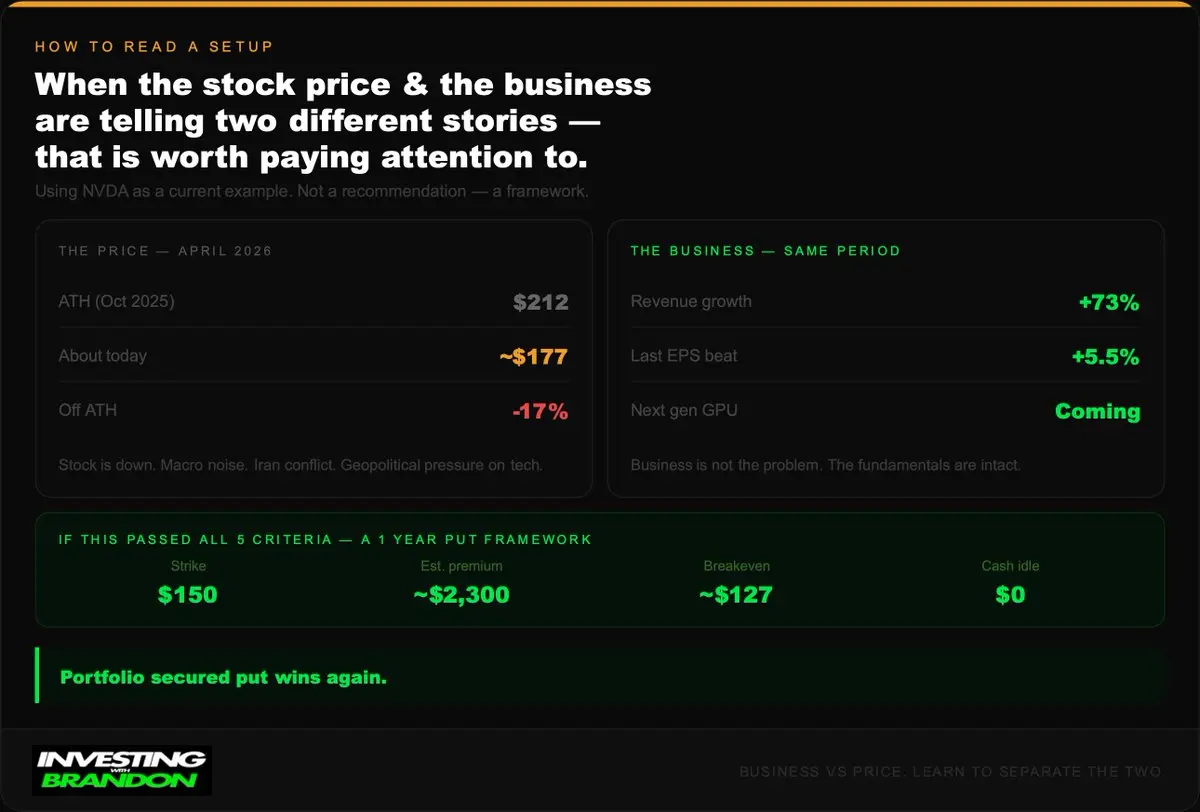
When the stock price & the business are telling two different stories — that is worth paying attention to.
Using NVDA as a current example.
Not a recommendation — a framework for how to think about it.
The price — April 2026:
ATH (Oct 2025): $212.
About today: ~$177.
Off ATH: -17%.
The business — same period:
Revenue growth last quarter: +73%.
Last EPS beat: +5.5% above estimates.
Next gen Rubin GPU: coming later this year.
The stock is down on macro noise & geopolitics.
The business is not the problem.
If this passed all 5 criteria, here is how a 1 year portfolio secured put would look:
Strik
post-image
  • Reward
  • Comment
  • Repost
  • Share
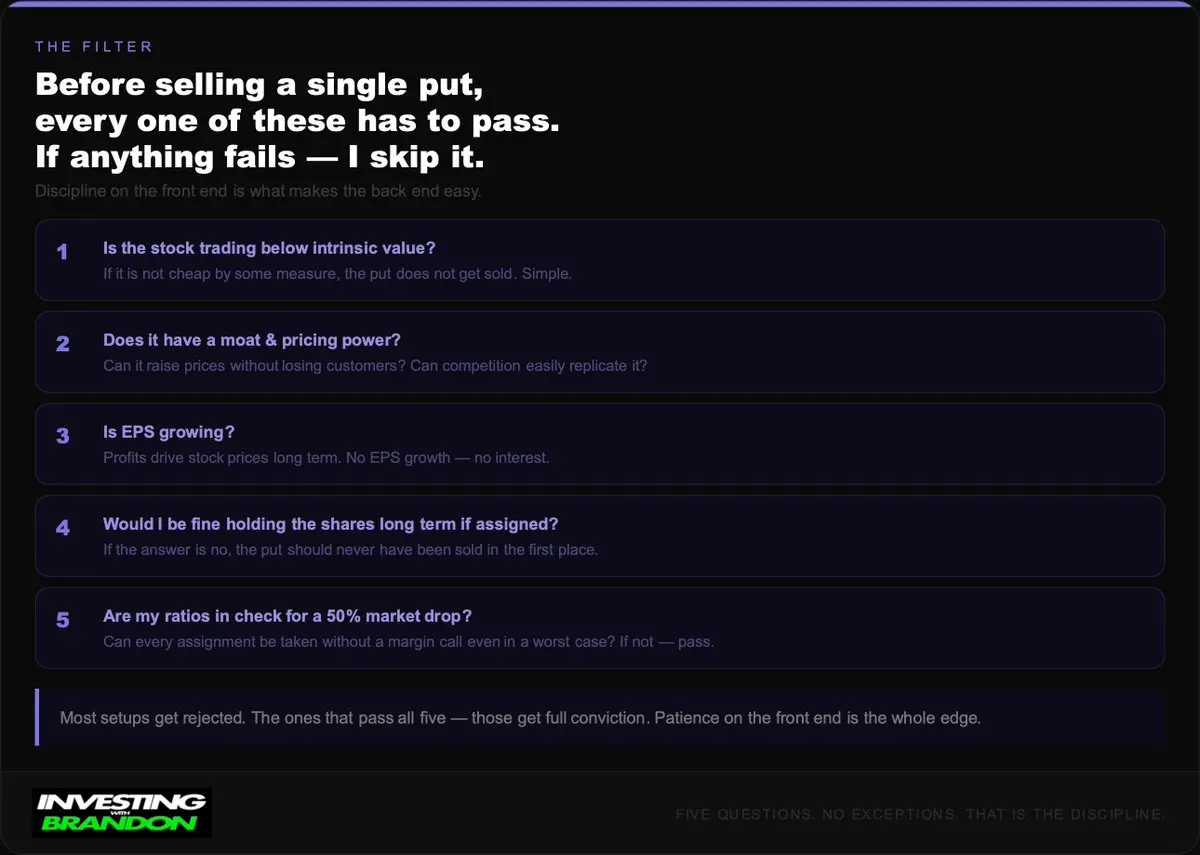
Before selling a single put, every one of these has to pass.
If anything fails... skip it.
1. Is the stock trading below intrinsic value?
If it is not cheap by some measure, the put does not get sold.
2. Does it have a moat & pricing power?
Can it raise prices without losing customers?
Can competition easily replicate it?
3. Is EPS growing?
Profits drive stock prices long term.
No EPS growth — no interest.
4. Would I be fine holding the shares long term if assigned?
If the answer is no, the put should never have been sold in the first place.
5. Are my ratios in check for a 50% market drop?
Can
post-image
  • Reward
  • Comment
  • Repost
  • Share
Why most people selling puts are working 10x harder for a fraction of the result.
Same underlying.
Completely different outcome.
1 month put on Q at $540 strike:
~$420 collected per contract.
Need 9 trades in a row just to match the alternative.
Cash secured = $54,000 sitting completely idle.
No EPS tailwind. Just 30 days and hope.
1 year put on Q at $525 strike:
~$3,800 collected. One trade. Right now.
Portfolio secured. $0 idle. Every dollar still working.
12 months of EPS growth working in your favor.
Take premium. Buy Q shares & LEAPS today.
Ratios in check to be fine in crashes/volatilit
  • Reward
  • Comment
  • Repost
  • Share
WHEN THE MARKET GOES STRAIGHT UP, EVERYONE IS A GENIUS:
But the day we get a tiny dip everyone is suddenly big on risk management, bonds, CDs, gold, ect...
I have seen this time and time again…
People just don’t learn.
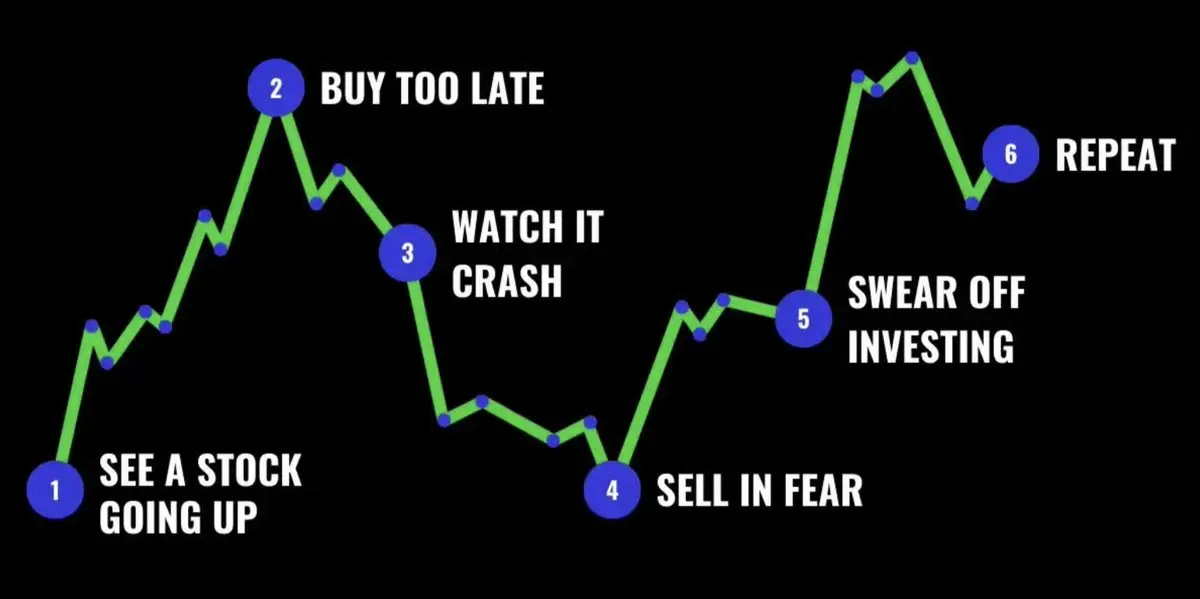
They buy into the hype, get smoked, then sell for a loss.
The exact opposite of what should be done.
post-image
  • Reward
  • Comment
  • Repost
  • Share
Where are the day trading Billionaires?
  • Reward
  • Comment
  • Repost
  • Share
Buy great companies for less than they are worth.
That's it.
  • Reward
  • Comment
  • Repost
  • Share
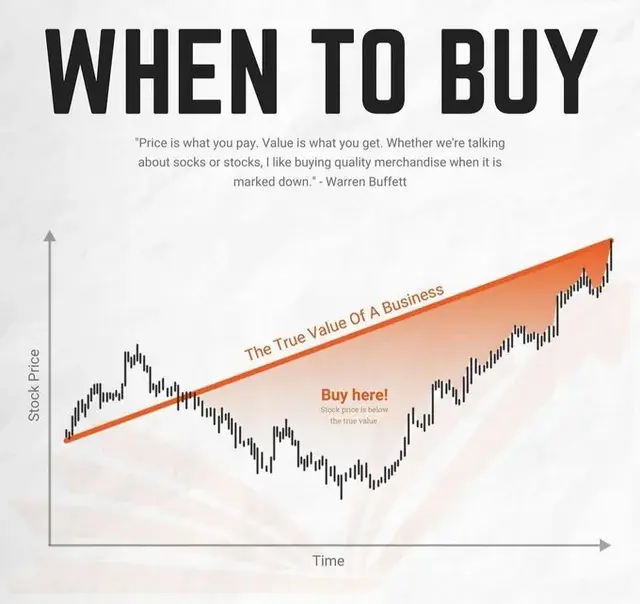
IF YOU UNDERSTAND THIS, YOU CAN MAKE MILLIONS:
The real win isn’t just buying any old dip.
It’s buying when a stock is trading below its intrinsic value.
As Warren Buffett says, "price is what you pay, value is what you get"
But most people don’t know the difference between price and value.
They know the price a stock is trading at 24/7, but have no clue how to value it.
The key is understanding what a business is actually worth.
Once you know that, you stop guessing and start investing.
When you find the deal:
1. Buy shares.
2. Sell portfolio secured puts.
3. Buy calls.
All options are 1+ y
post-image
  • Reward
  • Comment
  • Repost
  • Share
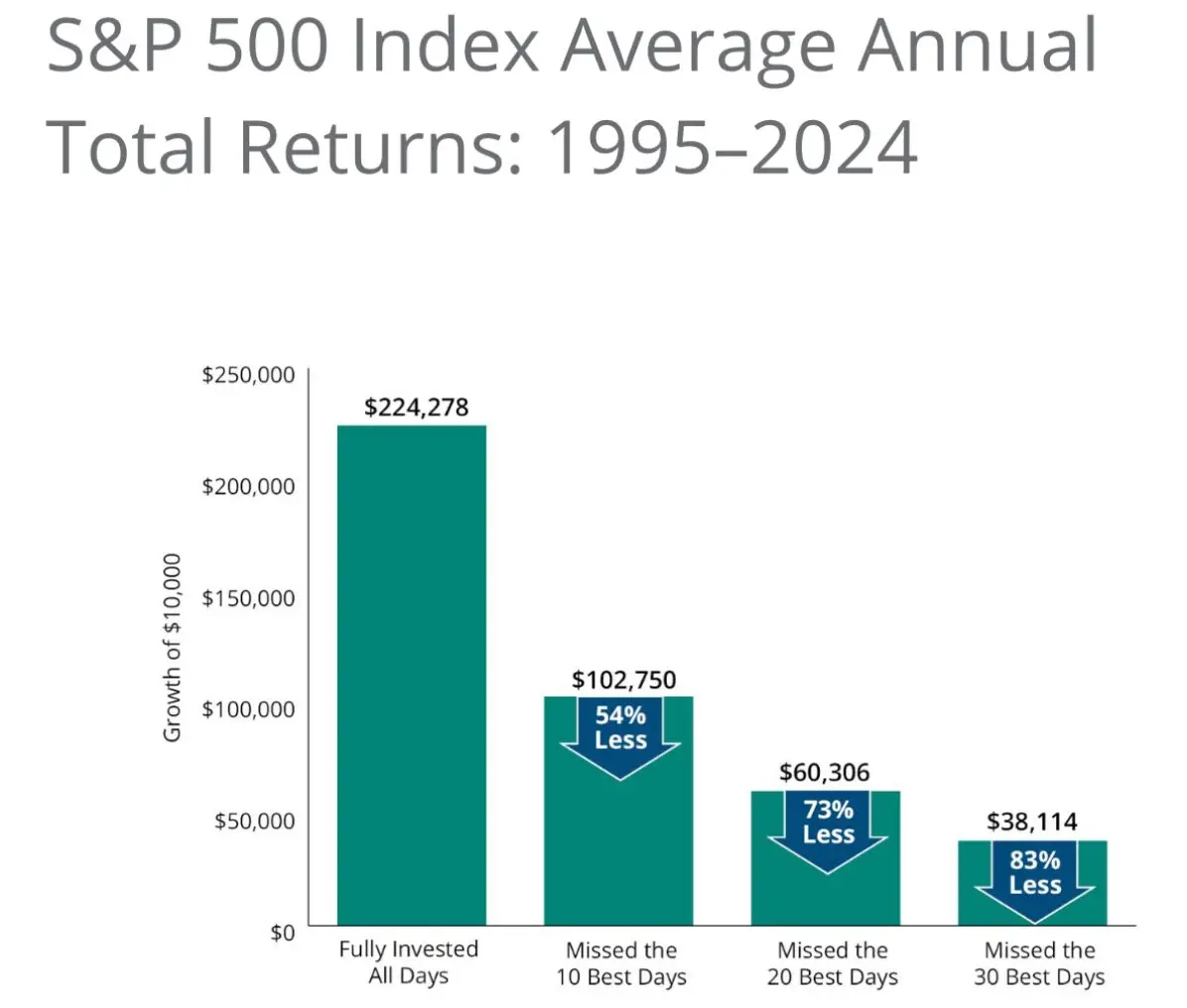
If you miss the 10 best days in the market in the last 30 years, your returns will be cut in half!
Think about that!
Are you really good enough to predict the 10 best days in a 30 year time period!?
You aren’t.
Nobody is.
Moral of the story... stay invested in great companies at good prices.
post-image
  • Reward
  • Comment
  • Repost
  • Share
The same Q trade. Two very different outcomes.
Q: about $585 today. ATH was $637.
1 month put at $555 strike:
Premium collected: ~$380.
Cash needed if cash secured: $55,500 sitting idle.
Margin of safety: ~5%.
EPS tailwind: none.
Need 10 trades in a row just to match the alternative.
1 year put at $525 strike:
Premium collected: ~$3,800.
Cash needed: $0. Portfolio is the collateral.
Margin of safety: ~10%.
EPS tailwind: 12 months of growth working for you.
Take the $3,800.
Buy Q shares & LEAPS.
Every dollar working.
Q at $525 in 1 year would be historically cheap.
That assignment is fine.
Port
  • Reward
  • Comment
  • Repost
  • Share
Most people learn about compounding.
Few actually feel it.
Here is when it starts to feel real.
$50,000 invested.
At 10% per year (S&P average):
Year 10: $130,000.
Year 20: $336,000.
Year 30: $873,000.
At 25% per year (with the options layer):
(my CAGR in the last 10 years is around 25% but will likely end up closer to 20 with time)
Year 10: $465,000.
Year 20: $4.3 million.
Year 30: $39.8 million.
Same $50,000. Same 30 years.
The only variable is the system you use.
Year 1 to 5 feels slow.
Year 10 starts to feel real.
Year 20 changes everything.
The hardest part is being patient enough to get
  • Reward
  • Comment
  • Repost
  • Share
Before I sell a single put, I ask these 5 questions.
This is the filter. If anything fails, I pass. No exceptions.
1. Is this stock trading below intrinsic value?
If it is not cheap, I do not sell the put.
2. Does it have a moat & pricing power?
Can it raise prices without losing customers?
Can competition easily copy it?
3. Is EPS growing?
Profits drive stock prices in the long run.
If EPS is not growing, I am not interested.
4. Am I OK to own the shares long term if assigned?
If I would not want to own the shares, I should not sell the put.
5. Are my ratios in check?
Can I take assignment wi
  • Reward
  • Comment
  • Repost
  • Share
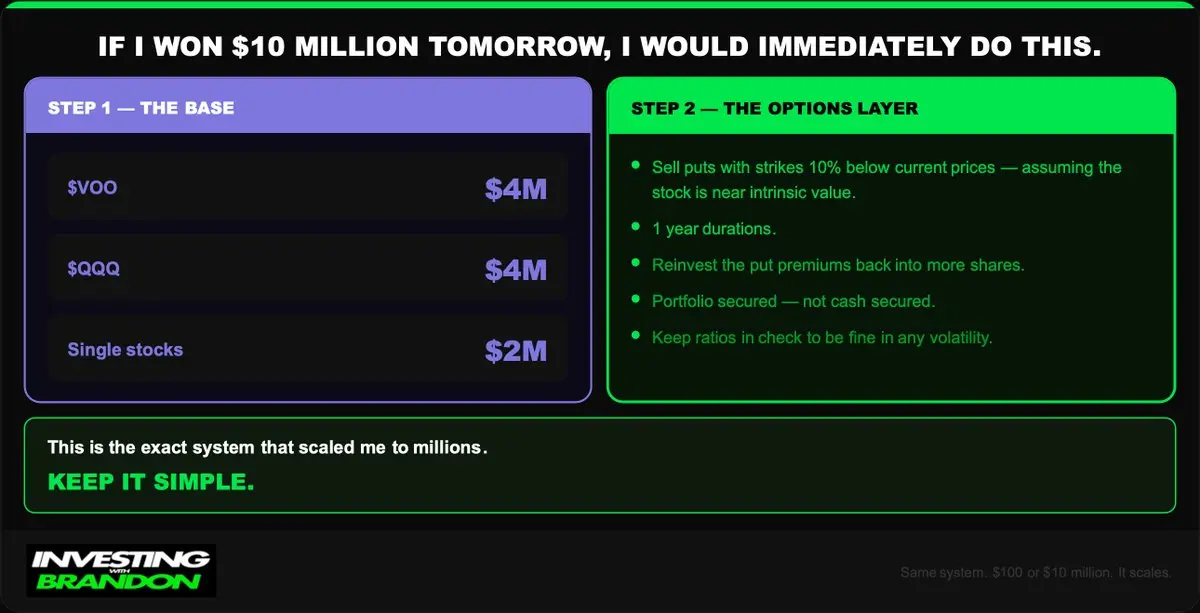
If I won 10 million bucks tomorrow, I would immediately do this:
$4m in $VOO
$4m in $Q
$2m in single stocks.
- Sell puts with strikes 10% below the current prices assuming the stock is near intrinsic value.
-1 year durations.
-Reinvest the put premiums back into more shares.
-Portfolio secured, not cash secured.
- Keep ratios in check to be fine in any volatility.
This is the exact system scaled me to millions, and it can scale you too.
KEEP IT SIMPLE GUYS
post-image
  • Reward
  • Comment
  • Repost
  • Share
You’ll likely be dreaming of these prices in 5 years for most companies.
Even more likely in 10 years.
Moral of the story, filter out the noise.
Stick to the plan.
  • Reward
  • Comment
  • Repost
  • Share
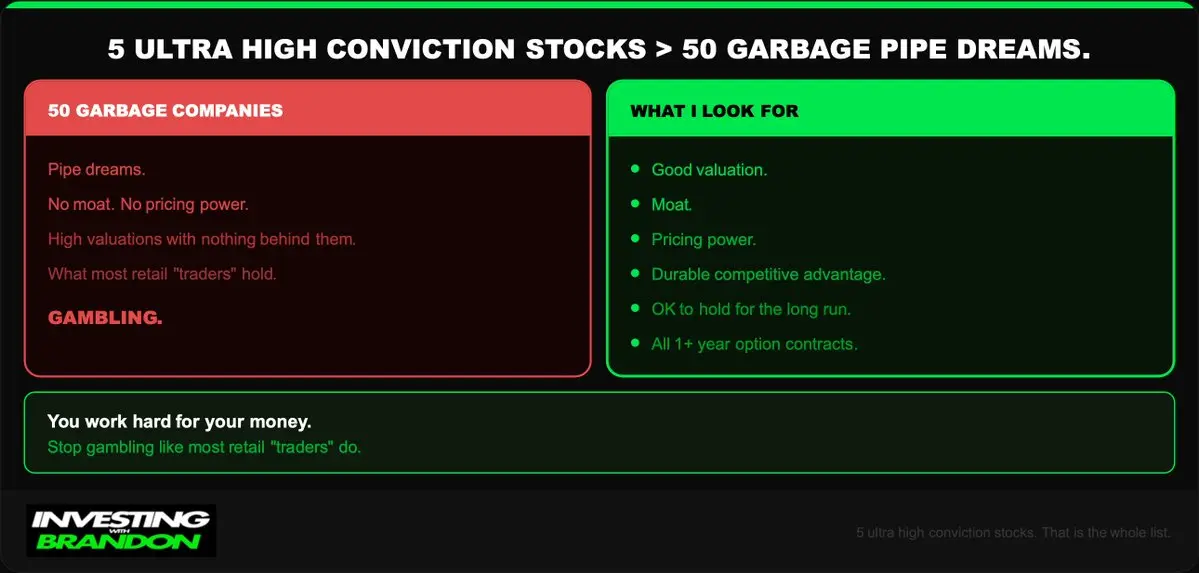
I'd rather own 5 ULTRA high conviction stocks vs 50 garbage companies that are pipe dreams...
What I Look For:
- Good Valuation
- Moat
- Pricing power
- Durable Competitive Advantage
- Ok To Hold For Long Run
- All 1+ year option contracts
You work hard for your money, stop gambling like most retail "traders" do.
post-image
  • Reward
  • Comment
  • Repost
  • Share
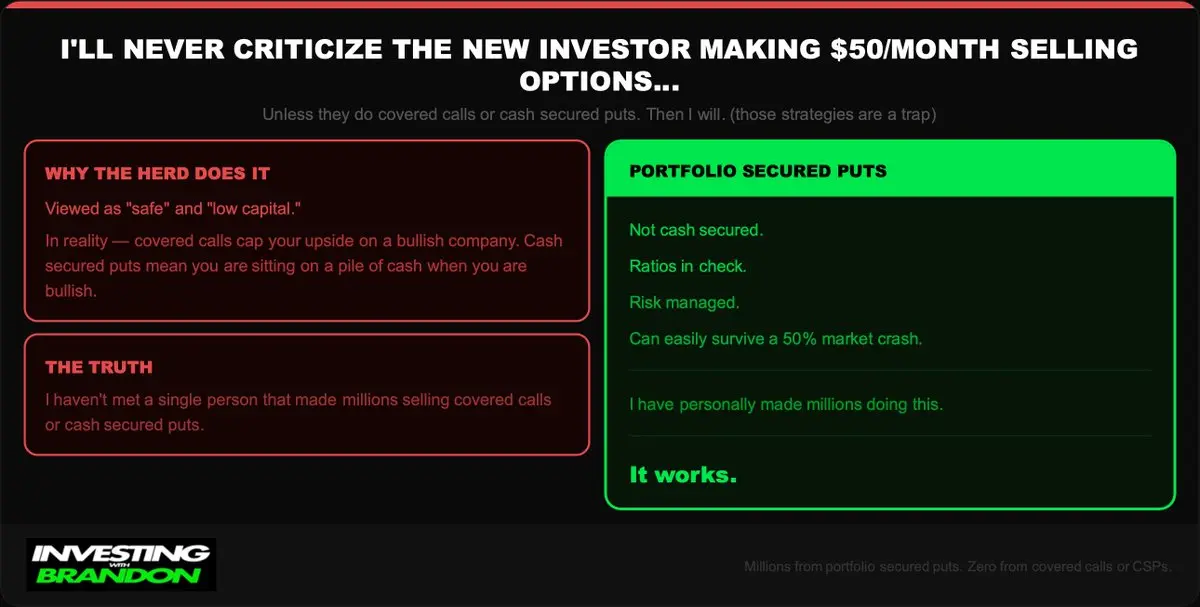
I'll never criticize the new investor making $50/month selling options...
Unless they do covered calls or cash secured puts...
Then I will.
(those strategies are a trap)
Most new investors fall victim to this because it's viewed by the herd as "safe" and "low capital"
But in reality, it's a way to cap upside on a bullish company (covered call) & a way to sit on a bunch of cash when you are bullish on a company (cash secured put)
I haven't met a single person that made millions selling CCs or CSPs...
But I have personally made millions selling portfolio secured puts, not cash secured.
Ratios in
post-image
  • Reward
  • Comment
  • Repost
  • Share
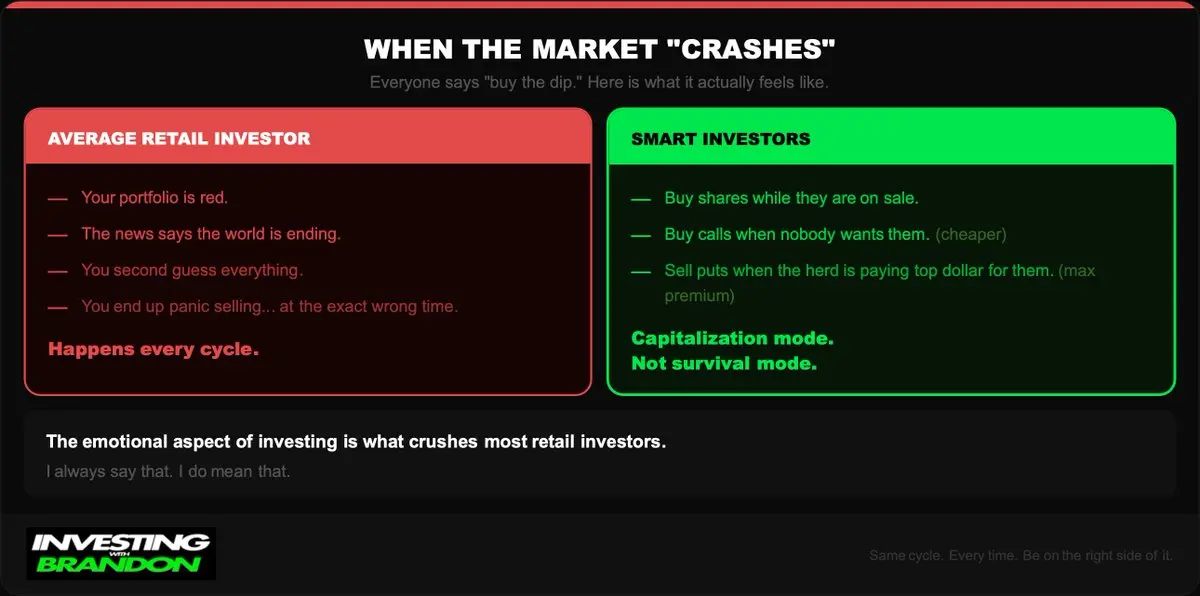
When the market "CRASHES"
Everyone says "Buy the dip"
But do you know what it feels like to actually buy during a "meltdown" as an average retail investor?
- Your portfolio is red.
- The news says the world is ending.
- You second guess everything.
- You end up panic selling... at the exact wrong time.
Happens every cycle.
Smart investors will:
- Buy shares while they are on sale.
- Buy calls when nobody wants them. (cheaper)
- Sell puts when the herd is paying top dollar for them. (selling for max premium)
I always say the emotional aspect of investing is what crushes most retail investors
post-image
  • Reward
  • Comment
  • Repost
  • Share
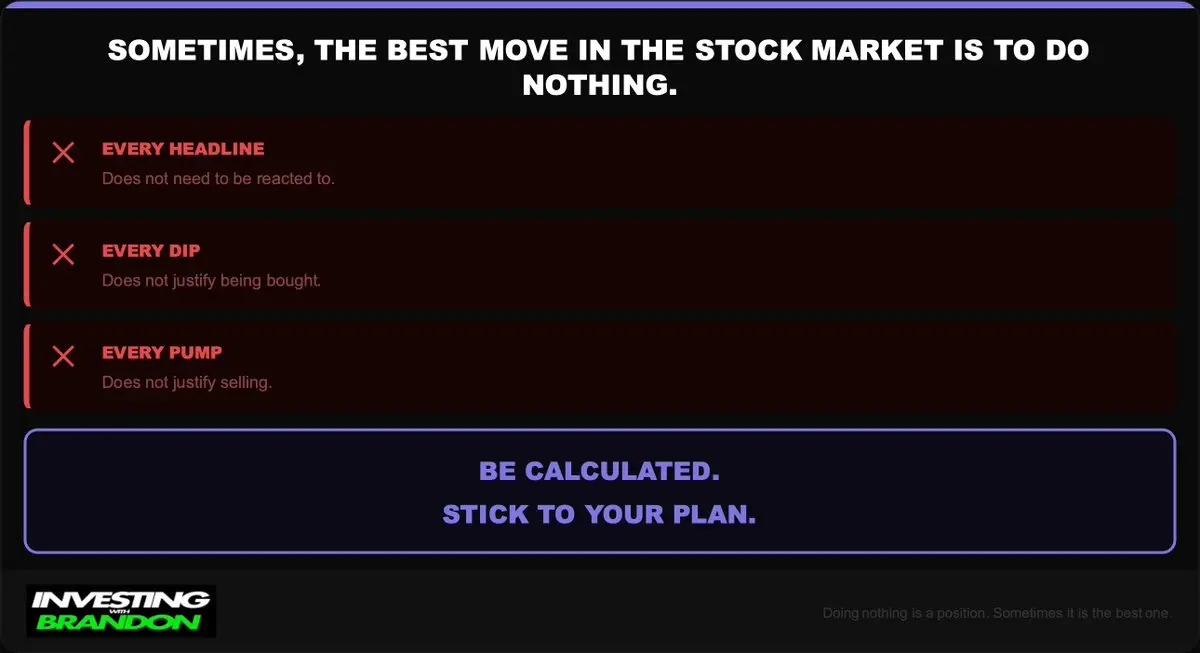
Sometimes, the best move to make in the stock market is to DO NOTHING.
Every headline doesn't need to be reacted to.
Every dip doesn't justify being bought.
Every pump doesn't justify to sell.
Be calculated and stick to your plan.
post-image
  • Reward
  • Comment
  • Repost
  • Share
  • Pin