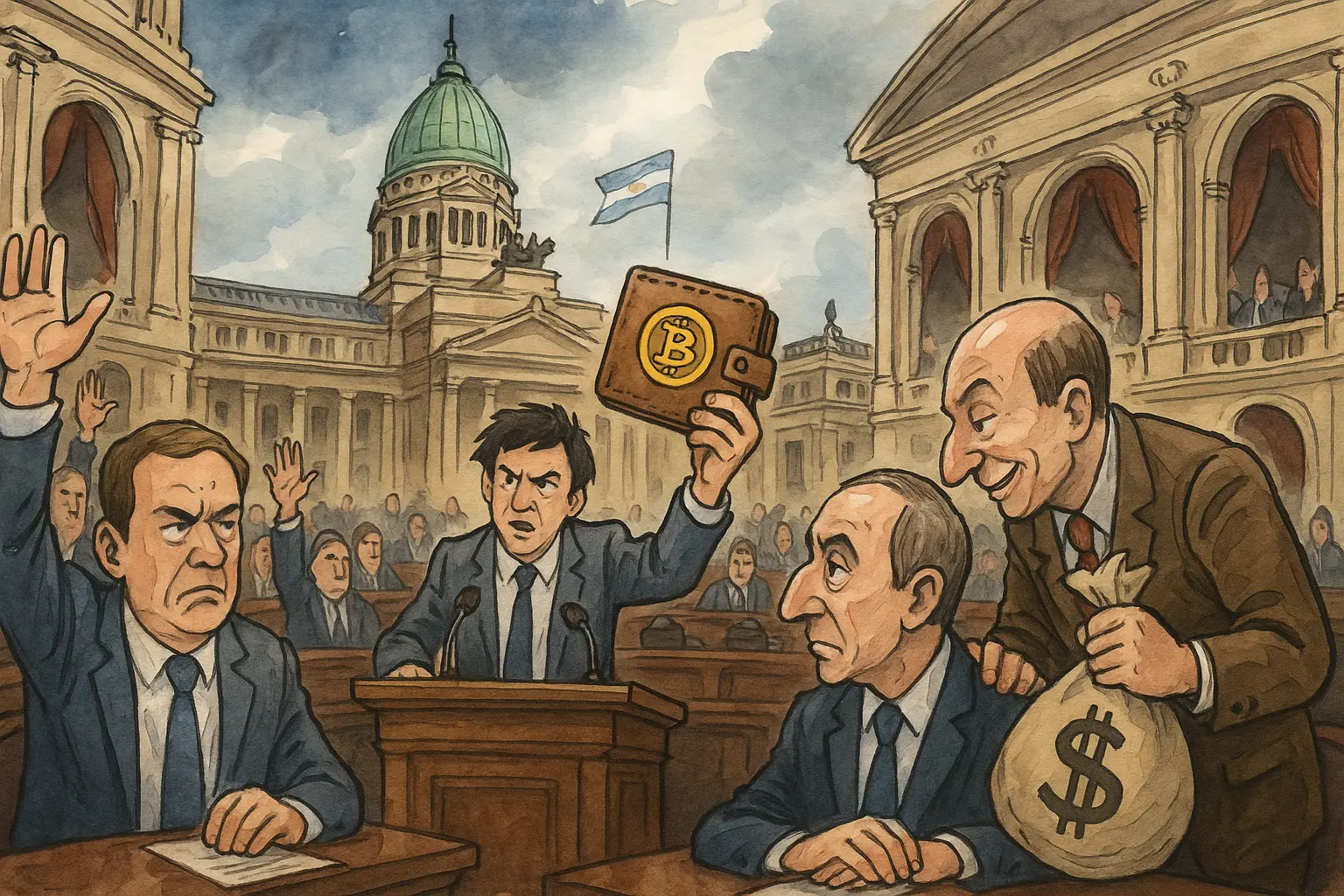
Argentina’s Congress removed the digital wallet salary option from the labor reform bill. The decision was influenced by banking industry lobbying efforts before the Senate vote. Most Argentinians support the freedom to choose where to deposit their wages. Current Argentine law requires employees to deposit their salaries into traditional bank accounts, but digital wallets have seen significant growth over the past decades. A 2022 survey by the Central Bank of Argentina found that only 47% of Argentinians have a bank account, mainly due to longstanding distrust of the traditional banking system.
2001 Deposit Freeze and Generational Distrust of Banks
Under current Argentine law, employees must deposit their wages into traditional bank accounts. Despite this regulation, digital wallet adoption has surged over recent decades, partly reflecting limited banking service reach. The 2022 Central Bank survey revealed only 47% of Argentinians have bank accounts, primarily due to long-term distrust of the banking system.
Decades of financial instability—including the 2001 “corralito” deposit freeze, persistent inflation, and repeated capital controls—eroded public trust in banks and accelerated the shift toward cash and dollar savings. The 2001 corralito was a traumatic event in Argentine financial history. To prevent bank runs and capital flight, the government froze all bank accounts and limited weekly cash withdrawals. This measure lasted about a year, during which countless families and businesses lost access to their savings, many seeing their life savings wiped out.
This trauma left a deep mark on Argentine society. More than 20 years later, many Argentinians still hesitate to deposit large sums in banks, preferring to hold cash or buy dollars to keep at home. This “bank distrust” culture has created space for fintech digital wallets. While these wallets carry risks, they are at least not directly controlled by the government, providing a psychological sense of “greater safety.”
Three Major Traumas of Argentina’s Financial Instability
2001 Corralito: Deposit freeze, wiping out many people’s life savings
Persistent inflation: Long-term annual inflation rates exceeding 50% or even 100%, rapidly devaluing savings
Capital controls: Repeated restrictions on dollar exchange and cross-border transfers
In response, fintech digital wallets operated by non-bank payment providers have expanded financial service coverage across Argentina. Platforms like Mercado Pago, Modo, Ualá, and Lemon are now among the most widely used. Many users who cannot access traditional bank accounts rely on these apps as their first step into formal digital finance. As a result, fintech leaders welcomed a clause allowing Argentinians to deposit wages directly into virtual wallets. However, this clause was removed from the proposed labor reform bill before the parliamentary debate.
“The exclusion of Article 35 in the labor reform deprives Argentinians of the right to freely choose how they receive their wages. In practice, under industry pressure, the regulation requiring wages to be paid through traditional banks remains in effect,” Lemon CFO Maximiliano Raimondi told BeInCrypto. “Governance requires negotiation, but it’s perplexing that, in a context where economic freedom is a core principle, a clause aimed at expanding specific freedoms faces regression.”
Bank Lobbying Defeats 90% Public Support
This setback stemmed from the powerful lobbying efforts of Argentina’s banking sector, which quickly acted to block the proposal. This week, the banking associations sent letters to several key senators outlining their opposition to allowing wages to be deposited into digital wallets. They argued that digital wallets lack sufficient regulation, pose potential systemic risks, and could deepen financial exclusion.
Argentina’s leading bank, Banco Provincia, stated: “They lack the same regulatory, prudential, or supervisory framework as banks. Approving them would generate legal, financial, asset, and systemic risks, directly impacting workers and the financial system.” While ostensibly aimed at protecting consumers and financial stability, these arguments primarily serve to defend banking interests. Allowing wages to be deposited directly into digital wallets would deprive banks of a significant source of deposits, which underpin their lending and profit models.
Fintech firms countered these claims, asserting they are well-regulated. “All payment service providers (PSPs) are supervised by the Central Bank of Argentina (BCRA). Digital wallets are a gateway for millions to access financial services—they can easily and freely open virtual accounts and obtain better financial solutions,” Lemon stated. This rebuttal is well-founded; digital wallets are not entirely unregulated gray areas—they are overseen by the central bank, though perhaps under less stringent standards than traditional banks.
A recent study by consulting firm Isonomía found that nine out of ten Argentinians want to be able to choose where their wages are stored. This trend is even more pronounced among self-employed and informal workers. The report also showed that 75% of Argentinians use digital wallets daily. The “90% support, 75% actively using” data starkly contrasts with the parliamentary decision, illustrating a disconnect between public opinion and political or vested interests.
Ultimately, before the bill was put to a vote in the Senate, the banking sector achieved victory. Reports indicate the government removed the clause to avoid straining relations with banks and to increase the bill’s chances of passing. This political compromise highlights a harsh reality: even under a government that champions economic freedom, when public opinion conflicts with powerful vested interests, the latter often prevail.
Milei’s Economic Freedom and the Compromise Dilemma
During negotiations to garner broader support for the bill, despite polls showing overwhelming public support for free choice in wage deposit locations, President Javier Milei’s party agreed to exclude the clause. This compromise is highly ironic for Milei. An extreme free-market economist, Milei was elected on a platform of “economic freedom,” “reducing government intervention,” and “market reforms.” Allowing workers to choose where to deposit wages aligns with these principles. Yet, caving to banking industry pressure and dropping this clause betrays his core values.
This compromise may stem from pragmatic political considerations. Milei’s party does not hold a majority in Congress and must negotiate with other parties to pass legislation. The banking sector, one of Argentina’s most powerful interest groups, likely threatened to block the entire labor reform if the clause was not removed. Faced with the choice between “keeping the clause and risking defeat” or “removing the clause and passing the bill,” Milei chose the latter. However, this comes at the cost of losing public trust and the integrity of reform.
For Argentina’s fintech industry, this is a major setback. They had hoped that legalizing wage deposits into digital wallets would significantly expand their user base and funding. Now, that hope is dashed; they can only continue operating in a gray area—users voluntarily transfer wages from banks to wallets, which adds friction and costs. Worse, this failure may make future similar legislation more difficult, as banks have demonstrated their ability to block reforms threatening their interests.
For ordinary Argentinians, this event exemplifies “democratic failure.” Despite 90% support and 75% actively using digital wallets, Congress approved a decision that contradicts public will. This disconnect between power and popular opinion could deepen public disillusionment and anger toward the political system. The broader implication for global crypto and fintech is that, even in countries facing severe economic crises and banking distrust, efforts to legalize crypto and digital wallets still face formidable resistance from entrenched interests—resistance that extends beyond banks to political forces tied to banking interests.
Disclaimer: The information on this page may come from third parties and does not represent the views or opinions of Gate. The content displayed on this page is for reference only and does not constitute any financial, investment, or legal advice. Gate does not guarantee the accuracy or completeness of the information and shall not be liable for any losses arising from the use of this information. Virtual asset investments carry high risks and are subject to significant price volatility. You may lose all of your invested principal. Please fully understand the relevant risks and make prudent decisions based on your own financial situation and risk tolerance. For details, please refer to
Disclaimer.
Related Articles
Nearly $300 million flowed out of Bitcoin ETFs in a single week! Rising risk aversion suppresses the crypto market.
Due to escalating geopolitical conflicts and macroeconomic uncertainties, approximately $296 million net flowed out of the U.S. spot Bitcoin ETF last week, reflecting a decline in market risk appetite. Although the Bitcoin price rebounded to $67,500, market sentiment remains cautious, with investors anticipating a higher likelihood of Bitcoin dropping to $55,000.
GateNews8m ago
Middle East conflict escalates, impacting the market! Bitcoin rebounds to $67,000 after dropping below $65,000.
The worsening situation in the Middle East has led to significant volatility in Bitcoin prices. On Monday, Bitcoin briefly fell to $65,112 but quickly rebounded to $67,400, indicating active buying at support levels. The market's sensitive response to the escalation of war and increasing macroeconomic pressures has resulted in a divergence in the performance of mainstream assets. The future trend of Bitcoin will be influenced by geopolitical conflicts and macro variables, and it may continue to maintain high volatility.
GateNews21m ago
U.S.-Iran War Escalates: Trump Plans to Seize Hark Island, Brent Oil Surpasses 115, Taiwan Stocks Plummet
The U.S.-Iran conflict escalates again; Iran prepares for possible incursions. The U.S. is considering taking over Halk Island, and oil prices surge rapidly. Israeli airstrikes on Iran trigger a retaliatory response, with the Houthis making their first move. Market reaction is intense: Taiwan stocks plunge, inflation expectations change the path of monetary policy, and the global economy faces recession risk.
MarketWhisper25m ago
New York Times: Hundreds of U.S. special forces have arrived in the Middle East, with Navy SEALs set to spearhead the mission to seize Iranian nuclear facilities.
The New York Times reports that U.S. Army Rangers and Navy SEALs have been secretly deployed to the Middle East, possibly to participate in blocking the Strait of Hormuz, attacking Iranian oil facilities, and nuclear facilities. This operation reflects the growing military threat from Iran to the United States and may impact global oil and financial markets. As tensions rise, risk-averse sentiment increases, and Bitcoin is seen as "digital gold."
動區BlockTempo32m ago
Gold plummets, "safe haven for funds" changes hands? JPMorgan: During the war, "Bitcoin becomes the new favorite for hedging."
JPMorgan pointed out that in the Middle East conflict, Bitcoin has shown strong resilience against declines, with significant capital inflows and active trading, while gold and silver are facing capital outflows. Under high interest rates and strong dollar pressure, gold prices have dropped by about 15%. With its borderless characteristics, Bitcoin has become a safe-haven choice, and institutional investors are also adjusting their positions, indicating a decrease in gold liquidity while Bitcoin liquidity is increasing.
区块客37m ago
Economist Hank: The United States is losing the war in Iran, and fiscal bankruptcy accelerates the impact on capital markets.
Johns Hopkins University professor Steve Hanke said in an interview that the United States is in a precarious position in the conflict with Iran, and that Iran is gaining the upper hand in a war of attrition. The U.S. government is burdened with debts totaling as much as $136 trillion, and Hanke warned of the risk of a financial collapse, arguing that a “decapitation” strategy has failed. With Iran controlling the Strait of Hormuz, global markets have been impacted. He predicts that gold prices will reach between $6,000 and $7,000, and recommends carrying out fiscal reforms to address the debt problem.
MarketWhisper42m ago


