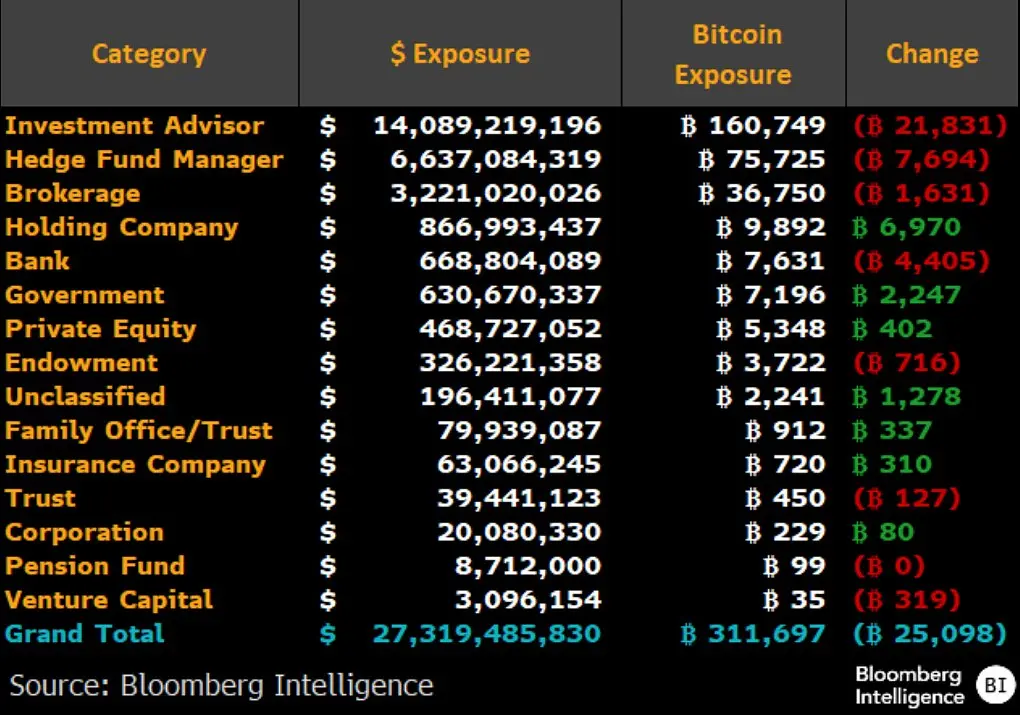
Bloomberg analyst analysis shows that after reviewing the Q4 2025 13F filings, large institutional investors reporting to the U.S. Securities and Exchange Commission (SEC) collectively reduced their Bitcoin ETF holdings by approximately 25,000 BTC during that quarter, representing a risk exposure of nearly $1.6 billion. Data reveals that the main sellers are concentrated among investment advisors and hedge funds, while holding companies and government-related entities increased their positions counter to the trend during the same period.
13F Filings Reveal: Major Selling Groups and Reduction Sizes in Q4
(Source: Bloomberg Intelligence)
13F filings are mandatory quarterly disclosures for institutional investors managing over $100 million, showing actual holdings at the end of each quarter. When an institution’s 13F shows a decrease in Bitcoin ETF holdings, it indicates they sold at some point during the previous quarter, but does not necessarily mean they sold physical Bitcoin on exchanges.
Net Reduction in Bitcoin ETF Holdings by Category in Q4 2025
Investment Advisors: approximately -21,831 BTC, the largest decrease among all categories
Hedge Fund Managers: approximately -7,694 BTC
Brokerages and Banks: also reduced holdings, specific data pending compilation
These three categories account for the majority of the overall net reduction, explaining why, despite short-term rebounds in Bitcoin prices, the market continues to face downward pressure—institutions selling near highs create a structural selling force.
Contrarian Buyers: Which Institutions Increased Bitcoin ETF Holdings in Q4?
Not all institutions are retreating. Data shows that holding companies and government-related entities increased their Bitcoin ETF holdings in Q4 2025, acting as a counterforce in the market.
This divergence reveals an important logic: the purpose of holding Bitcoin ETFs varies fundamentally by institution type. Investment advisors and hedge funds tend to use Bitcoin ETFs for short-term trading, hedging, or arbitrage, making their holdings highly sensitive to market sentiment shifts. In contrast, the increased holdings by holding companies and government-related entities likely reflect more strategic, long-term allocation rather than bets on short-term market movements.
ETF Capital Flows: Continued Outflows in February Intensify Short-term Pressure
(Source: SoSoValue)
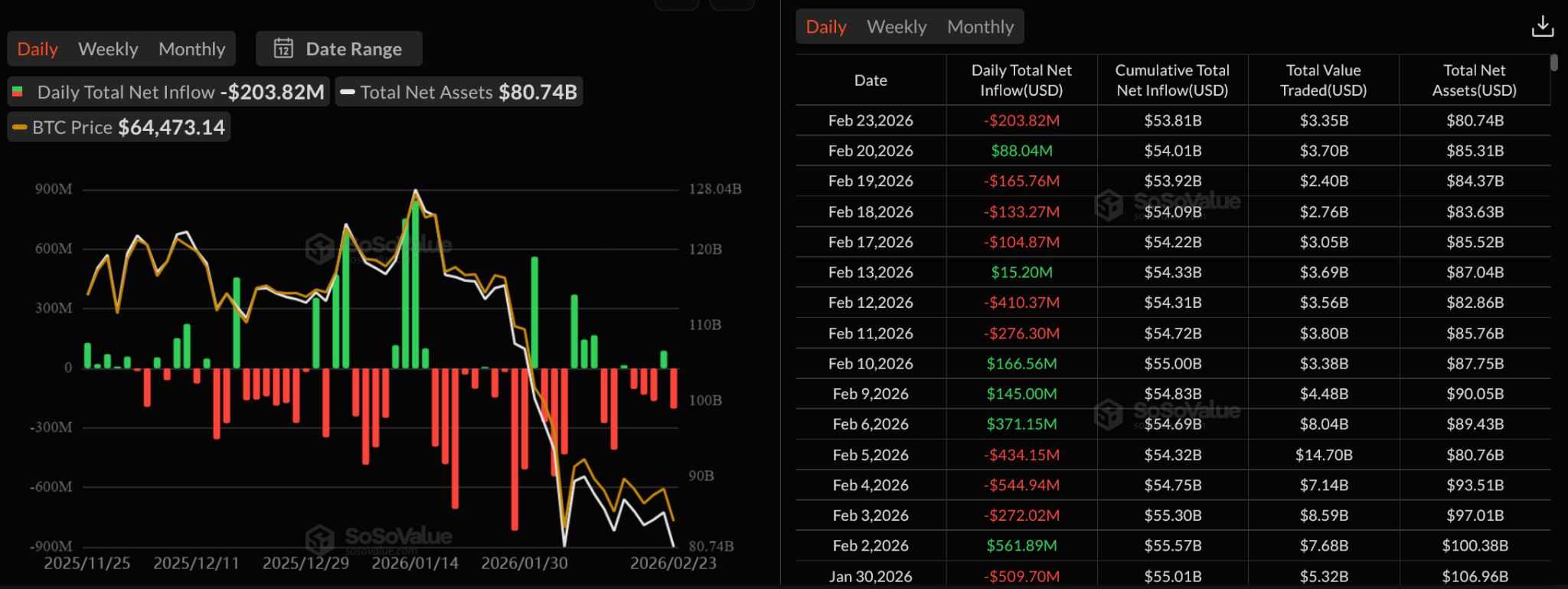
Data from SoSoValue shows that in February 2026, Bitcoin ETF daily capital flows experienced multiple significant outflow days, corroborating the overall contraction in institutional holdings. Consecutive days of outflows suggest that the ETF inflow pipeline has yet to see sustained replenishment.
Based on current observations, if daily ETF capital flows do not turn positive and stabilize over several trading days, Bitcoin’s current phase is closer to a “fragile rebound” rather than a confirmed trend reversal. The structural pressure from institutional selling needs new buying momentum to offset it before a positive capital flow cycle can re-establish.
Frequently Asked Questions
Does institutional reduction in 13F filings mean Bitcoin is being directly sold off?
Not necessarily. 13F filings reflect changes in institutional holdings of Bitcoin ETFs, not direct sales of physical Bitcoin. A decrease in ETF shares indicates institutions sold ETF positions, but this mechanism differs from direct spot market sales. ETF trading occurs in the secondary market; only when large redemptions trigger the ETF’s physical delivery process does it directly impact the supply of actual Bitcoin.
Why are investment advisors and hedge funds the main sellers, rather than long-term holders?
Investment advisors and hedge funds often use Bitcoin ETFs as portfolio adjustment tools, engaging in short-term trading, hedging, or arbitrage, rather than long-term value investing. Their holdings are thus more sensitive to market sentiment. In contrast, long-term holders like pension funds or sovereign wealth funds tend to have strategic allocations and are less reactive to short-term price movements.
What does the increased holding of Bitcoin ETFs by government-related entities imply?
Increased holdings by government-related entities generally indicate more strategic asset allocation decisions, often with longer holding periods. Such increases are sometimes viewed as a recognition of Bitcoin as a reserve asset, but the scale of these holdings is still limited relative to the overall market, and currently insufficient to offset the selling pressure from advisors and hedge funds.
Disclaimer: The information on this page may come from third parties and does not represent the views or opinions of Gate. The content displayed on this page is for reference only and does not constitute any financial, investment, or legal advice. Gate does not guarantee the accuracy or completeness of the information and shall not be liable for any losses arising from the use of this information. Virtual asset investments carry high risks and are subject to significant price volatility. You may lose all of your invested principal. Please fully understand the relevant risks and make prudent decisions based on your own financial situation and risk tolerance. For details, please refer to
Disclaimer.
Related Articles
F2Pool Co-Founder Says Thai Condo Bought for 2,900 BTC Was Sold for Just 7 Bitcoin
Wang Chun, co-founder of F2Pool, sold a condo in Thailand for 7 BTC, which he originally bought for 2,900 BTC in 2015. This transaction highlights Bitcoin's significant long-term opportunity cost, illustrating the risks early adopters faced when spending Bitcoin instead of holding it.
CryptoNewsFlash5m ago
A CEX’s trading volume over the past 24 hours reached $1.106 billion, with XRP, BTC, and ETH ranking in the top three
According to CoinGecko data, on April 2, the trading volume of a certain CEX reached $1.106 billion. XRP, BTC, ETH, ONT, and USDT ranked as the top five by trading volume, with XRP accounting for 9.91%.
GateNews6m ago
Has the logic for the next bull market changed? Clem Chambers warns: the crypto market will move on from the “coin-flipping era”
Clem Chambers指出 that in the future, the crypto market will no longer rely solely on token hype, but will shift toward real applications and long-term value creation. The market is moving toward tokenized assets and stablecoins, with attention on the ability of blockchain technology to deliver real-world implementation. Although speculation will still dominate in the short term, projects that truly have use value will become the core driving force for the future.
GateNews31m ago
Why is the crypto market down today? Trump’s tough remarks sparked a wave of selling, and Bitcoin is approaching the key $65,000 support level
April 2, 2026, the total market capitalization of the cryptocurrency market fell 2.6%. Bitcoin dropped to $66,250, Ethereum is nearing $2,000, and major assets generally pulled back. Due to Trump making tough remarks about the Iran situation, risk-off sentiment intensified in the market, and funds are taking a wait-and-see stance in the short term. High interest rates and geopolitical risk together are weighing on prices; going forward, attention will be on developments in the Middle East and changes in macro liquidity.
GateNews33m ago
Bitcoin is moving sideways—quiet undercurrents are building beneath the surface! The expectation that “the war will end” has already been priced in, yet capital is slowly pulling back
Bitcoin’s price has been trading in a tight range around $68,000 ahead of an upcoming speech by Trump, and expectations that the conflict could ease have not translated into a more optimistic positioning of capital. Trading volume indicators show sellers are in control, and the market is in the “distribution phase.” Despite some buy-side attempts to enter, confidence is lacking, and near-term direction will be driven by geopolitical factors and capital flows.
GateNews34m ago
Bitcoin trader sees 'new lows' as US dollar due highest level since mid-2025
Bitcoin (BTC) saw another $69,000 rejection on Thursday as risk-assets suffered over US-Iran war headlines.
Key points:
Bitcoin faces fresh downside pressure as stocks and gold fall on US President Donald Trump’s address to the nation.
US dollar strength ramps up on the back of an
Cointelegraph34m ago


