
Venice Token (VVV) has gained over 100% in the past week, becoming a rare strong asset amid the overall weakness in the cryptocurrency market. VVV is currently trading between $7 and $8, with a market cap of approximately $330 million. The core drivers behind this rally stem from Venice becoming a recommended model provider for OpenClaw and the protocol actively tightening token supply, creating a dual effect.
Core Driver 1: Becoming a Recommended AI Model Provider for OpenClaw
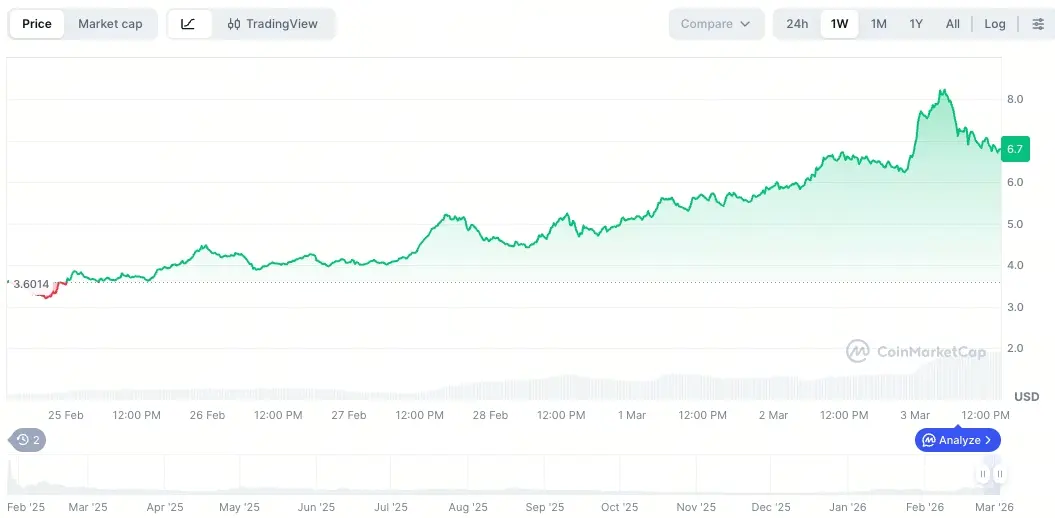 (Source: CMC)
Venice is a decentralized privacy-focused AI protocol founded by Erik Voorhees. Its main goal is to enable users to utilize large language models without revealing their data. The immediate catalyst for this rally was the announcement of Venice’s partnership with OpenClaw — an open-source autonomous agent framework recently acquired by OpenAI.
Voorhees confirmed in a post on X platform on March 2 that Venice is now a recommended model provider for OpenClaw, advising users to abandon the “outdated” Llama 3.3 model in favor of the more powerful GLM 4.6 (model name: zai-org-glm-4.6).
Following the announcement, VVV’s price surged to $8.30, and the protocol’s fully diluted valuation (FDV) surpassed $600 million. This partnership has increased Venice’s visibility within the AI agent ecosystem and created tangible demand expectations for its underlying VVV tokens.
Core Driver 2: Active Token Supply Tightening and Ecosystem Expansion
The strong performance of VVV is not solely dependent on the OpenClaw announcement but is supported by solid technical fundamentals and developments beforehand:
Supply Tightening: Venice decided to reduce its annual VVV token issuance by 25% around February 10, 2026, directly decreasing new token issuance pressure and increasing the token’s relative scarcity.
DeFi Ecosystem Integration: Venice continues to expand its real-world application scenarios, having integrated with platforms like Aerodrome, Morpho, and Plena.
Model Upgrades: Earlier this year, GLM 4.7 was set as the default model for Venice’s web application. In scenarios requiring complex reasoning and high-intensity programming tasks, Venice is positioned as a top choice for high-productivity AI workflows.
Frequently Asked Questions
What is Venice, and what is the use of VVV tokens?
Venice is a decentralized AI protocol centered on privacy protection, allowing users to invoke large language models without sending data to centralized servers. VVV tokens are the native asset of the protocol; holders can stake VVV to gain priority access to the protocol’s computing power, and VVV also functions as a governance token for protocol decision-making.
What does the partnership between Venice and OpenClaw specifically mean?
According to Voorhees, Venice is now a “recommended model provider” for the OpenClaw framework, meaning developers building AI agents with OpenClaw will be guided to prioritize Venice’s model services. Given OpenClaw’s recent acquisition by OpenAI and its broad influence within the global AI agent developer community, this partnership provides significant endorsement potential for Venice in terms of demand.
Is the 100% increase in VVV sustainable?
Short-term sharp gains often imply that some market signals have been priced in early. Long-term fundamentals supporting VVV include: scarcity from supply tightening, genuine demand for privacy-focused computing resources in the AI agent market, and ongoing DeFi ecosystem integrations. However, sustainability ultimately depends on whether the OpenClaw partnership can lead to measurable actual usage growth and how the overall macro environment of the crypto market evolves.
Disclaimer: The information on this page may come from third parties and does not represent the views or opinions of Gate. The content displayed on this page is for reference only and does not constitute any financial, investment, or legal advice. Gate does not guarantee the accuracy or completeness of the information and shall not be liable for any losses arising from the use of this information. Virtual asset investments carry high risks and are subject to significant price volatility. You may lose all of your invested principal. Please fully understand the relevant risks and make prudent decisions based on your own financial situation and risk tolerance. For details, please refer to
Disclaimer.
Related Articles
USD.AI launches a token with a “non-transferable” trap; CHIP claims are open but trading is impossible
USD.AI has opened claims for the token CHIP, but trading is still not possible, which does not match the settlement standard “issue tokens” for prediction markets, resulting in settlement being “No.” The agreement is led by Framework Ventures, and although it has market momentum, there are risks in the lending model and team background that need to be assessed. The official listing date will be key to pricing.
MarketWhisper37m ago
March DEX total trading volume fell to $20.2 billion, and Solana DEX trading volume hit the lowest level since September 2024.
Gate News message, April 2, Defillama data shows that in March 2026, the total DEX trading volume was $202.0 billion, nearly dropping back to the $251.3 billion level from March 2025. During the same period, Solana DEX trading volume was about $57.3 billion, falling to its lowest level since September 2024.
GateNews52m ago
XRP Today News: New OCC regulations take effect, speeding up Ripple’s banking license process
The U.S. Office of the Comptroller of the Currency (OCC) issued Bulletin 2026-4, effective April 1, providing a clear regulatory path for Ripple’s national trust bank and allowing it to operate after meeting the conditions to open for business. This bulletin replaces “fiduciary activities” with “the operations of a trust company,” expanding the organization’s service scope, including digital asset custody services. Ripple’s regulatory status has undergone a significant transformation, and in its application for a licensed institution, it seeks a Federal Reserve master account, focusing on the growth and challenges of the digital asset market.
MarketWhisper1h ago
DeFi platform Drift was hacked on April Fools' Day! The hacker drained $270 million in assets, with the administrator key being the vulnerability.
Drift Protocol suffered a major security incident on April 1, with losses exceeding $270 million, and TVL dropped sharply within 12 minutes. The investigation shows the attackers began deploying three weeks earlier, using forged tokens and an administrator key vulnerability to carry out manipulation, resulting in large-scale withdrawals of funds. The incident dealt a severe blow to market confidence, and Drift is seeking to recover the funds and strengthen its security protections.
CryptoCity1h ago
The crypto market sector is broadly down, while the ETH and GameFi sectors are relatively resilient
On April 2, the crypto market broadly fell, with the RWA and Layer 1 sectors down 1.71% and 1.66%, respectively. Bitcoin fell 0.75% to $68,000, while Ethereum inched up 0.15%. The GameFi sector performed better, rising 0.71%. Most other sectors trended downward.
GateNews1h ago
Drift Protocol hacker swaps 129,000 ETH for tokens and launders the stolen funds cross-chain
Drift Protocol was hacked on April 1, when attackers stole about $285 million in assets, setting the record for the largest loss in DeFi security incidents in 2026. The hackers quickly converted funds to ETH and split up storage, increasing the difficulty of recovery. The industry is currently pessimistic about the likelihood of funds being recovered. This incident will intensify regulatory pressure on the DeFi industry and force developers to strengthen smart contract security.
MarketWhisper2h ago


