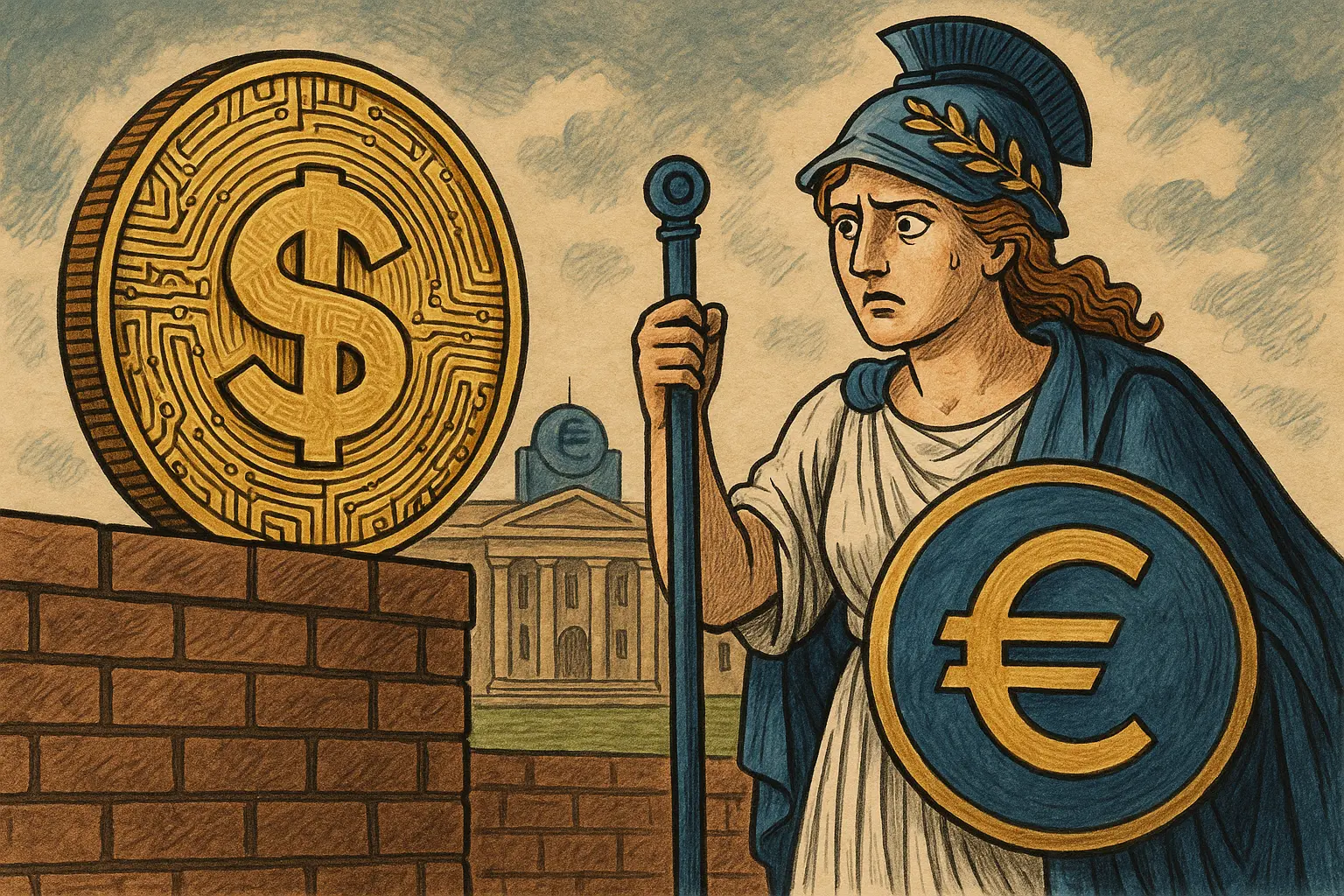
Researchers at the European Central Bank (ECB) have published a working paper warning that widespread adoption of stablecoins could pose significant risks to the euro area banking system and the ECB’s monetary sovereignty, especially in a context where foreign currency-denominated instruments such as the US dollar dominate. This could introduce external currency conditions into the eurozone and increase uncertainty in the transmission of monetary policy.
Core Risk Identification Framework of the Working Paper
This jointly authored working paper by multiple ECB researchers identifies three main transmission channels through which the widespread adoption of stablecoins could impact the euro area’s monetary system.
First, rapid expansion could trigger large-scale reallocation of funds from retail bank deposits into digital assets, weakening the stability of banks’ funding sources; second, impaired banking intermediation could reduce the effectiveness of ECB policy rate transmission to actual lending volumes; third, if the stablecoin market is dominated by non-euro-denominated instruments, the impact could be significantly amplified—fluctuations in demand for foreign currency-denominated stablecoins may directly transmit external currency and financial shocks into the euro area.
The document states: “Demand fluctuations for foreign currency-pegged stablecoins could transmit external currency and financial shocks directly into the euro area, effectively introducing external liquidity conditions that may be orthogonal to domestic policy stances.”
Policy Context: Trump’s Crypto Policies Trigger European Regulatory Vigilance
The release of this ECB working paper coincides with the Trump administration actively promoting mainstream adoption of cryptocurrencies, raising broad concerns about the potential expansion of US dollar-backed stablecoins in European markets. ECB Executive Board member Piero Cipollone previously stated in January that such tools could “threaten financial stability”; meanwhile, German Bundesbank President Joachim Nagel has expressed a more positive view, emphasizing the potential benefits of euro-pegged stablecoins in payment scenarios.
Currently, major European banks such as Citigroup, ING, UniCredit, and DekaBank are collaborating on developing regulated euro stablecoins, seen as an active European response to counter the expansion of dollar-denominated stablecoins.
Key Risk Points Identified in the ECB Working Paper
Deposit Reallocation: Rapid expansion may lead to large-scale transfer of retail deposits into digital assets, weakening banks’ funding base.
Impaired Intermediation: Unstable bank funding sources reduce credit provisioning capacity, impacting real economy financing.
Reduced Policy Transmission Effectiveness: ECB rate adjustments face obstacles in transmission to the loan market, weakening monetary policy effectiveness.
Amplification by Foreign Currency Stablecoins: When dollar and other foreign currency stablecoins dominate the market, external currency shocks can enter the euro area directly without ECB control.
Wholesale Financing Risks: Banks may increase reliance on foreign currency wholesale funding, further diminishing sensitivity to ECB policy stance.
Frequently Asked Questions
What exactly does the ECB mean by the “monetary sovereignty” risk?
The ECB’s monetary sovereignty refers to its ability to effectively influence borrowing costs and credit flows in the euro area through policy rate adjustments. When large funds shift from ECB-regulated bank deposits to foreign currency-denominated stablecoins, the ECB’s policy tools have significantly less influence over these funds, weakening the transmission of interest rate decisions.
Why are US dollar stablecoins more threatening to European monetary policy than euro stablecoins?
Euro stablecoins’ reserves and operations are still under ECB regulation, maintaining relatively complete monetary policy transmission channels. In contrast, the liquidity and value of US dollar-denominated stablecoins are determined by the Federal Reserve’s policies. Once widely circulated in the euro area, they effectively introduce US monetary conditions directly into European markets, bypassing ECB tools and creating a direct channel for external currency shocks.
Can the joint development of euro stablecoins by European banks effectively address ECB’s risk concerns?
The euro stablecoin plans led by institutions like Citigroup, ING, UniCredit, and DekaBank align somewhat with the ECB’s stance—German Bundesbank President Nagel has expressed a positive attitude toward euro stablecoins in payment applications. If euro stablecoins can compete with dollar stablecoins in scale and usability, they may reduce users’ motivation to switch to foreign currency tools. However, specific regulatory frameworks and launch timelines remain unclear.
Disclaimer: The information on this page may come from third parties and does not represent the views or opinions of Gate. The content displayed on this page is for reference only and does not constitute any financial, investment, or legal advice. Gate does not guarantee the accuracy or completeness of the information and shall not be liable for any losses arising from the use of this information. Virtual asset investments carry high risks and are subject to significant price volatility. You may lose all of your invested principal. Please fully understand the relevant risks and make prudent decisions based on your own financial situation and risk tolerance. For details, please refer to
Disclaimer.
Related Articles
U.S.-Iran war latest: Trump threatens to bomb Iran’s power plants and oil wells; U.S. crude surges past $100
Tensions between the U.S. and Iran are escalating. Trump threatens to bomb Iran’s oil and power facilities, pushing U.S. crude oil prices to surge past $100. Taiwan stocks fell sharply, dropping more than 400 points due to the spillover, while the Federal Reserve kept interest rates unchanged. U.S. stocks and Bitcoin continue to trade in choppy, sideways consolidation.
Latest developments in the U.S.-Iran war: Trump threatens to bomb Iran’s power plants and oil wells
---------------------
A coalition of U.S. and Israeli forces continues its military operations against Iran. According to a report by CNN, U.S. President Donald Trump threatened that if no agreement is reached and the Strait of Hormuz is opened, he would destroy Iran’s power plants and oil wells. Earlier, he said he was considering taking control of Iran’s Khark Island. Iran’s parliament approved charging tolls for vessels passing through the Strait of Hormuz and banned U.S. and Israeli ships from passage.
Israel’s military also carried out a large-scale airstrike against Tehran, Iran’s capital. In 24 hours, it struck 170 targets, including drone engines
CryptoCity5m ago
Ko Ju- chun discusses the central bank’s U.S. dollar stablecoin foreign-exchange reserves, and the central bank governor Yang Jin-long signals: “Time and space will change.”
In recent discussions in Taiwan’s Legislative Yuan about whether to include USD stablecoins in the country’s foreign exchange reserves, Legislator Ko Ru-chiun suggested that the central bank could run a small pilot program. Central Bank Governor Yang Chin-lung said he still has reservations, but may adjust in the future. Experts also mentioned that consideration should be given to issuing an indigenous stablecoin to safeguard financial sovereignty and provide diversified options.
ChainNewsAbmedia32m ago
Cuba’s central bank approves 10 companies to use cryptocurrencies for international payments
Cuba’s central bank has for the first time approved 10 companies to use cryptocurrencies for international payments, including 9 small and micro enterprises and 1 joint venture, with a license validity period of 1 year. This marks the first time that Cuban companies have been granted permission to directly operate international payments, which must be handled through approved virtual asset service providers and with transaction information reported on a regular basis.
GateNews1h ago
ETH 15-minute price increase of 1.04%: institutional spot buy orders and on-chain activity in sync are driving the move higher
From 2026-03-31 01:15 to 2026-03-31 01:30 (UTC), ETH recorded a +1.04% return within 15 minutes. The price range was 2039.77 to 2062.77 USDT, with a swing of 1.13%. During this period, market volatility intensified, trading activity surged, and attention to short-term moves increased.
The main drivers behind this unusual move are continued inflows of institutional capital via spot ETFs, with buy-side dominance in the Ethereum spot market. On-chain large transfers increased, whale addresses boosted their holdings within a short time, and funds flowed from multiple major exchanges into centralized and decentralized platforms.
GateNews1h ago
401(k) retirement savings can be invested in crypto! The U.S. Department of Labor proposes a landmark rule draft
The U.S. Department of Labor proposes new regulations, aiming to make it easier for 401(k) retirement plans to include alternative assets such as cryptocurrencies to reflect the modern investment landscape. Supporters believe this move can increase portfolio diversification, while opponents worry it could harm wage earners. The rules are still in the public comment phase and the final form has not yet been determined.
MarketWhisper2h ago
Why is Bitcoin up today? Trump pauses strikes on Iranian energy facilities, and the Fed signals support for risk markets
Bitcoin rebounded to above $67,000 on March 31, mainly driven by signals from U.S.-Iran diplomacy and the Federal Reserve’s decision to keep interest rates unchanged. Market sentiment temporarily improved, but Iran’s Ministry of Foreign Affairs said that the lack of direct negotiations could limit the rebound. The potential impact of the Strait of Hormuz toll bill on supply chains is pushing up oil prices and putting pressure on the market; it’s important to closely monitor future price movements.
MarketWhisper2h ago


